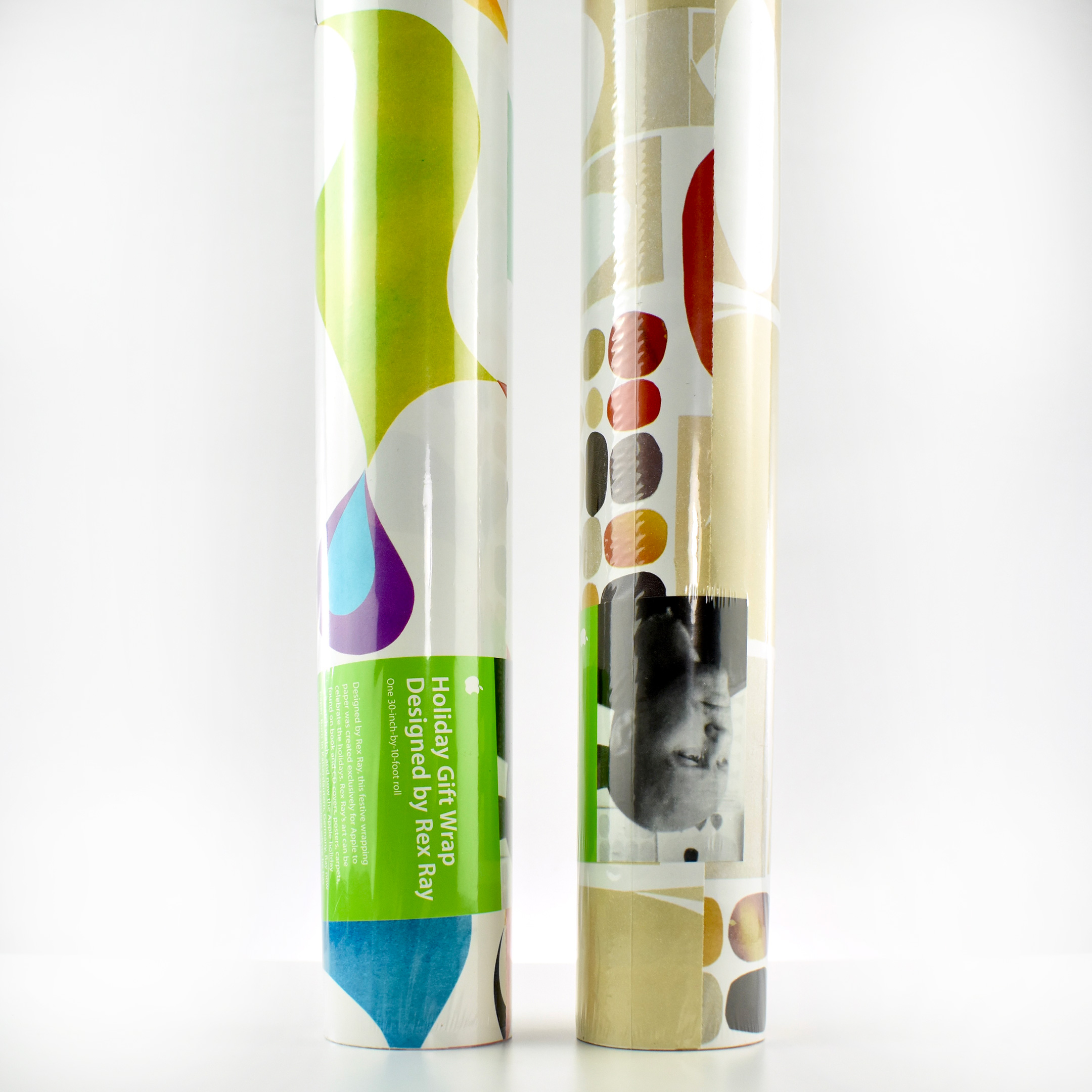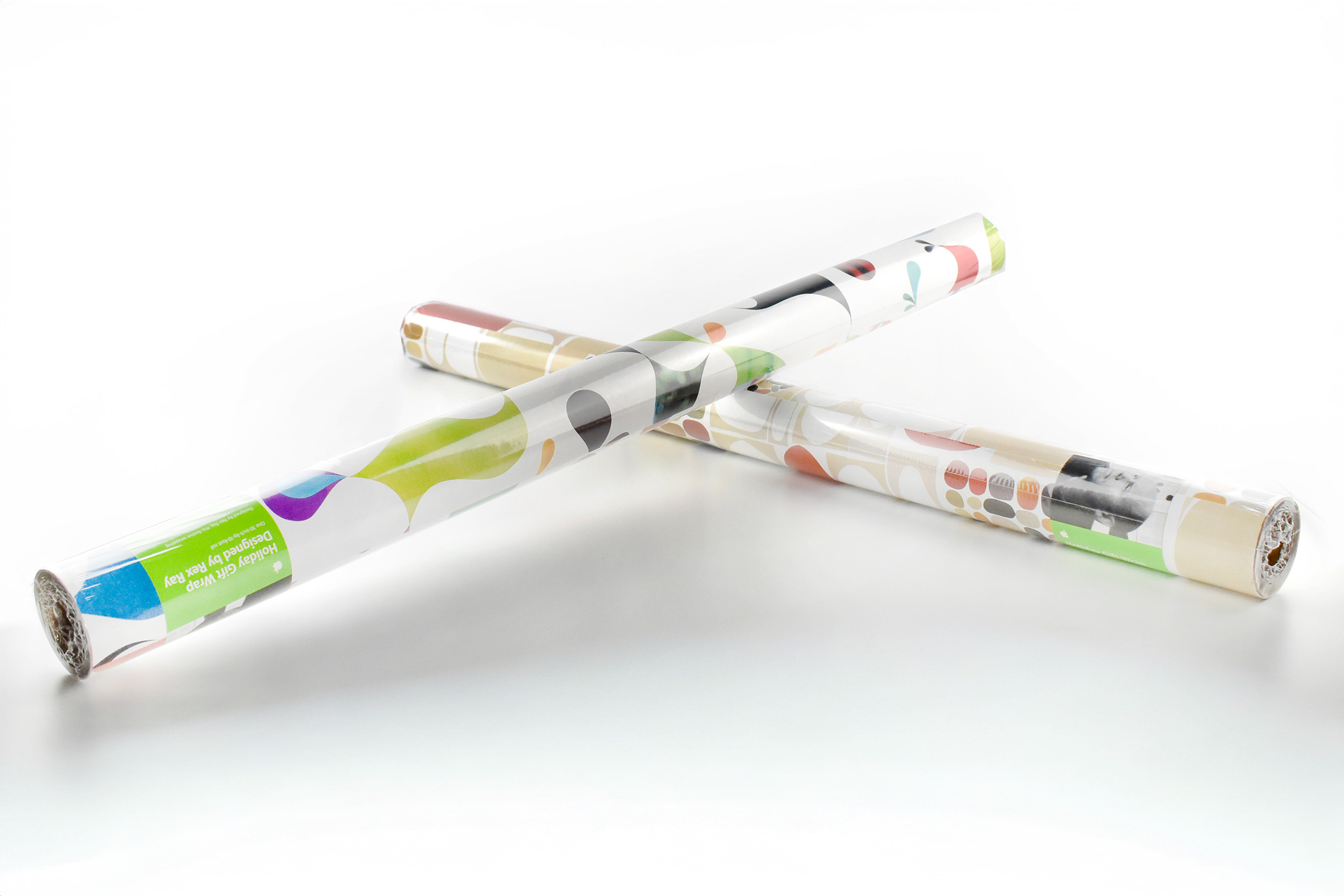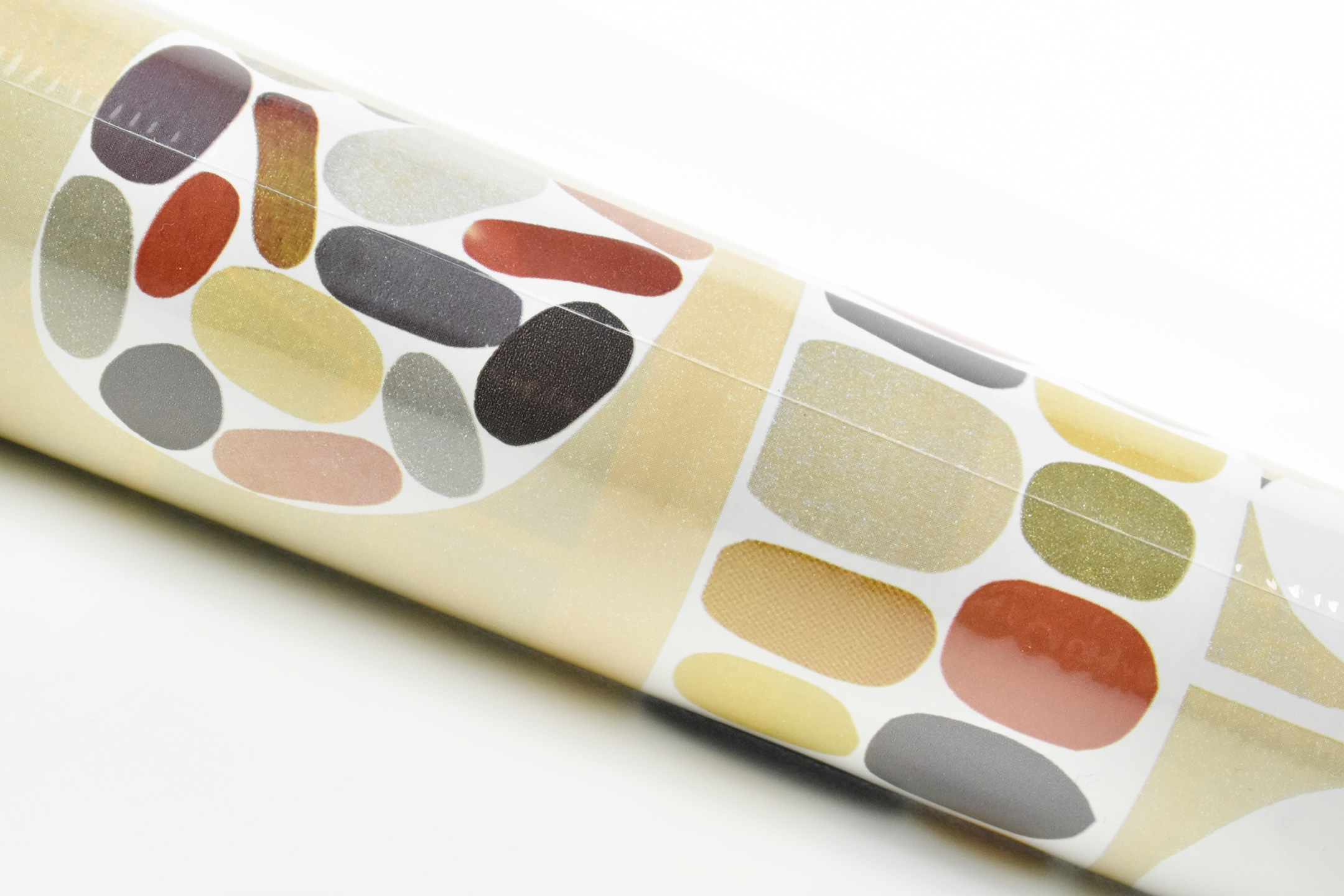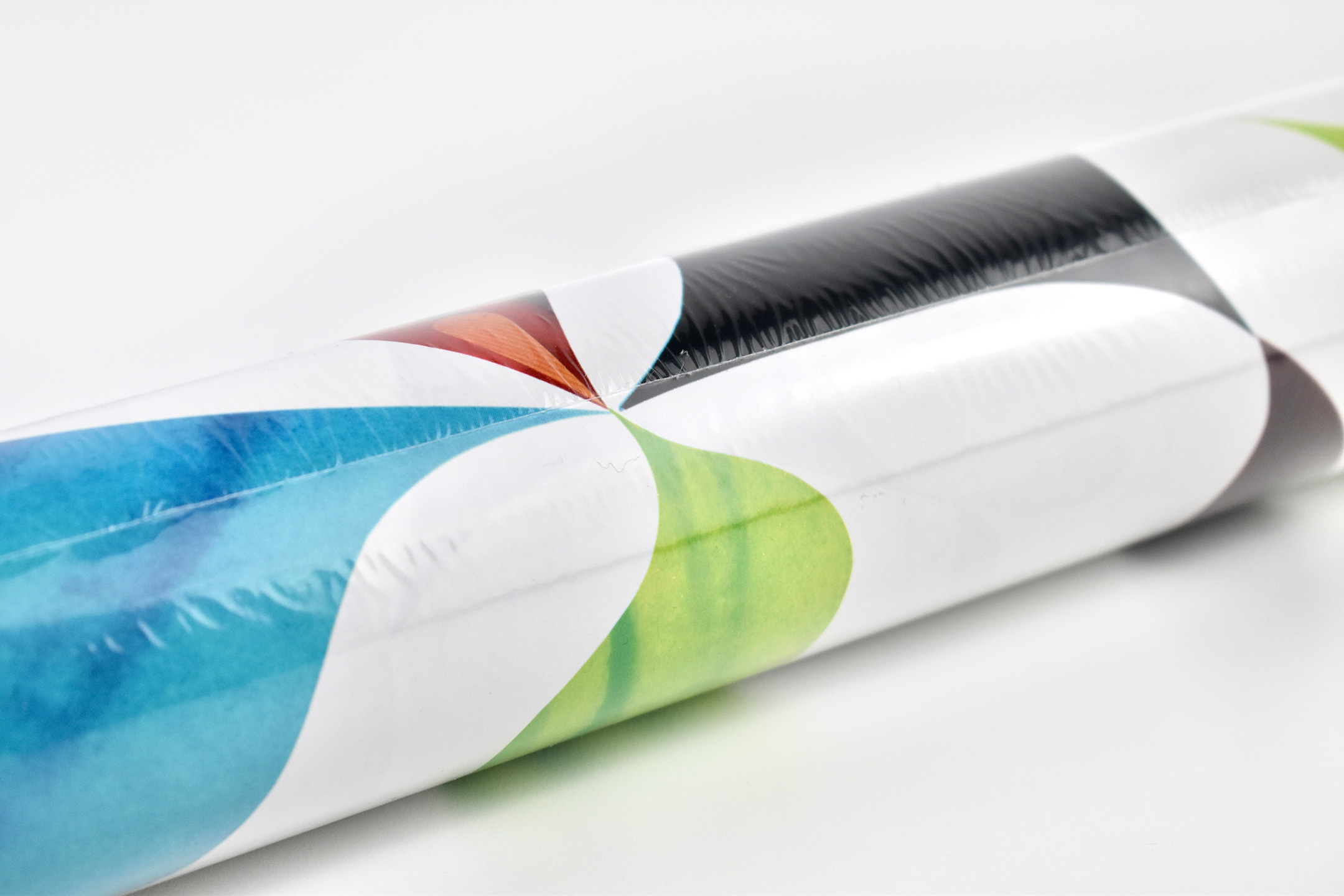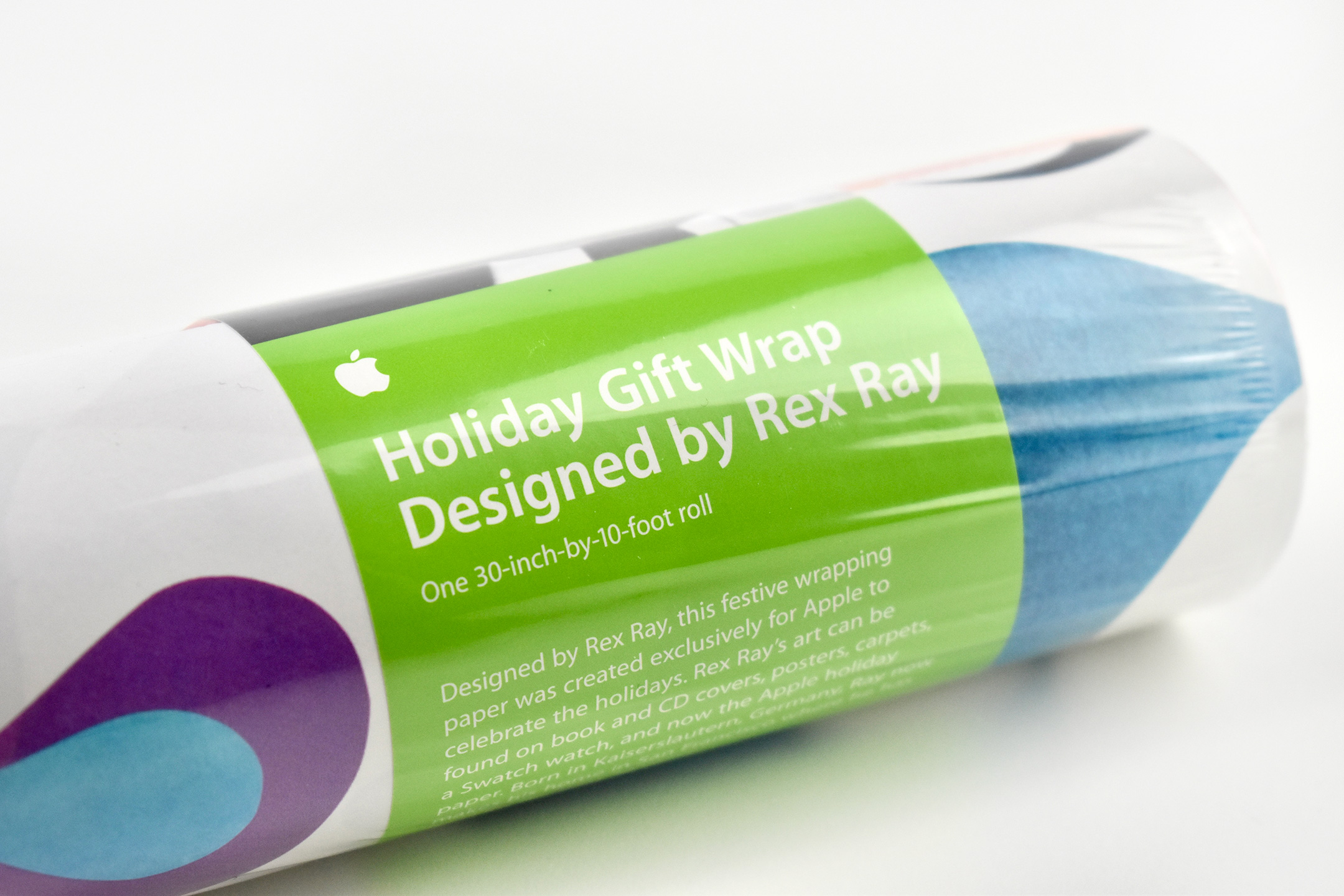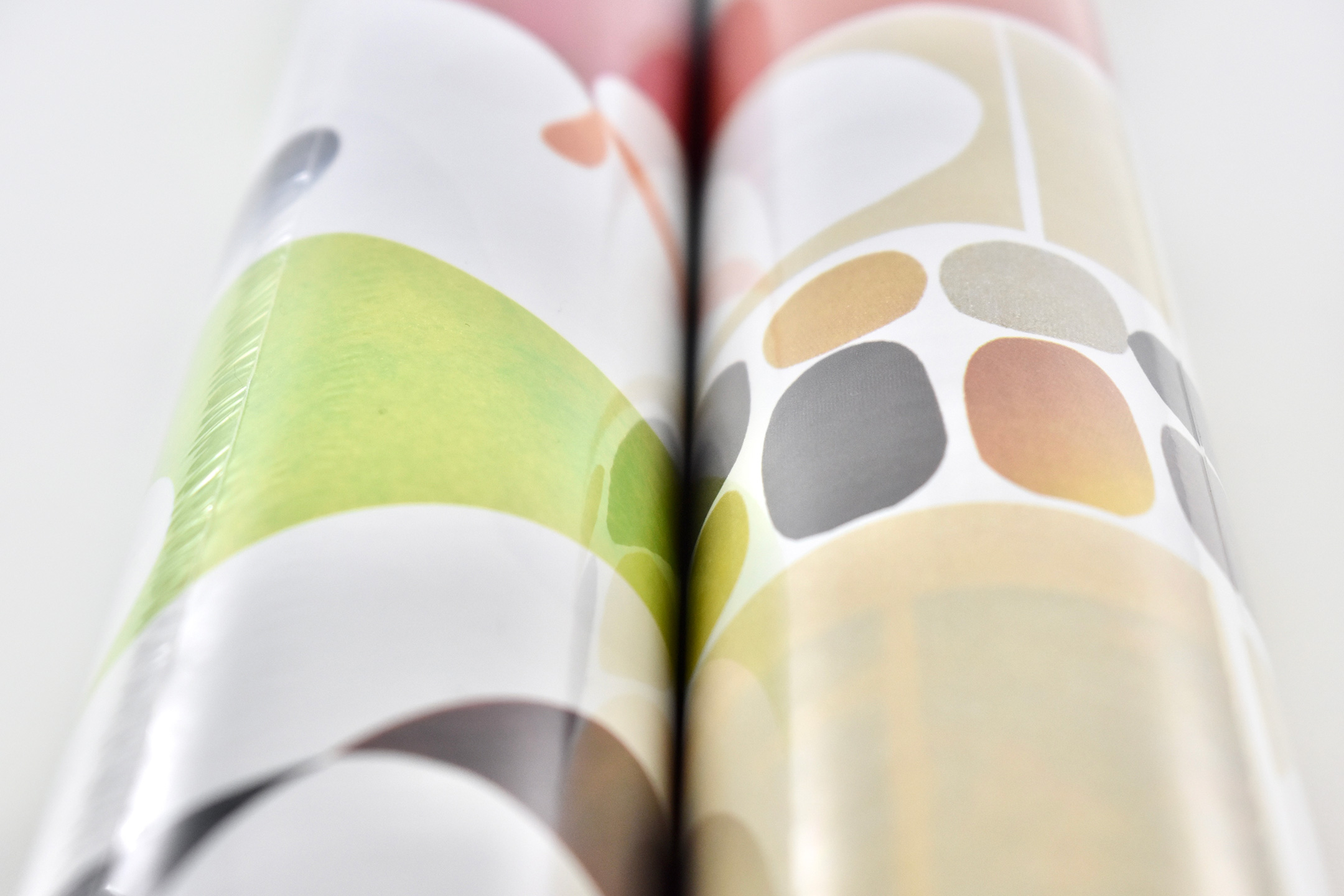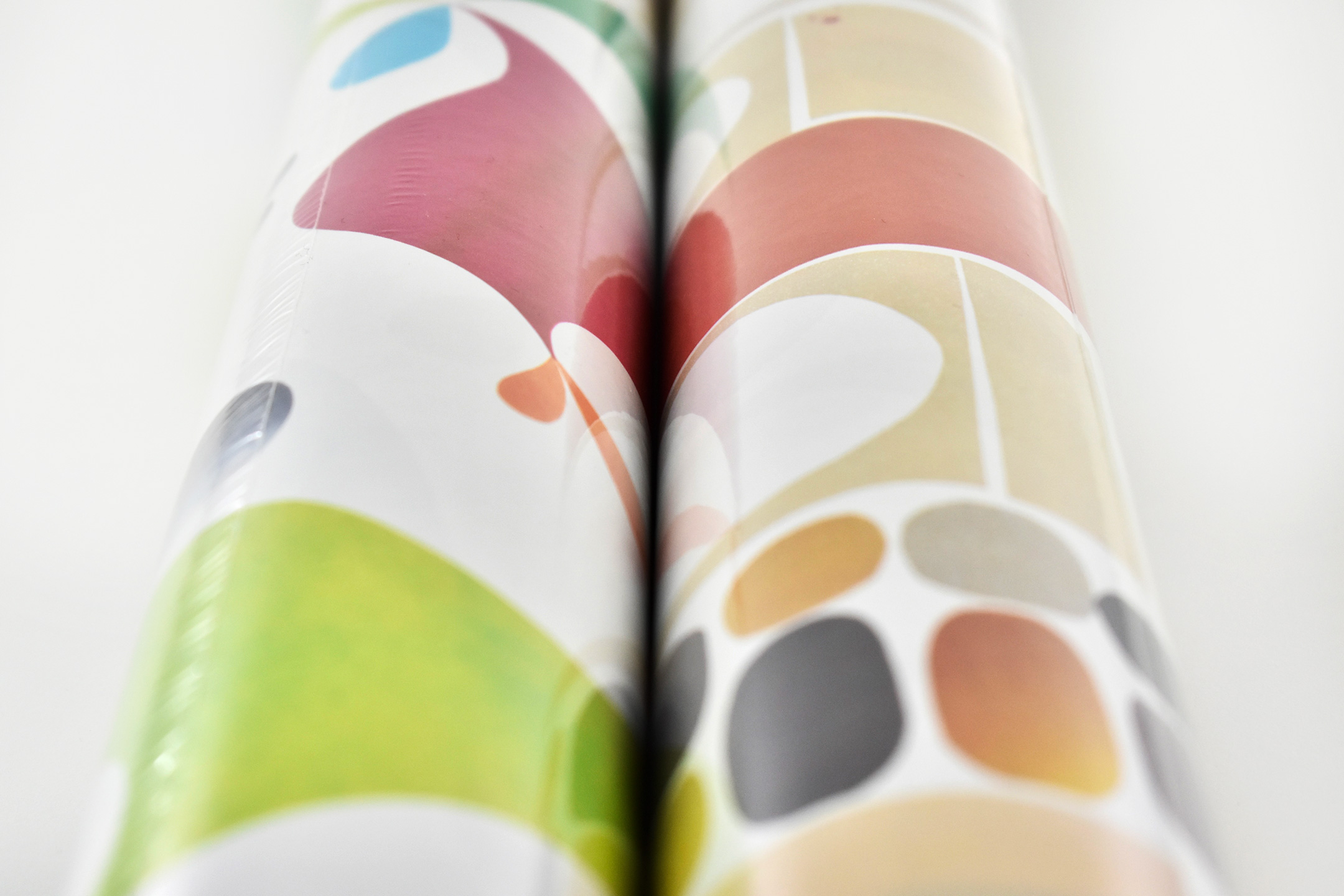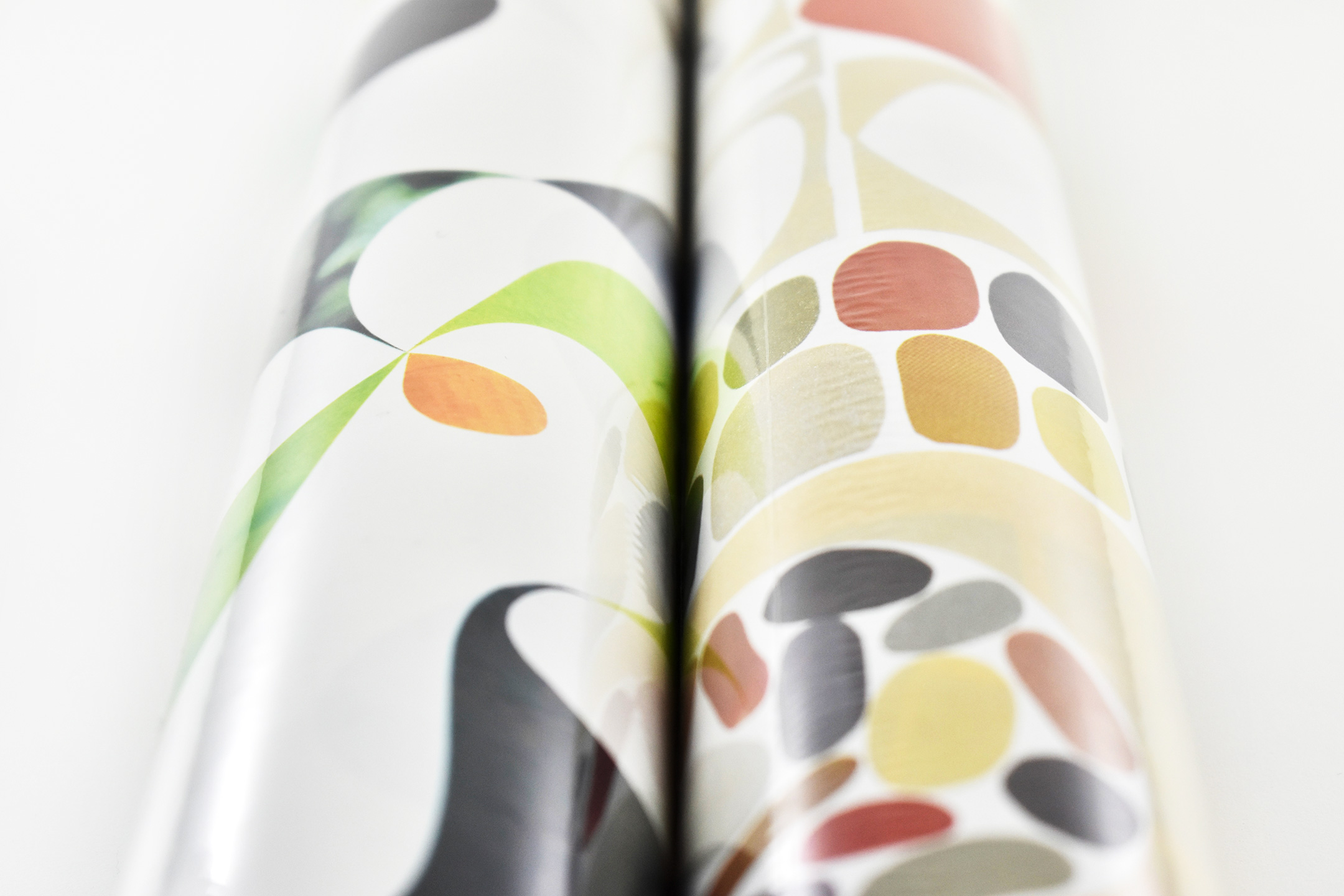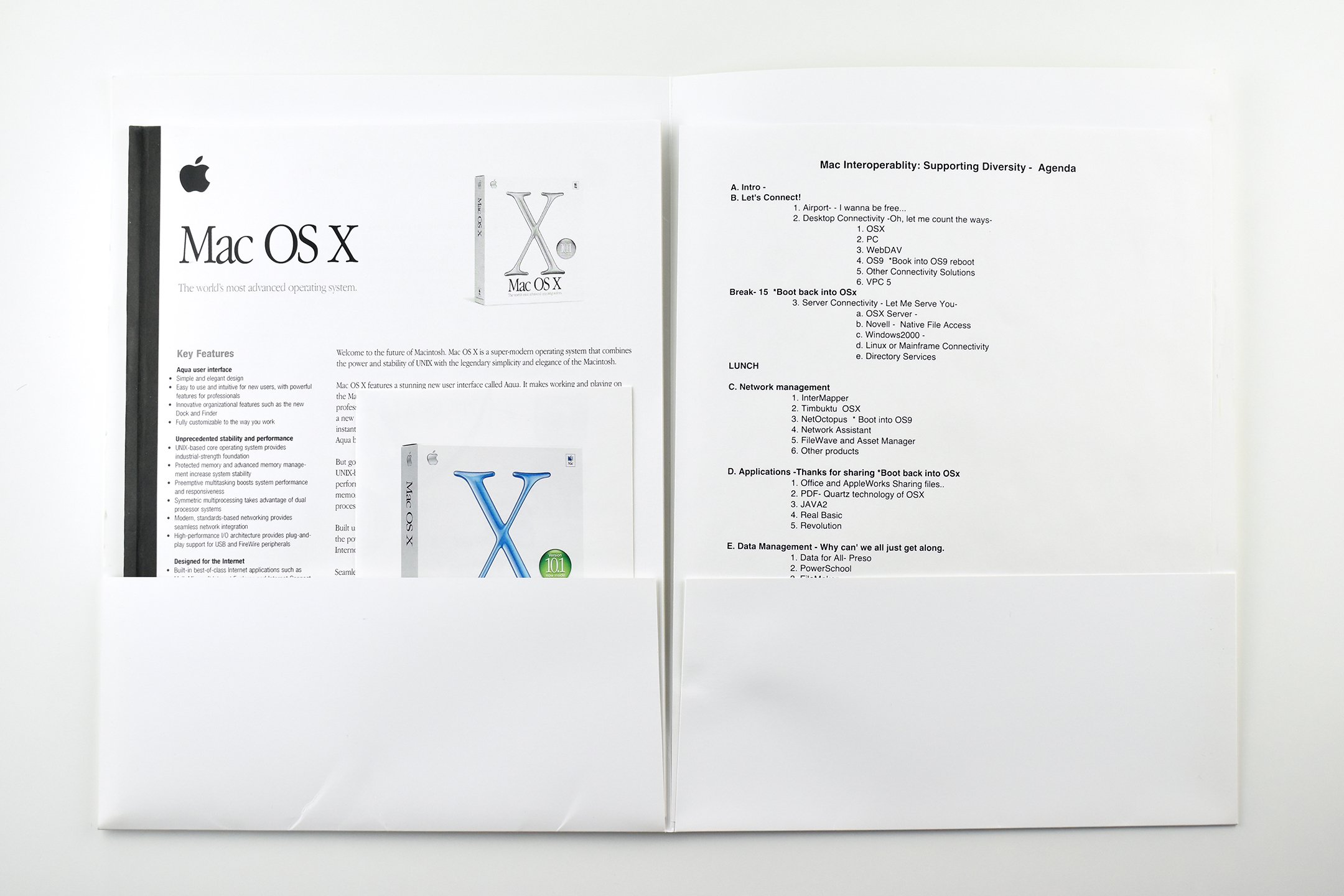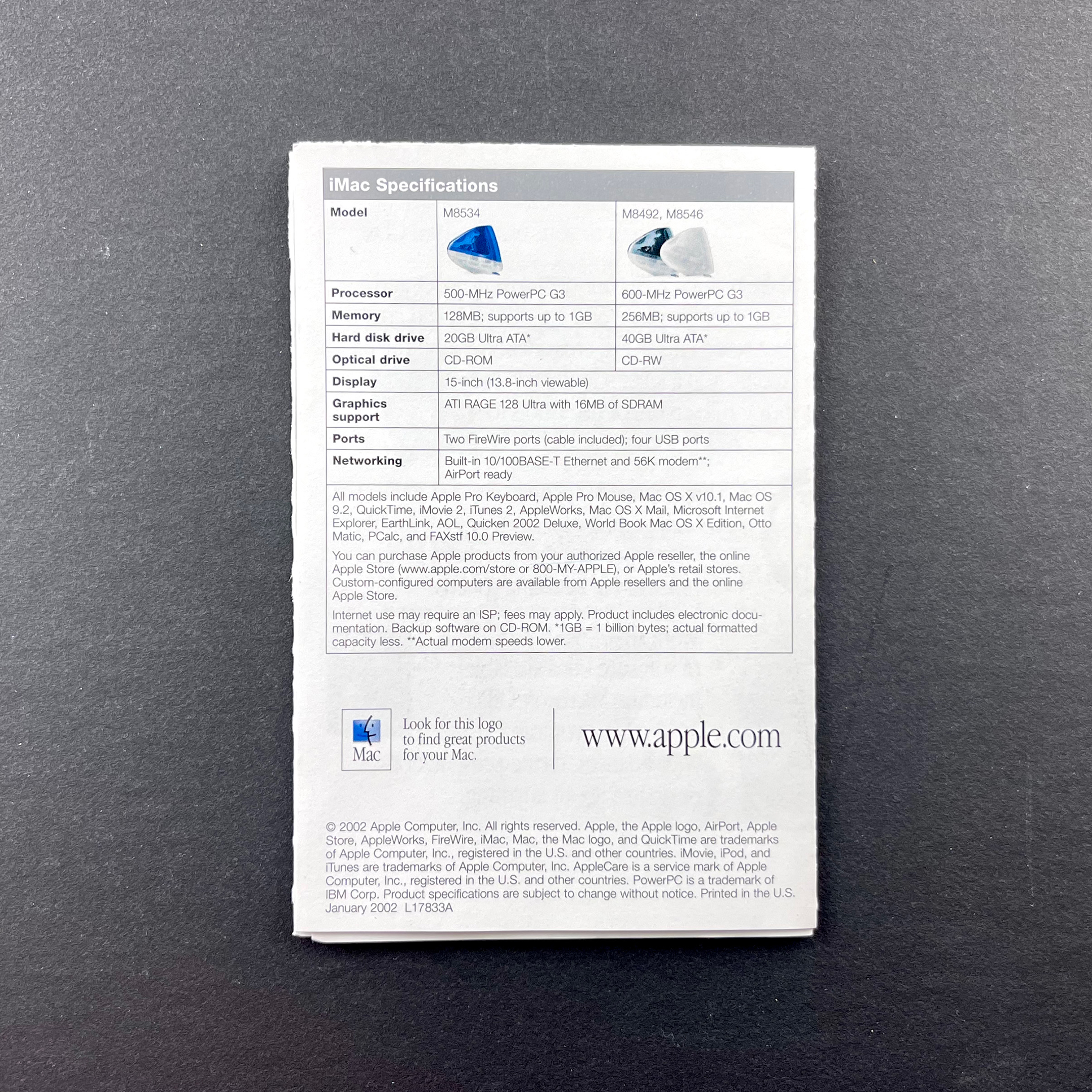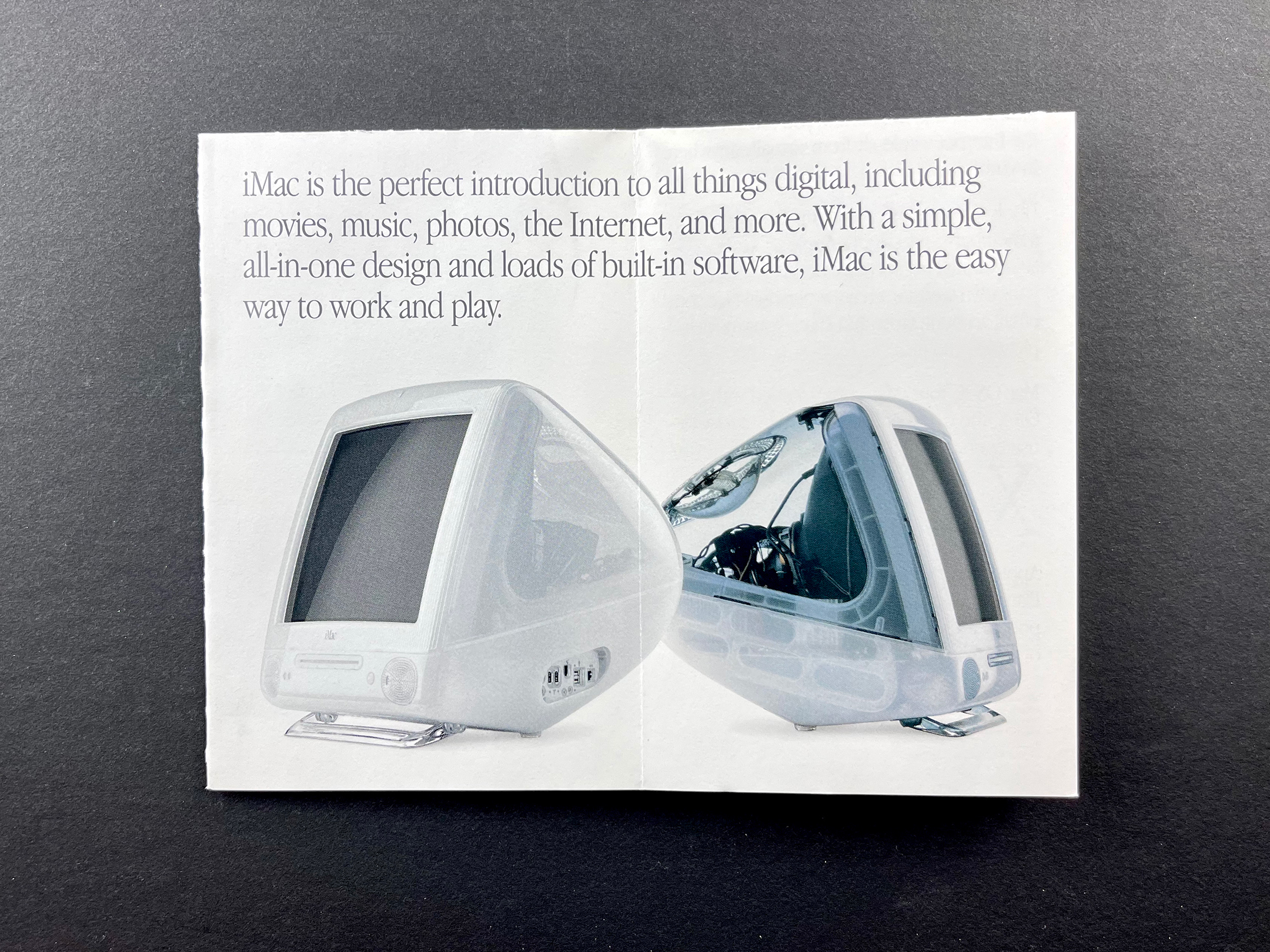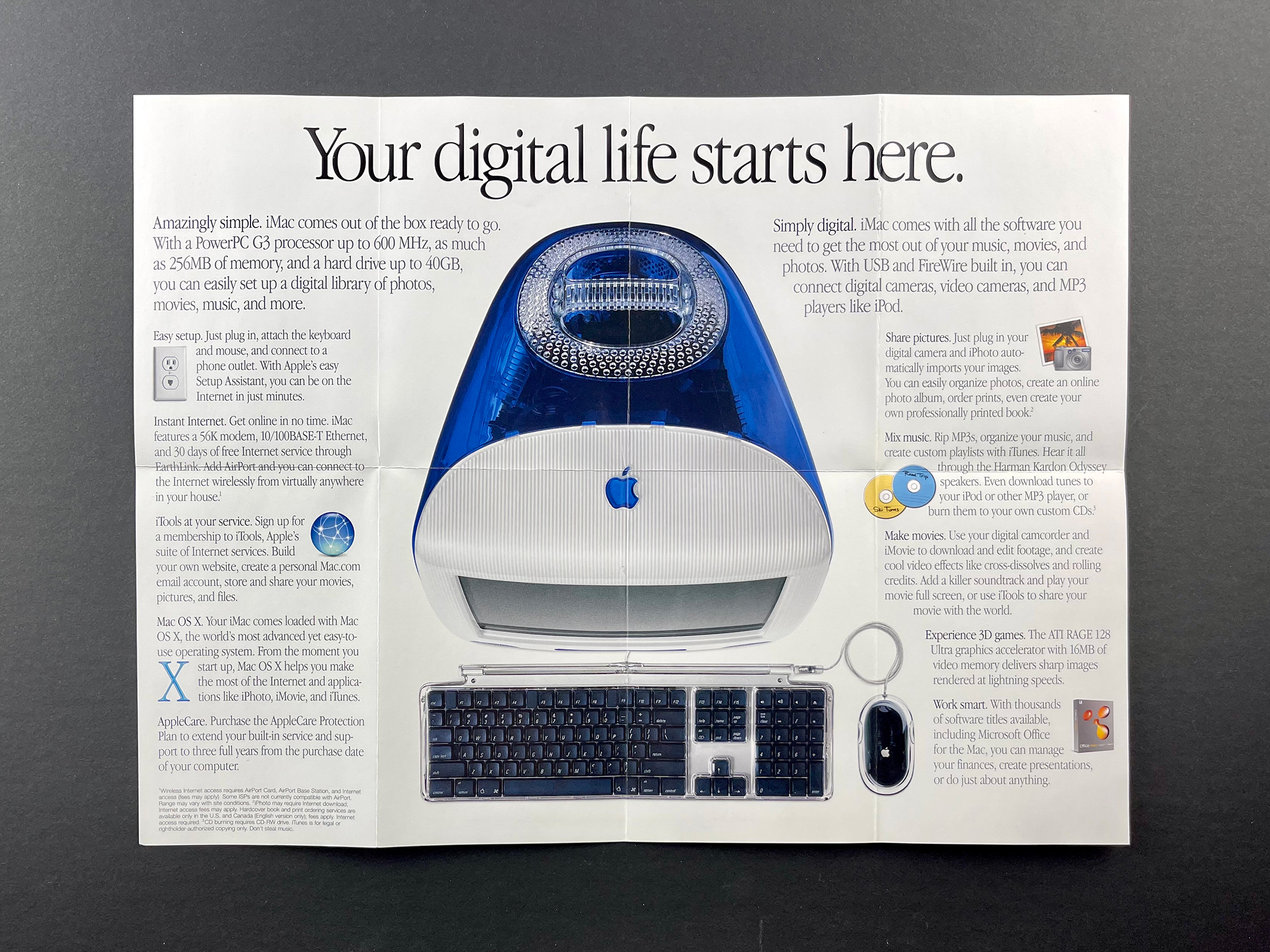
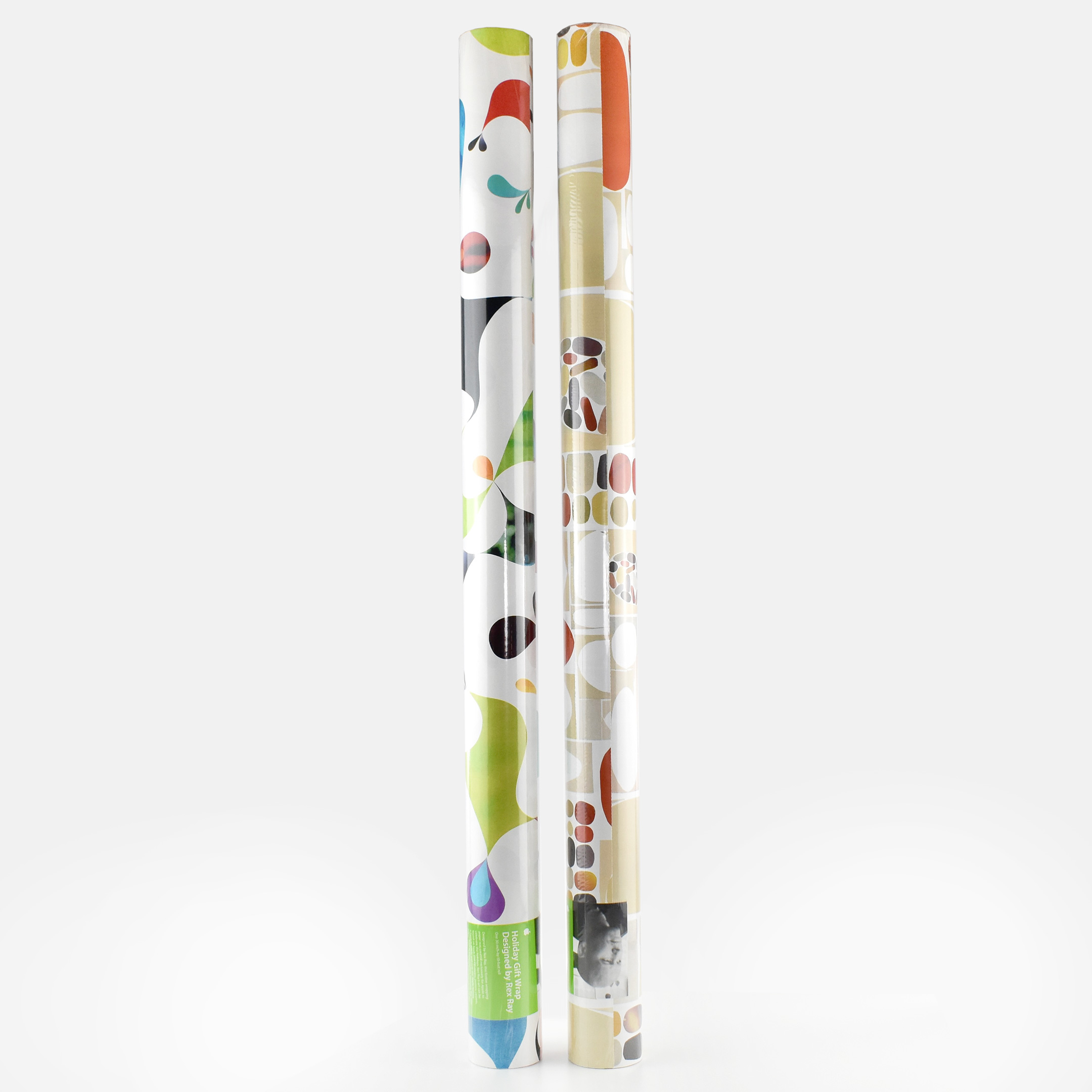
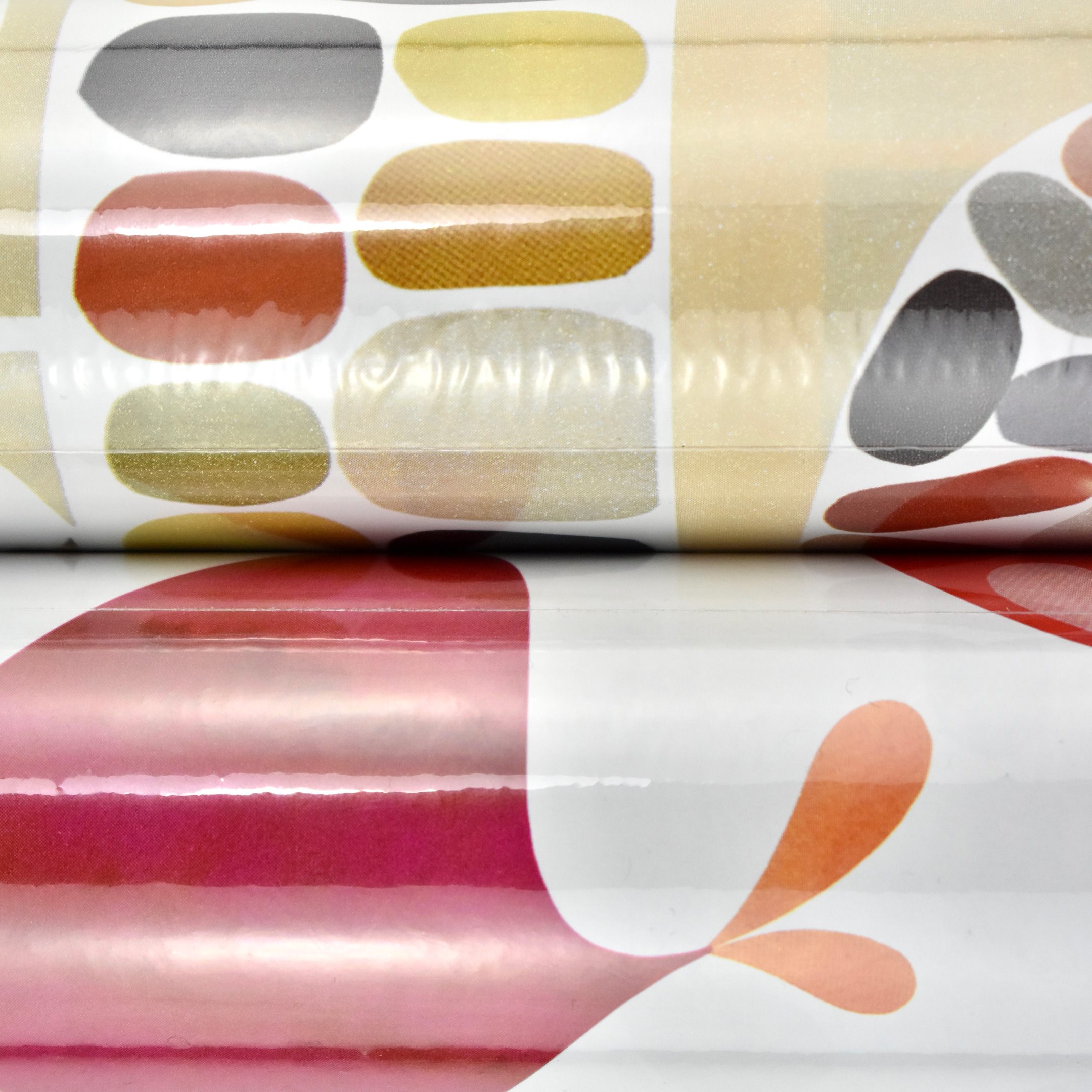
Holiday Gift Wrap Designed by Rex Ray (beige design, bright colors design, 2002)

These two gift wrap designs were created for Apple by artist Rex Ray, born September 11, 1956, and died February 9, 2015. He was an “American artist best known for his innovative pop aesthetic in fine and commercial art—on canvases, wood panels, album covers, paper, book jackets, murals, and rock and roll posters.”

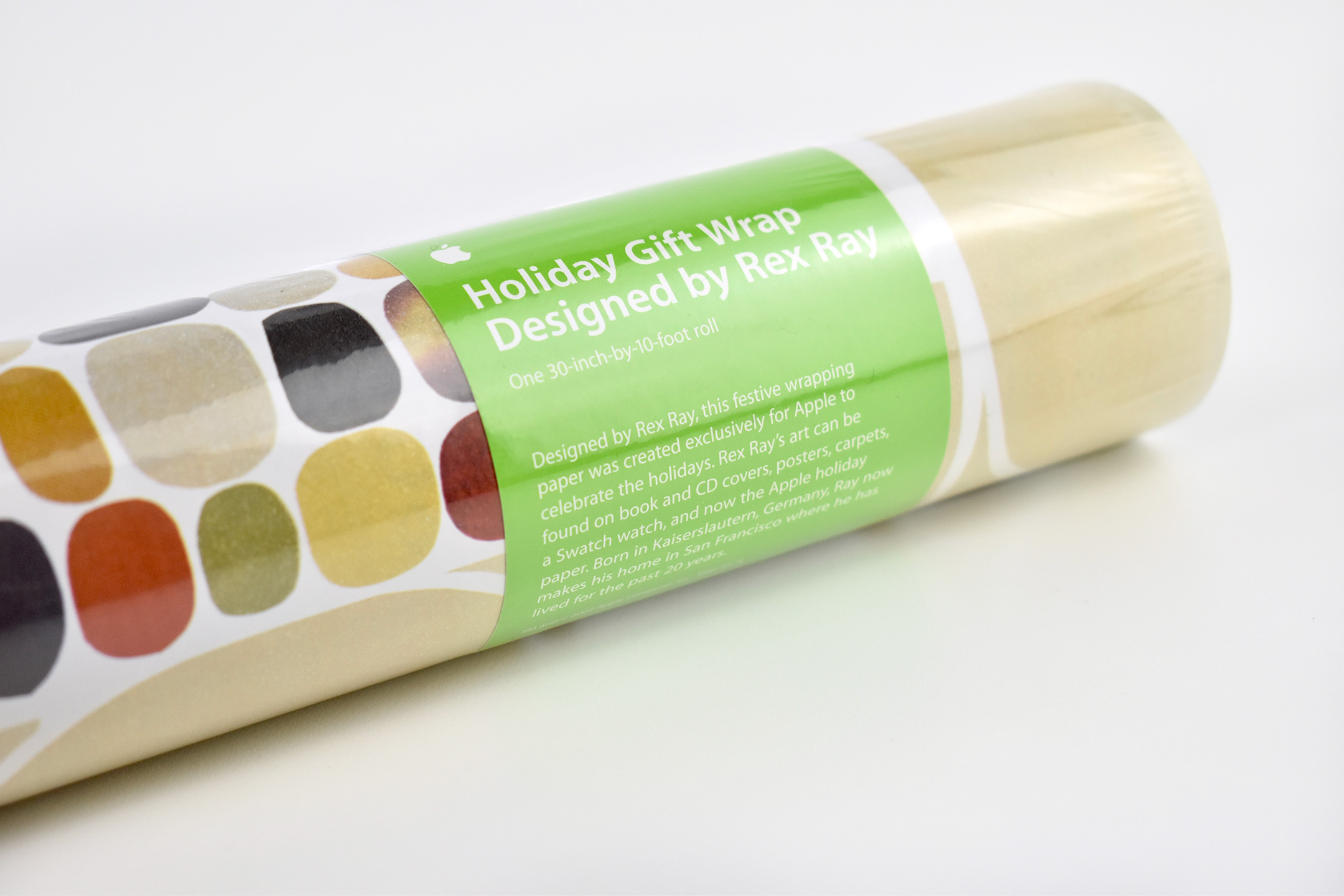
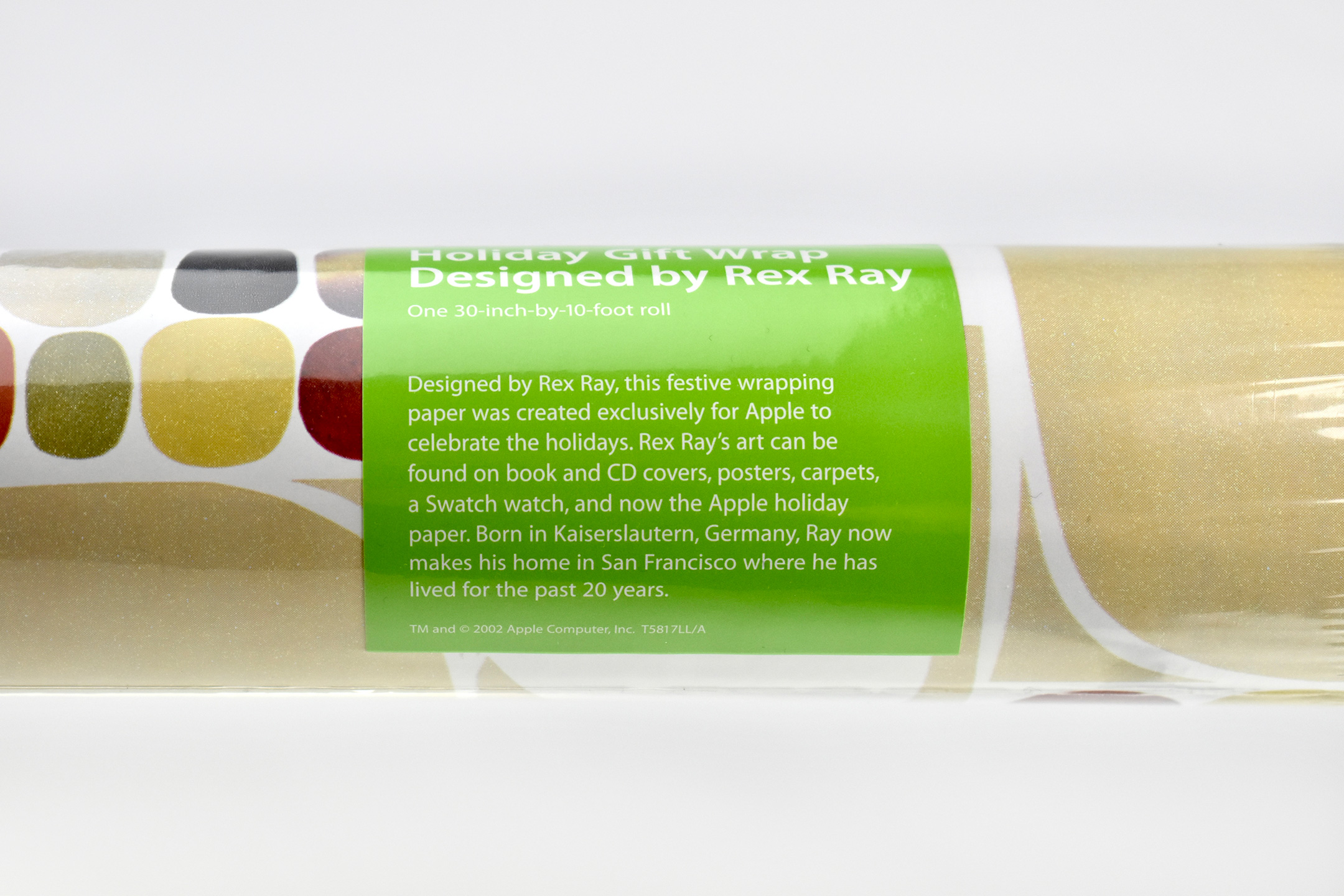
The label on the rolls of gift wrap were bright green with white text in the Apple Myriad font and matched Apple’s product packaging at the time. The label included a black-and-white headshot of Rex Ray, and the product description:

“Designed by Rex Ray, this festive wrapping paper was created exclusively for Apple to celebrate the holidays. Rex Ray’s art can be found on book and CD covers, posters, carpets, a Swatch watch, and now the Apple holiday paper. Born in Kaiserslautern, Germany, Ray now makes his home in San Francisco where he has lived for the past 20 years.”

Although the two designs are not named, the beige/brown design has the product number T5817LL/A, and the bright colored design has the product number T5818LL/A. 

As a collector, I had no idea this product existed until it appeared on a local Facebook Marketplace post. I had to research it to make sure it was an actual Apple product and found it not only to be legitimate, but Apple had also made a magnetic poetry set with the beige/brown border design the same year (that I also found and acquired on eBay). 

The woman from whom I purchased the gift wrap told me she had purchased all the rolls in stock at an Apple Store in 2002 (presumably Woodfield Mall in Schaumburg, IL—the only Apple Store in the Chicago area at the time). We negotiated a price, and I purchased all of 29 rolls she had. 

Source: Rex Ray Studio
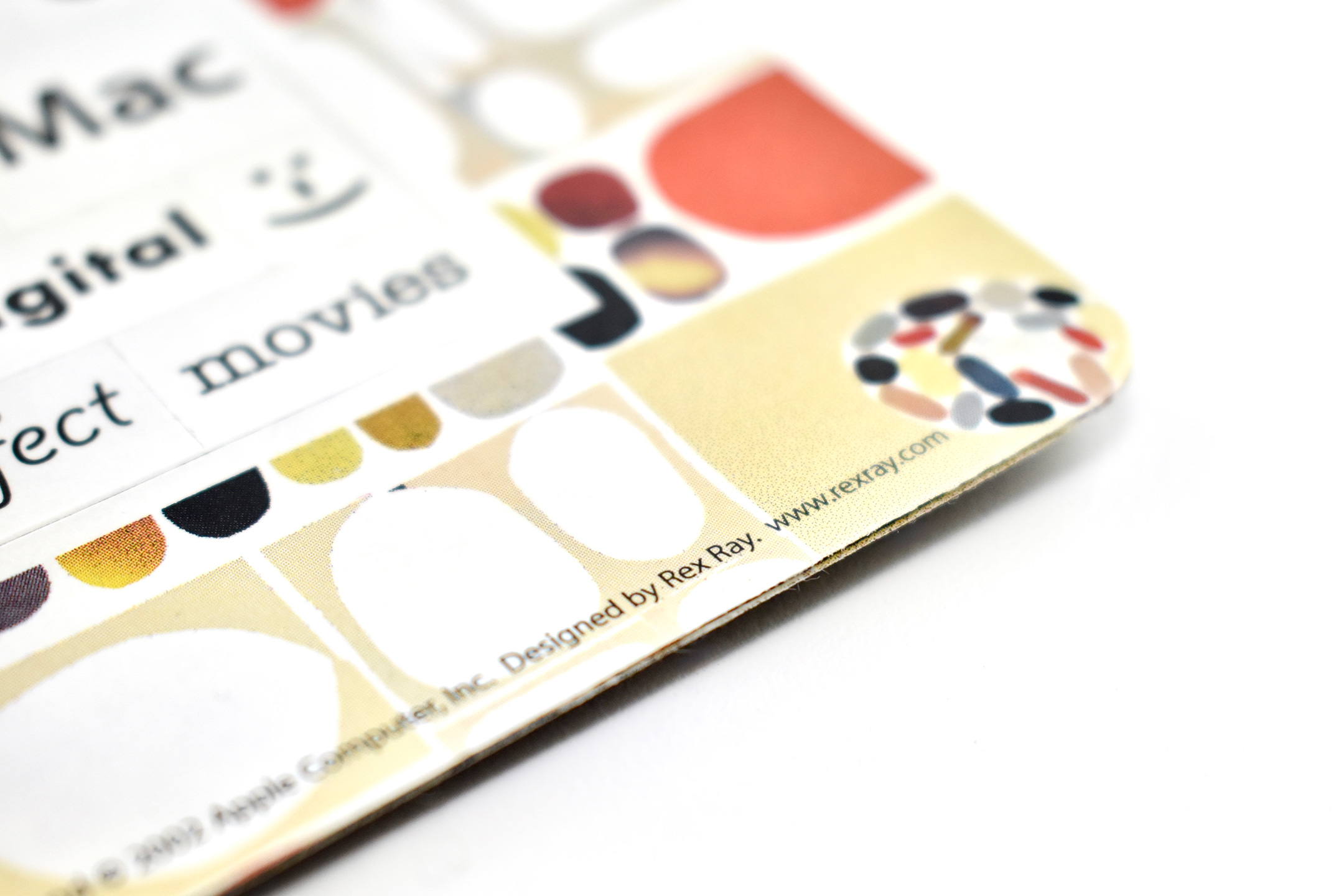
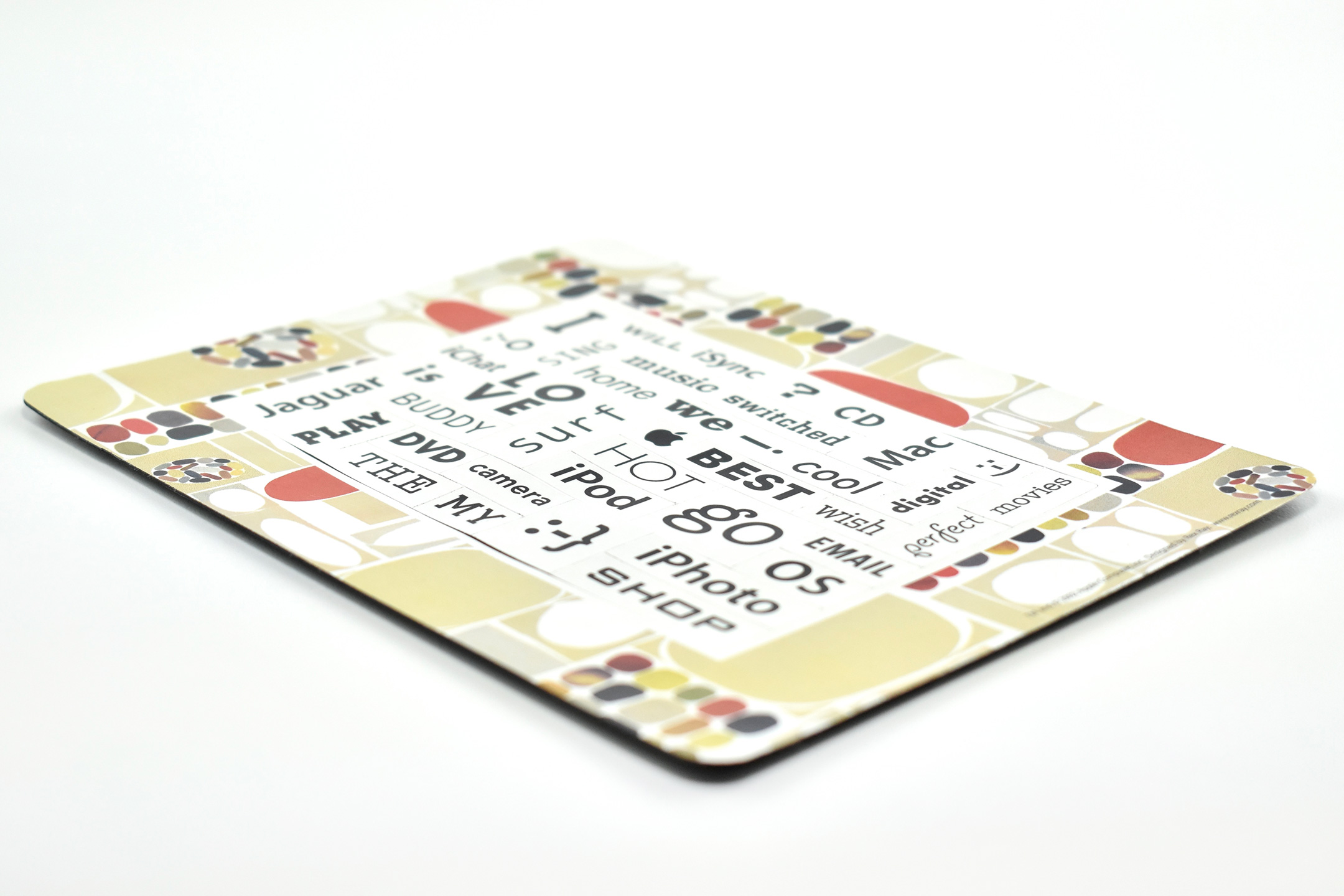
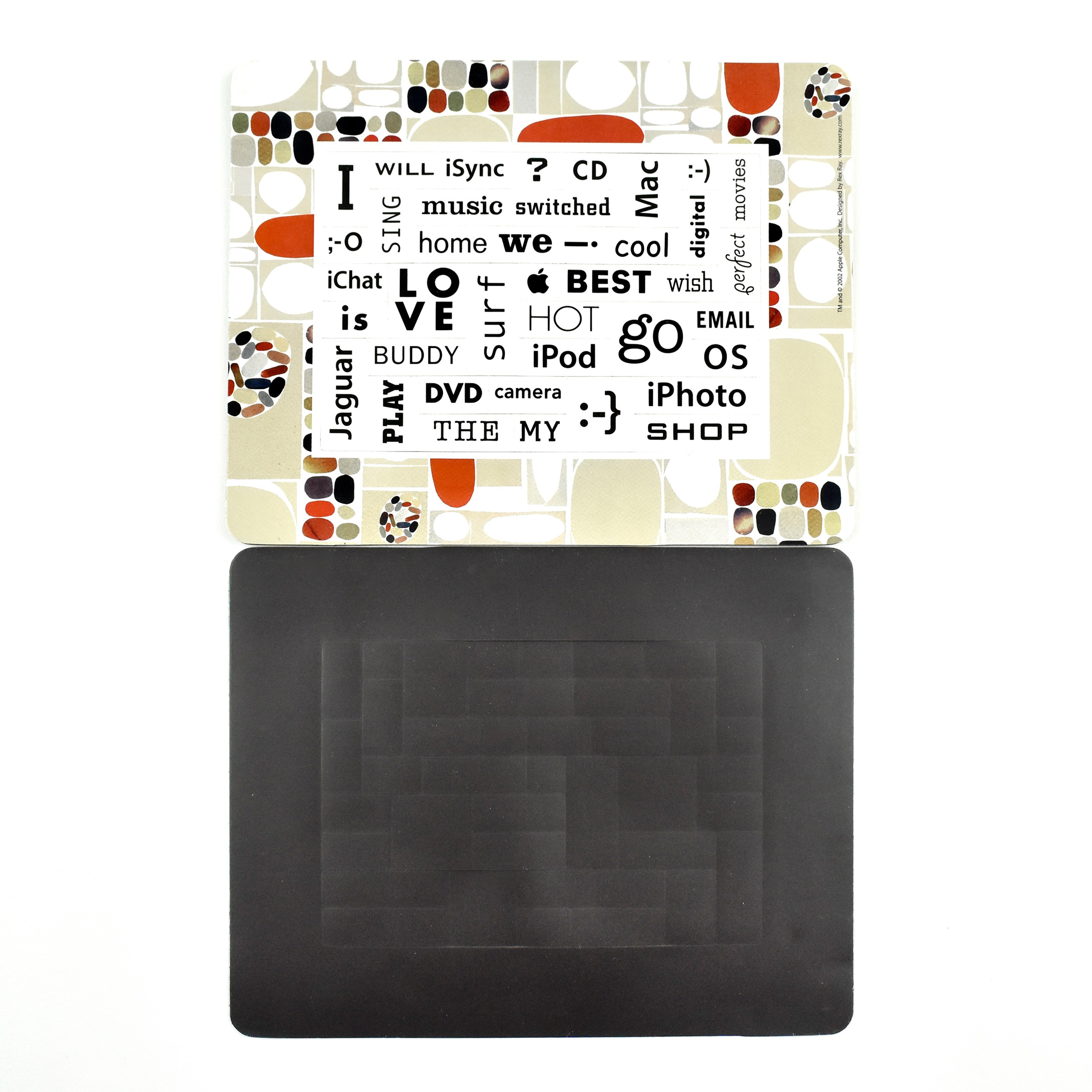
Magnetic Poetry Set designed by Rex Ray (2002)

The border of this magnetic poetry set was designed by artist Rex Ray. Born September 11, 1956, and died February 9, 2015, Rex Ray was an “American artist best known for his innovative pop aesthetic in fine and commercial art—on canvases, wood panels, album covers, paper, book jackets, murals, and rock and roll posters.”

The border of this magnetic poetry set matches a design Ray created for Apple that was used for gift wrap, also available in 2002. 

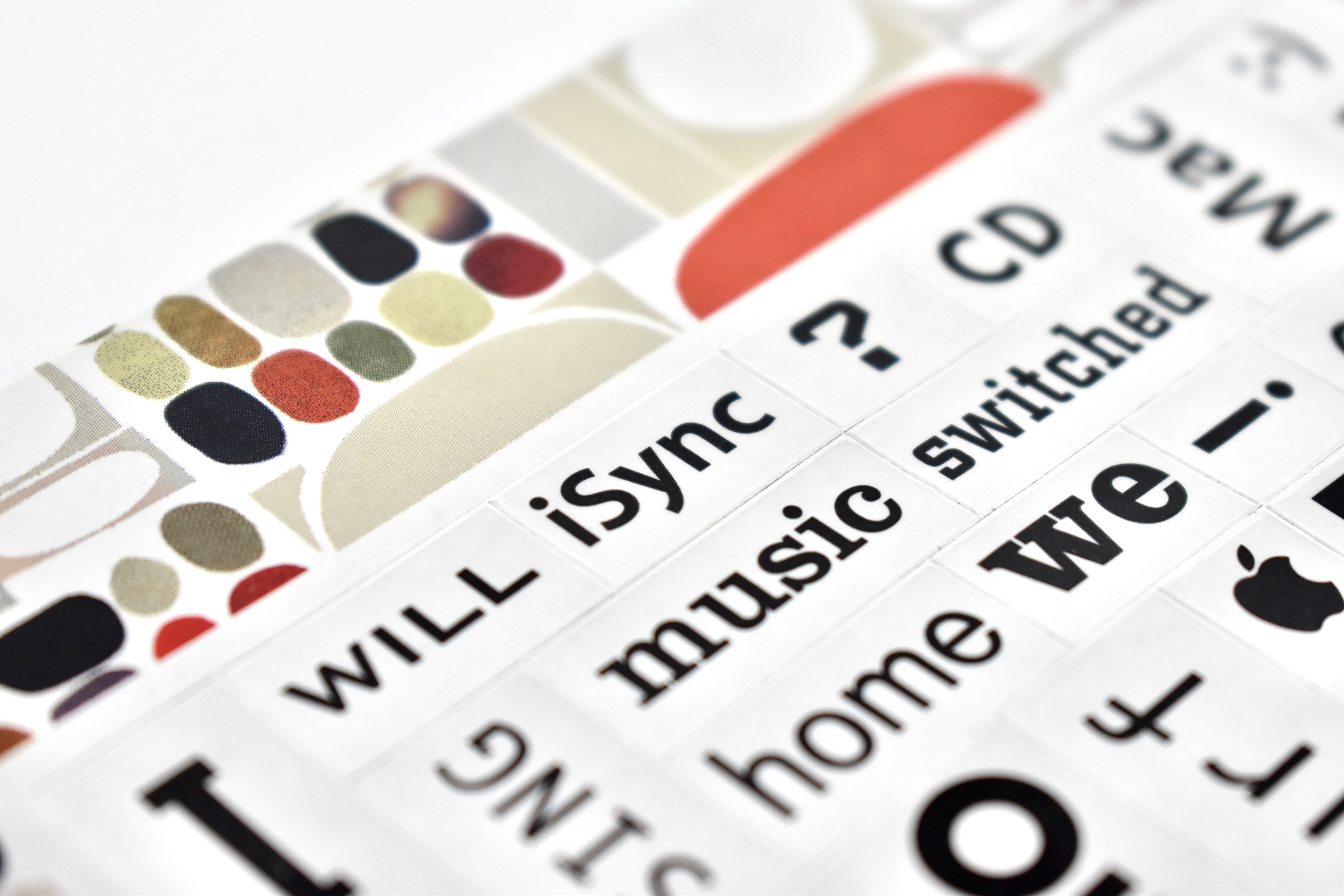
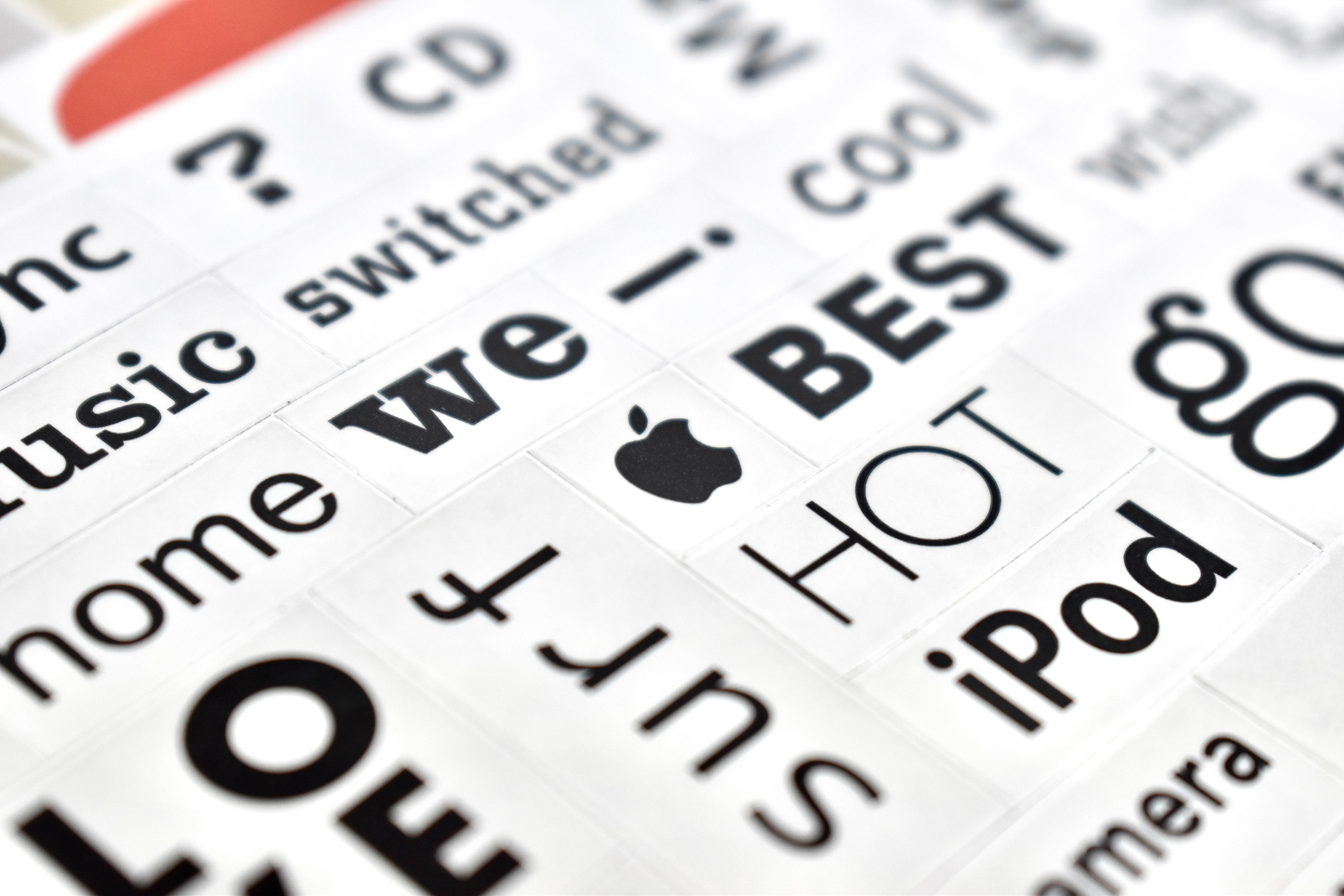
The inside of this magnetic poetry set was also used by Apple with a jaguar-skin border that was released along with Mac OS X version 10.2, “Jaguar.” The magnetic words are a combination of Apple products, words, punctuation-based emoji, and symbols. The complete list of poetry elements include (in alphabetical order):

BEST, BUDDY, camera, CD, cool, digital, DVD, EMAIL, go, home, I, iChat, iPhoto, iPod, iSync, Jaguar, LOVE, movies, music, MY, OS, perfect, PLAY, SHOP, SING, surf, switched, THE, we, WILL, wish, ;-O, :-), :-}, ! (or i), ?, [Apple logo]

The poetry magnet set measures 6.75 × 5.25 inches.

Interestingly, as of this writing in 2025, except for “Mac,” all other Apple products featured in this poetry set have been discontinued or are no longer in general use (iSync, iChat, iPod, iPhoto, Jaguar).

Source: Rex Ray Studio
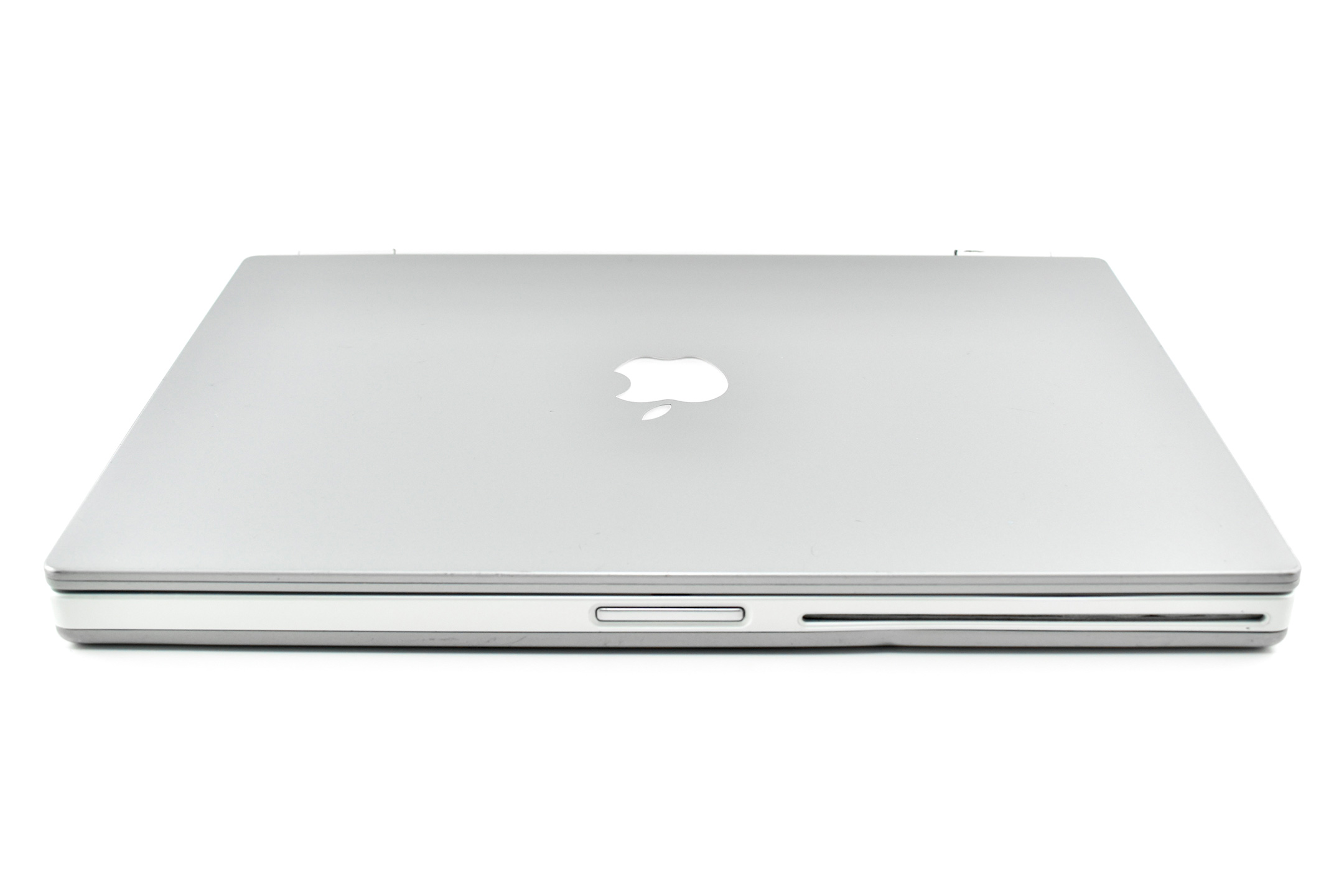
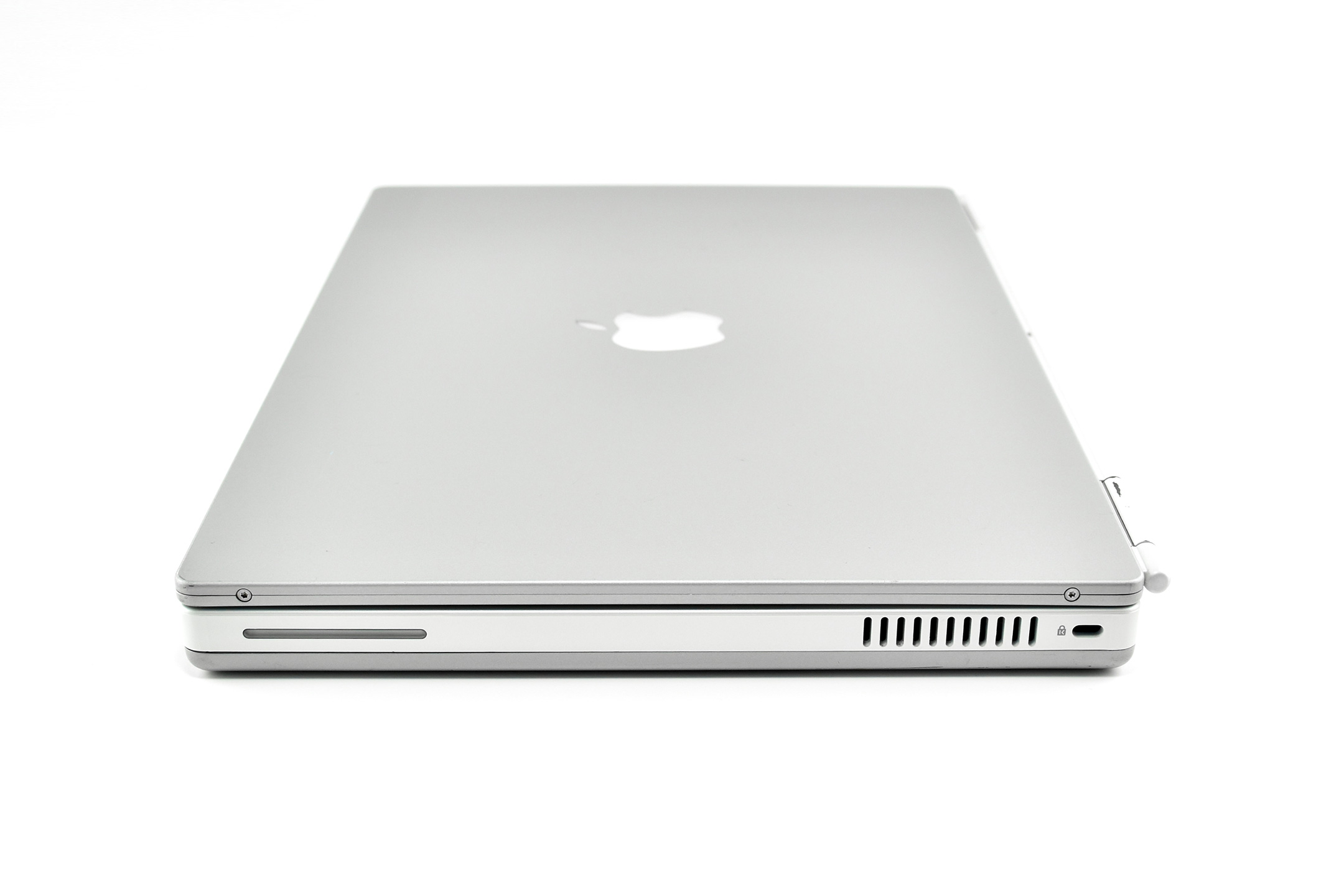
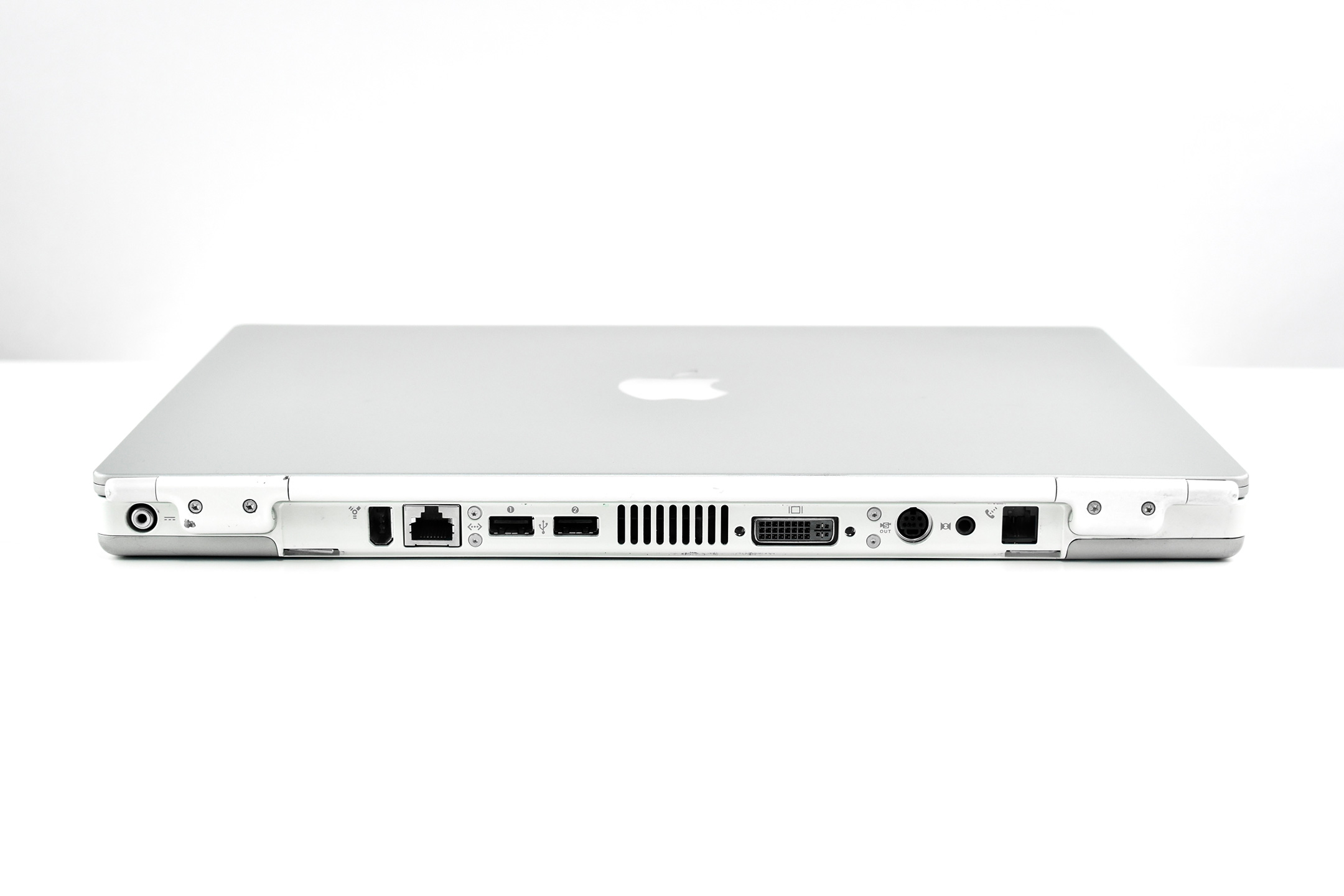
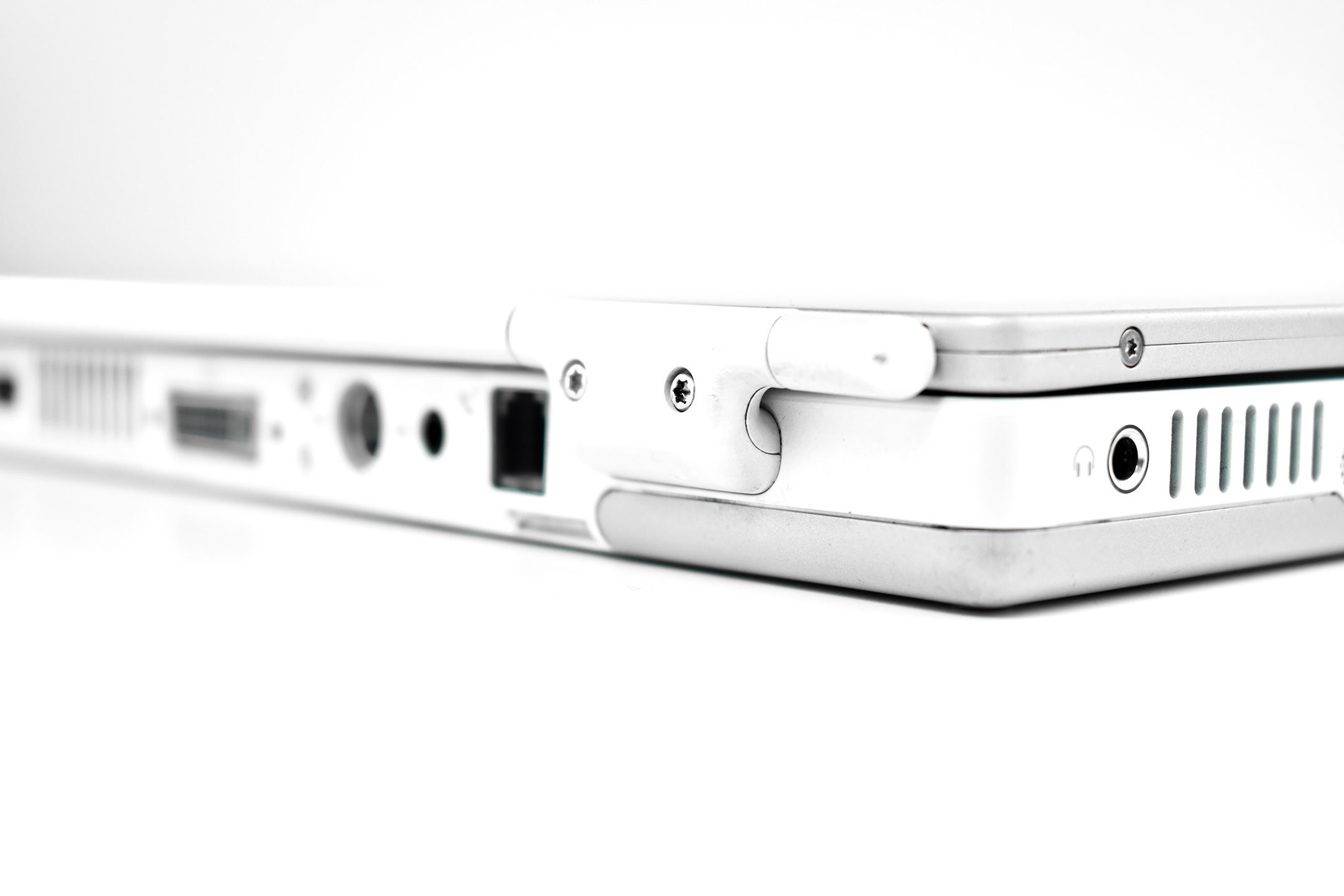
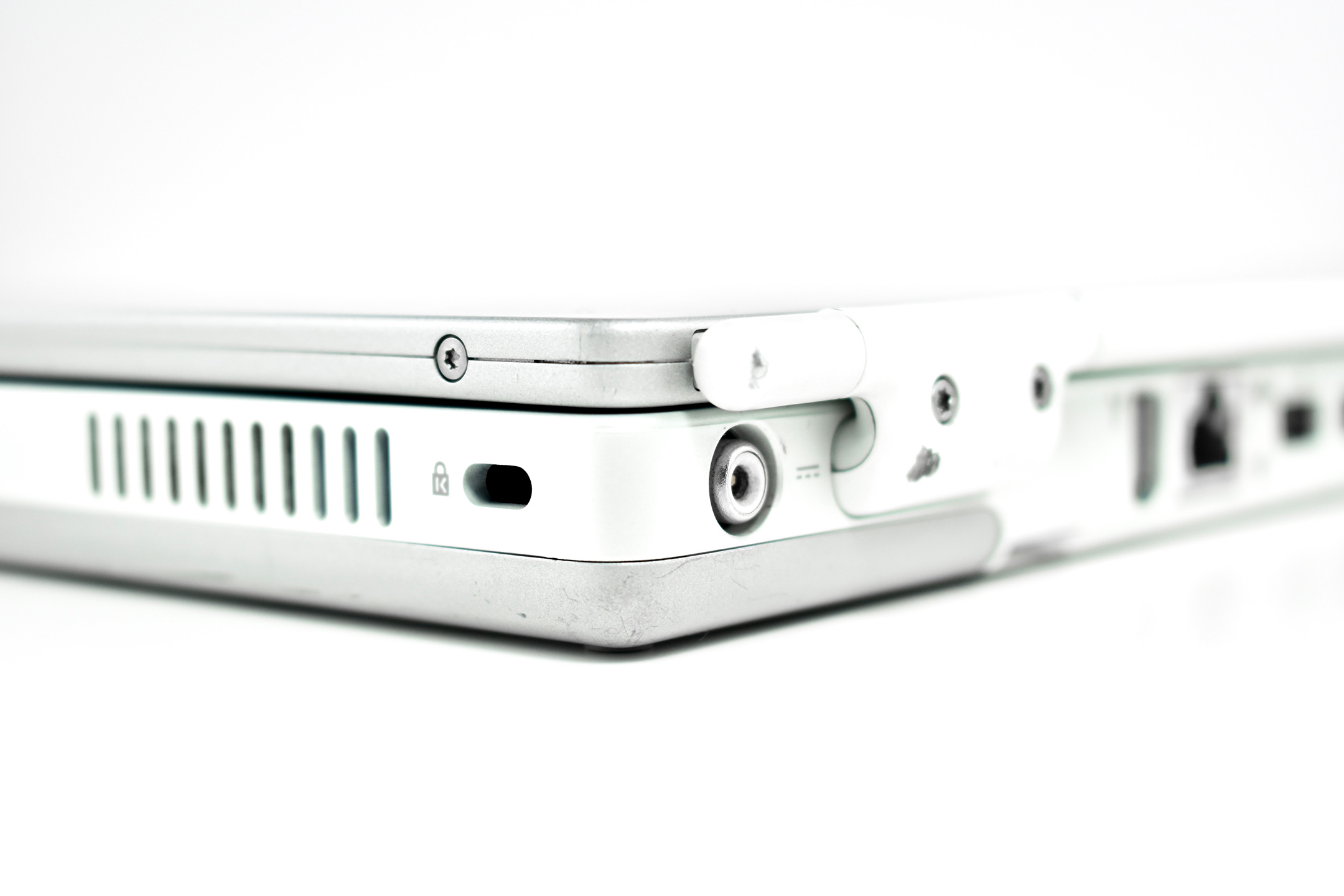
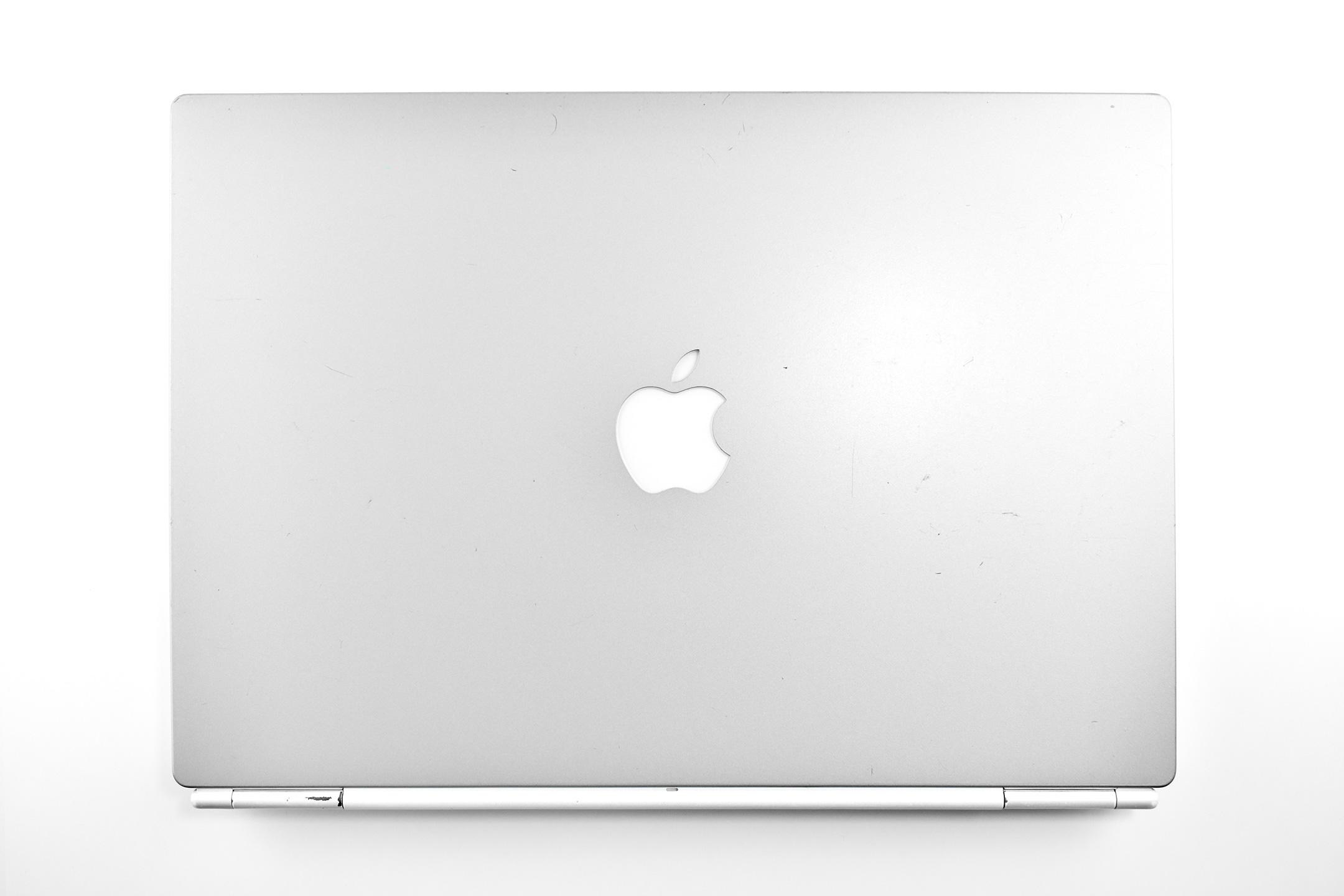
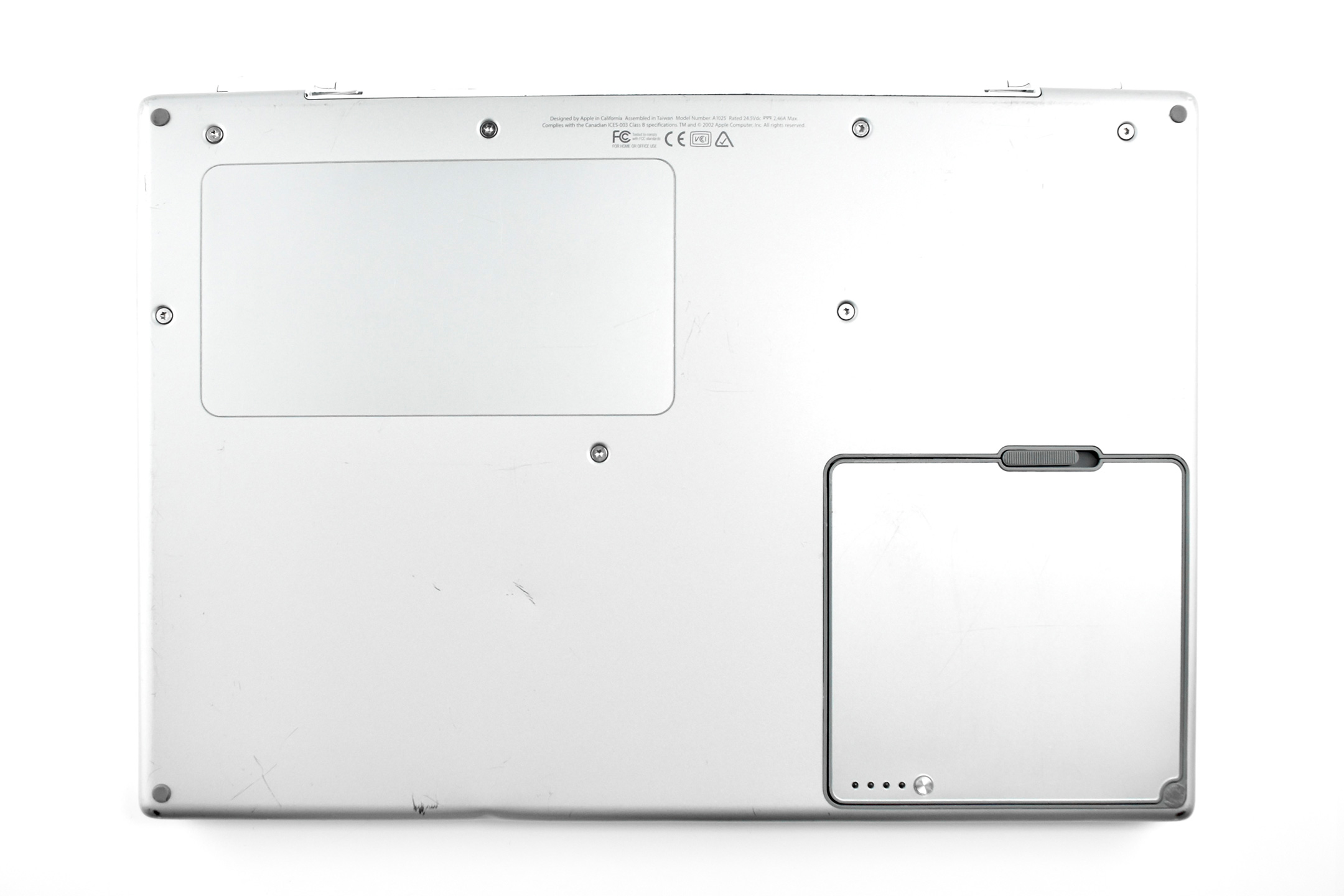
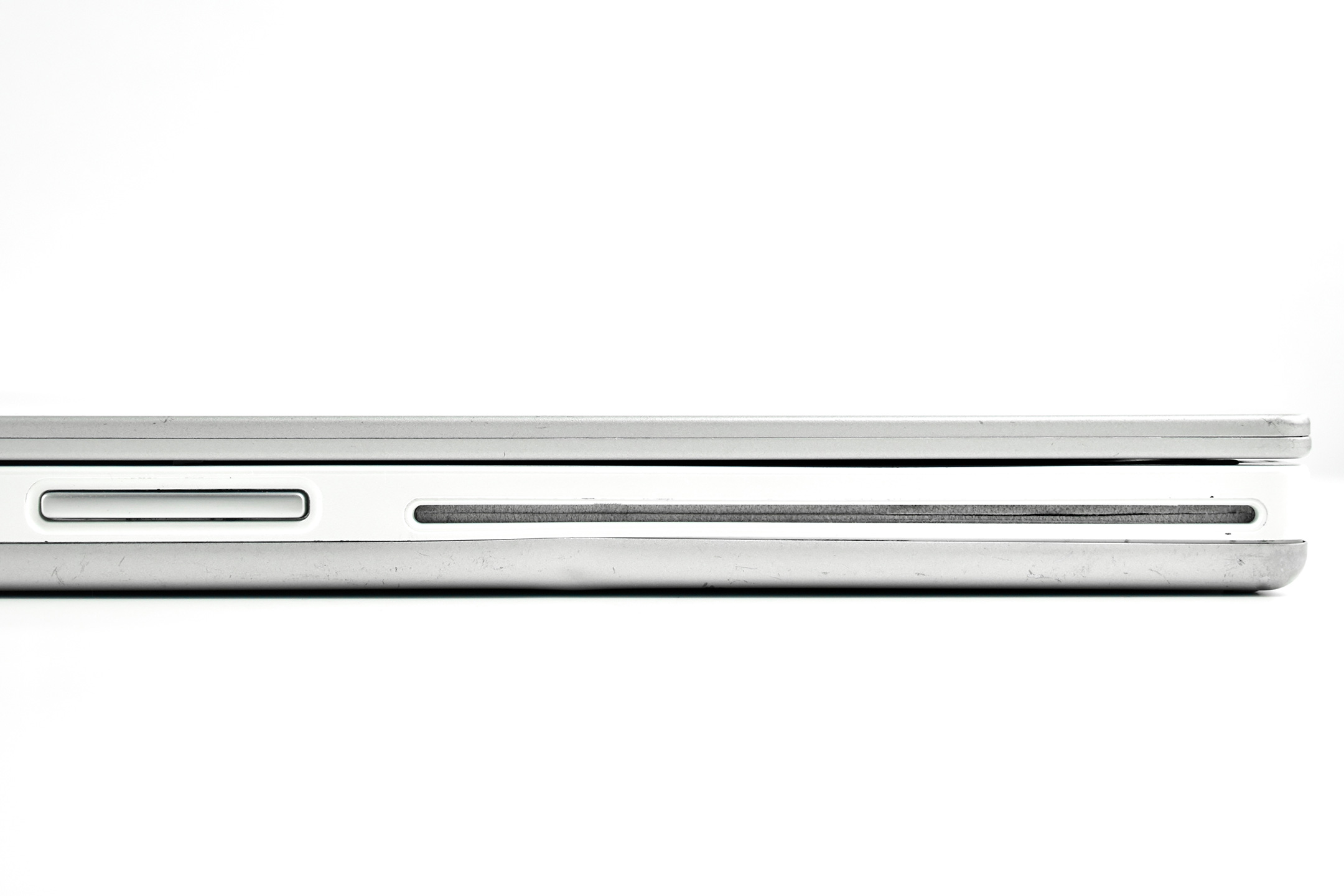
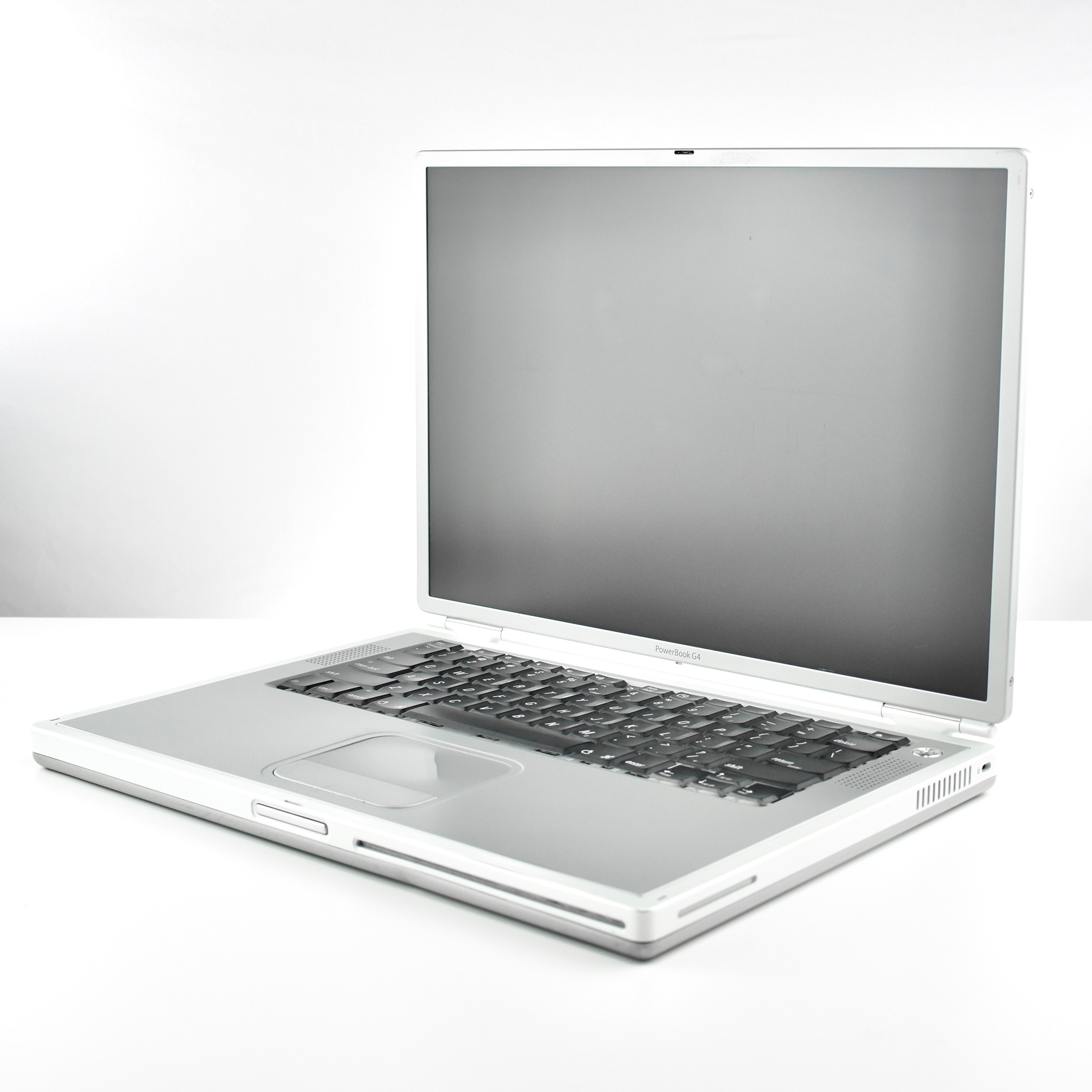
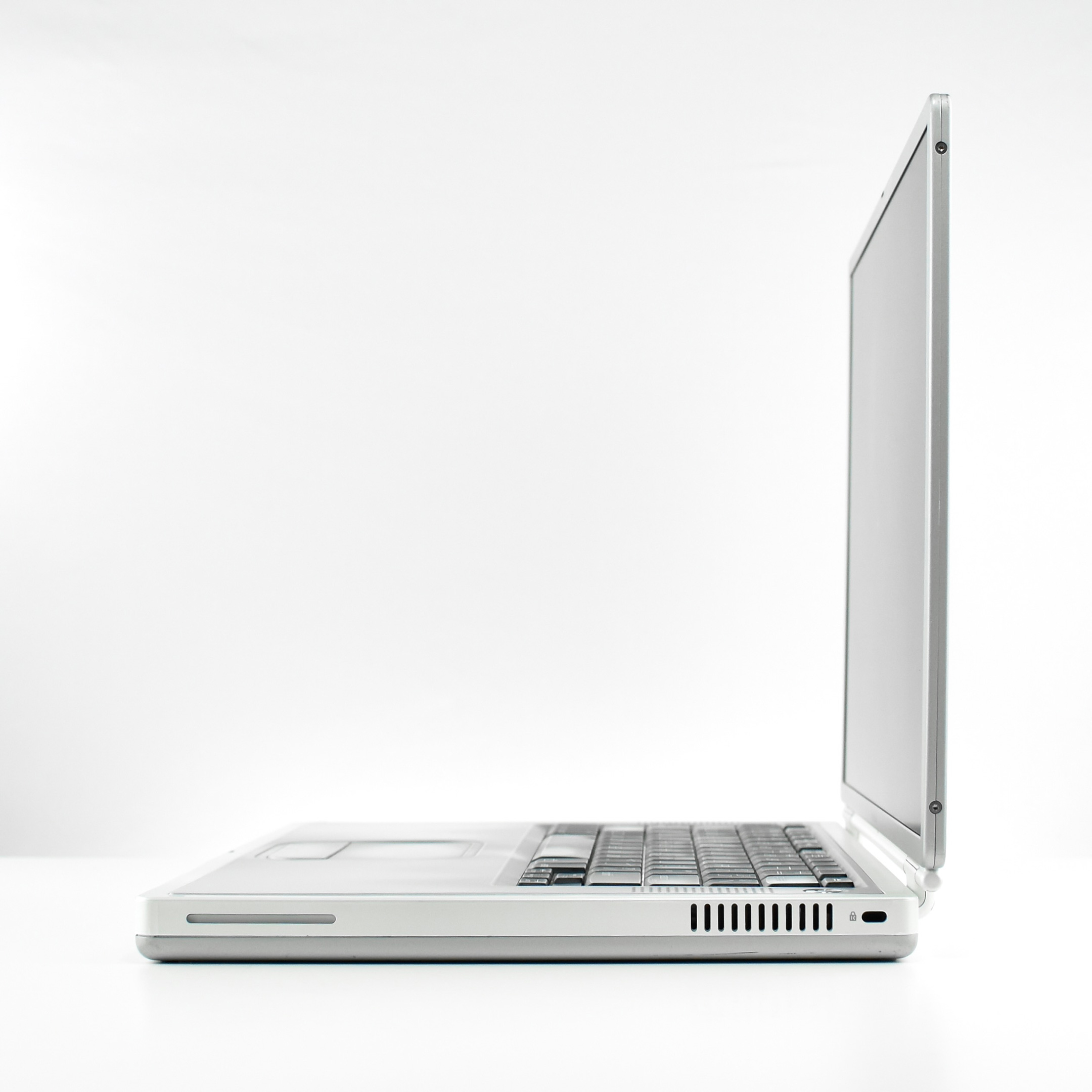
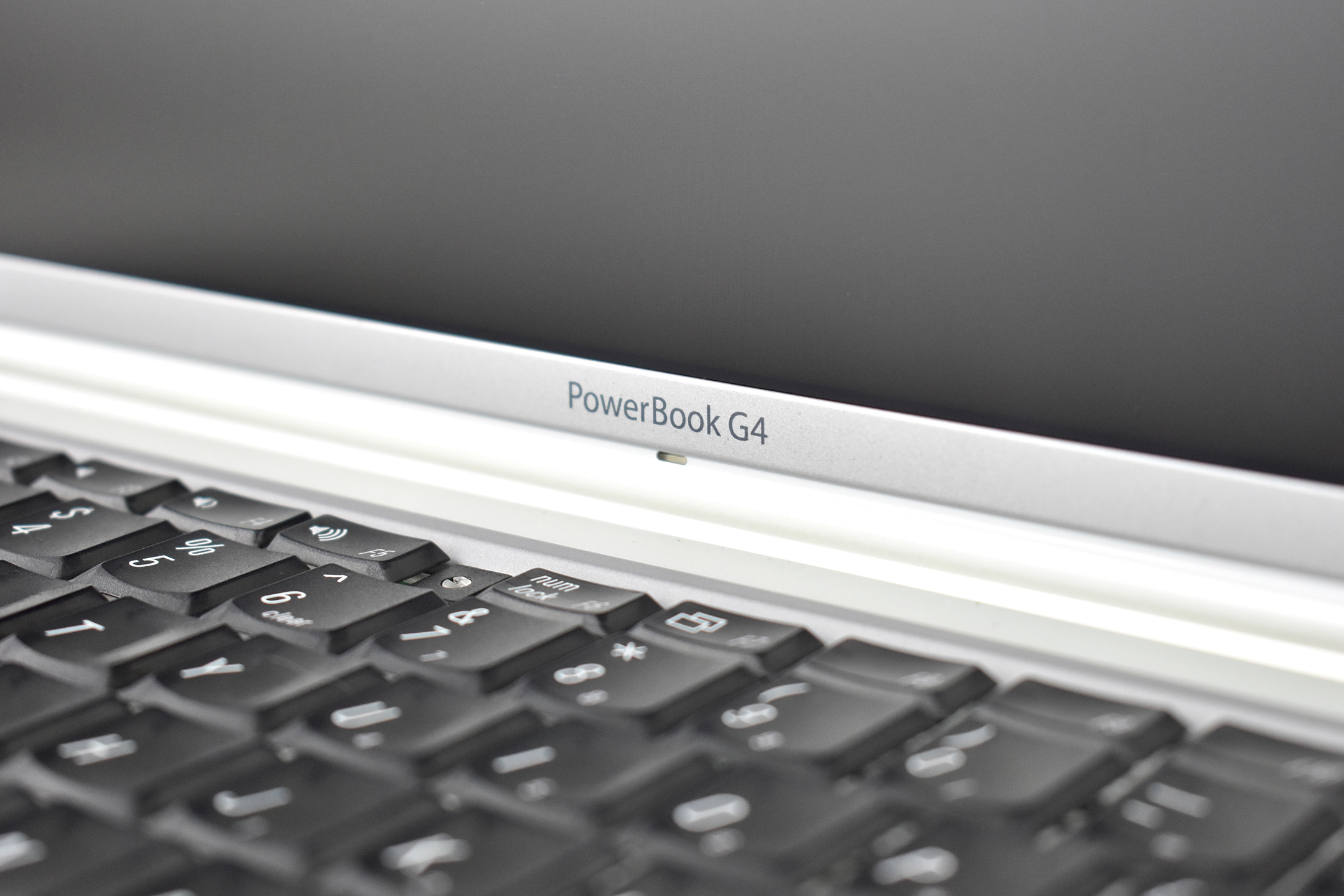
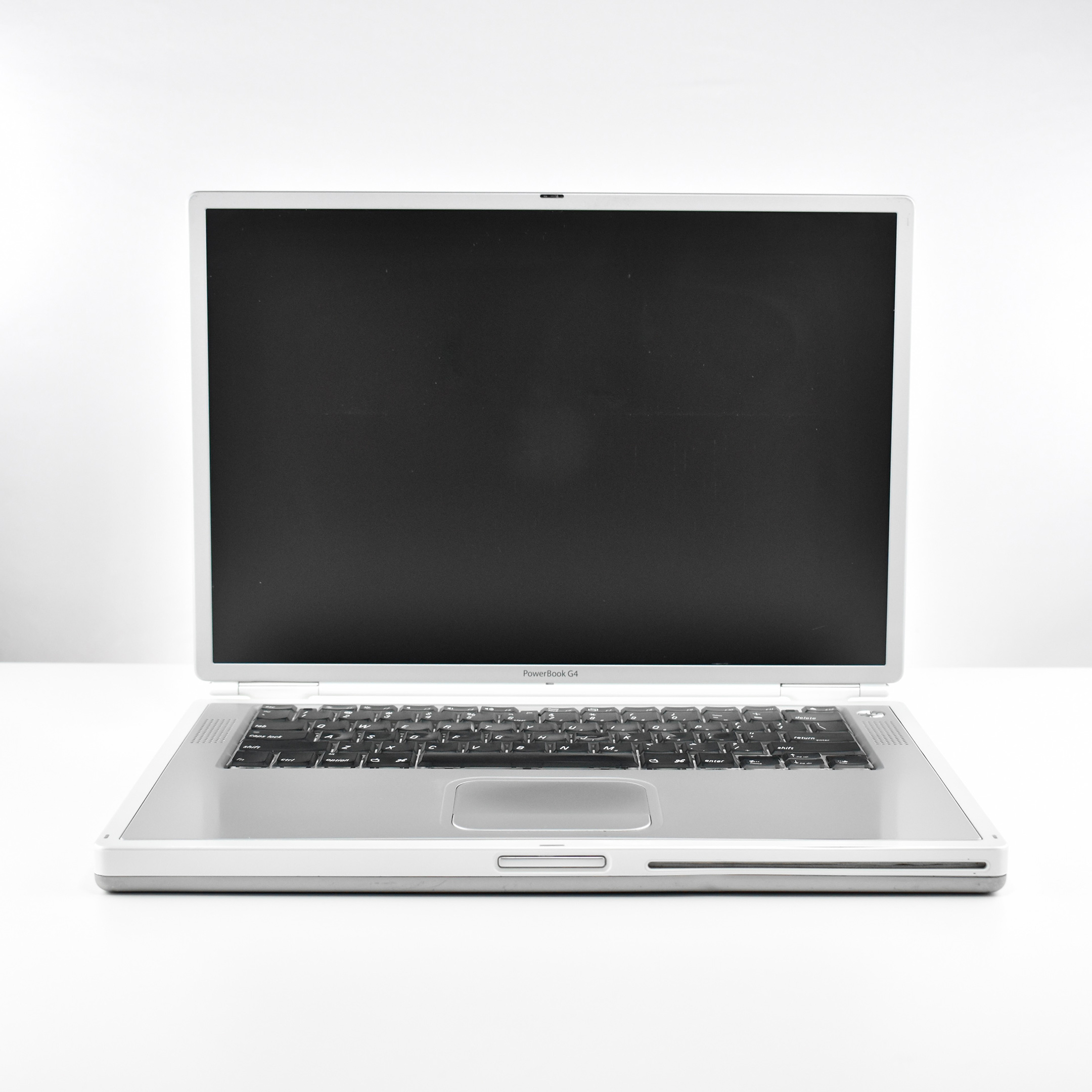
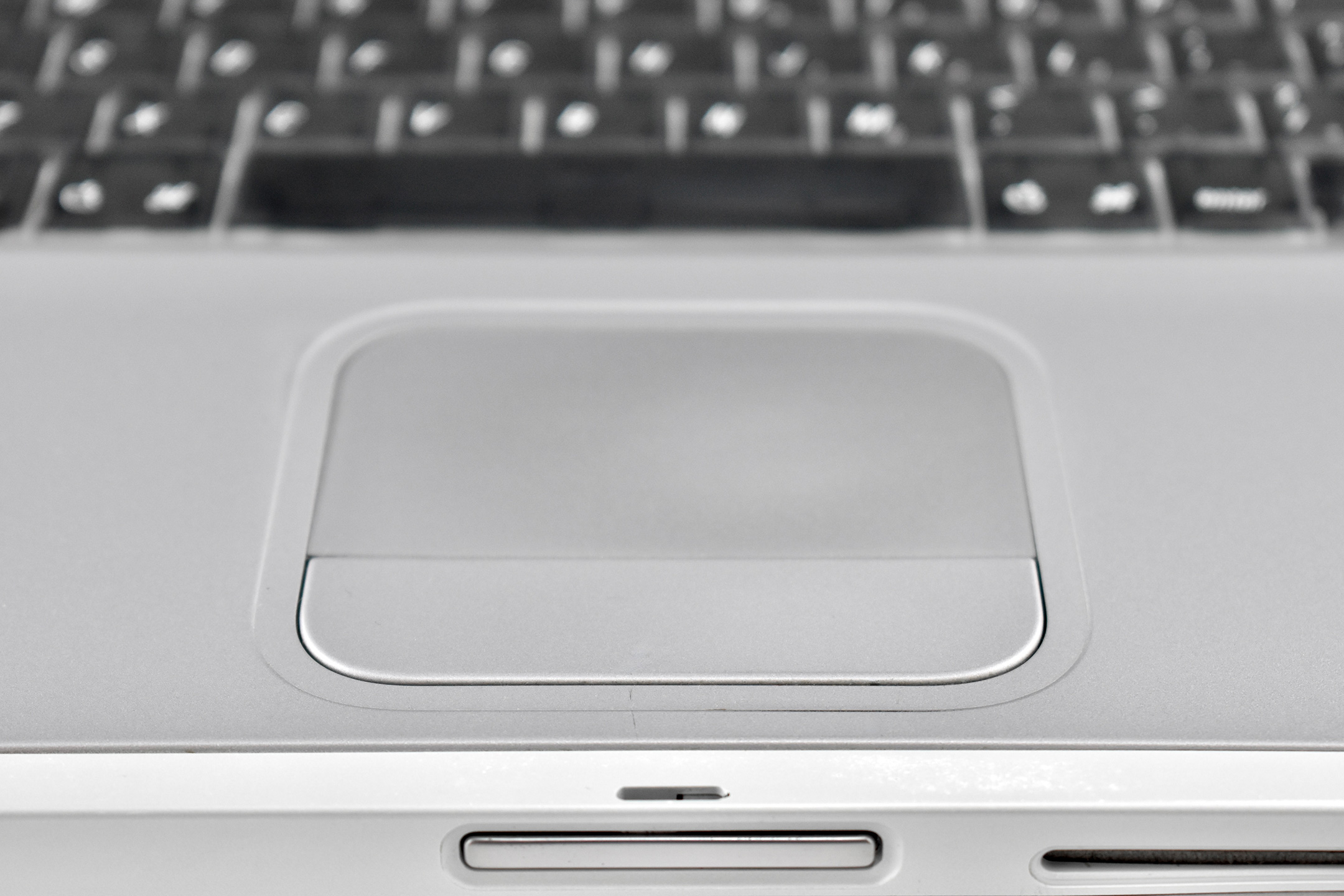
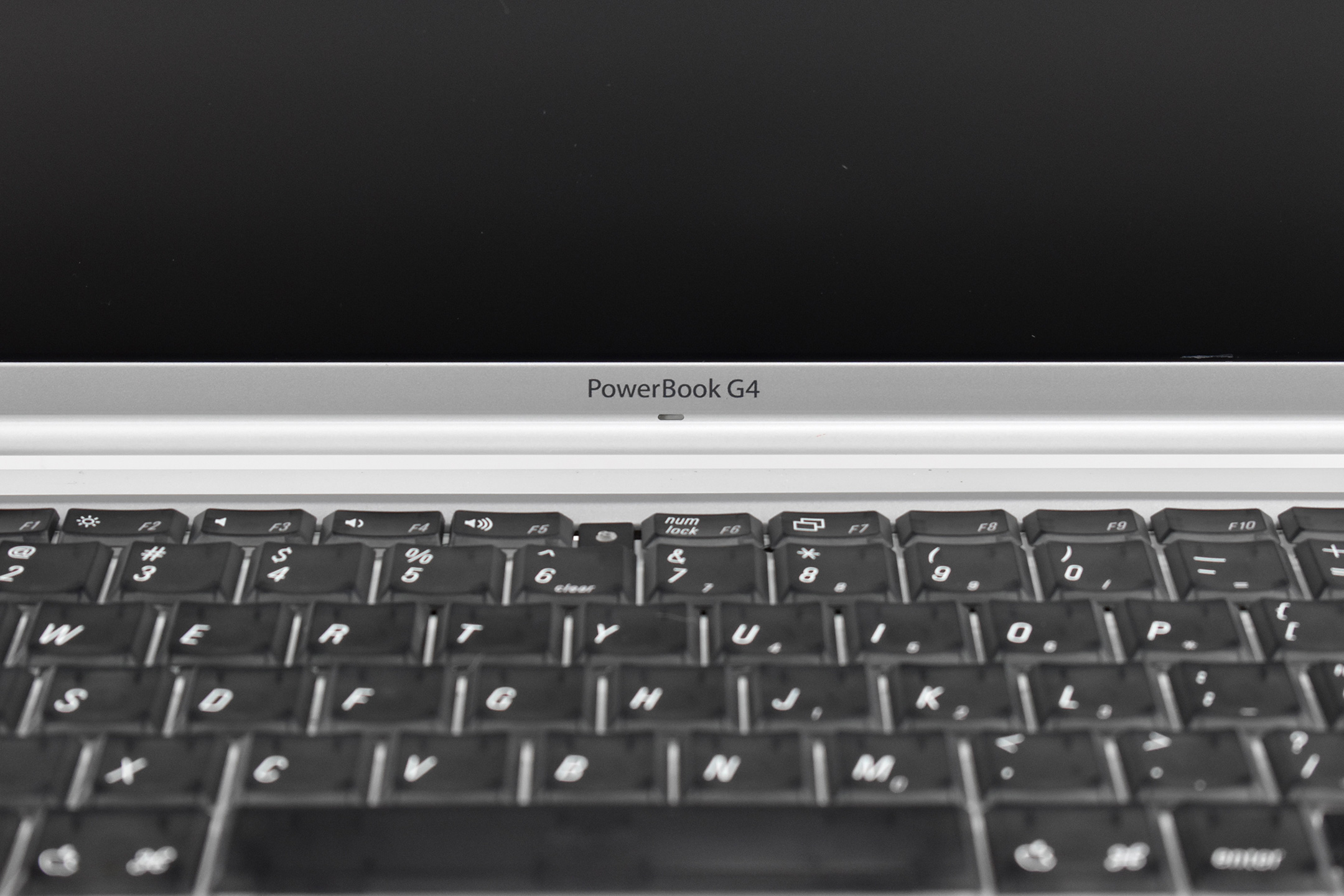
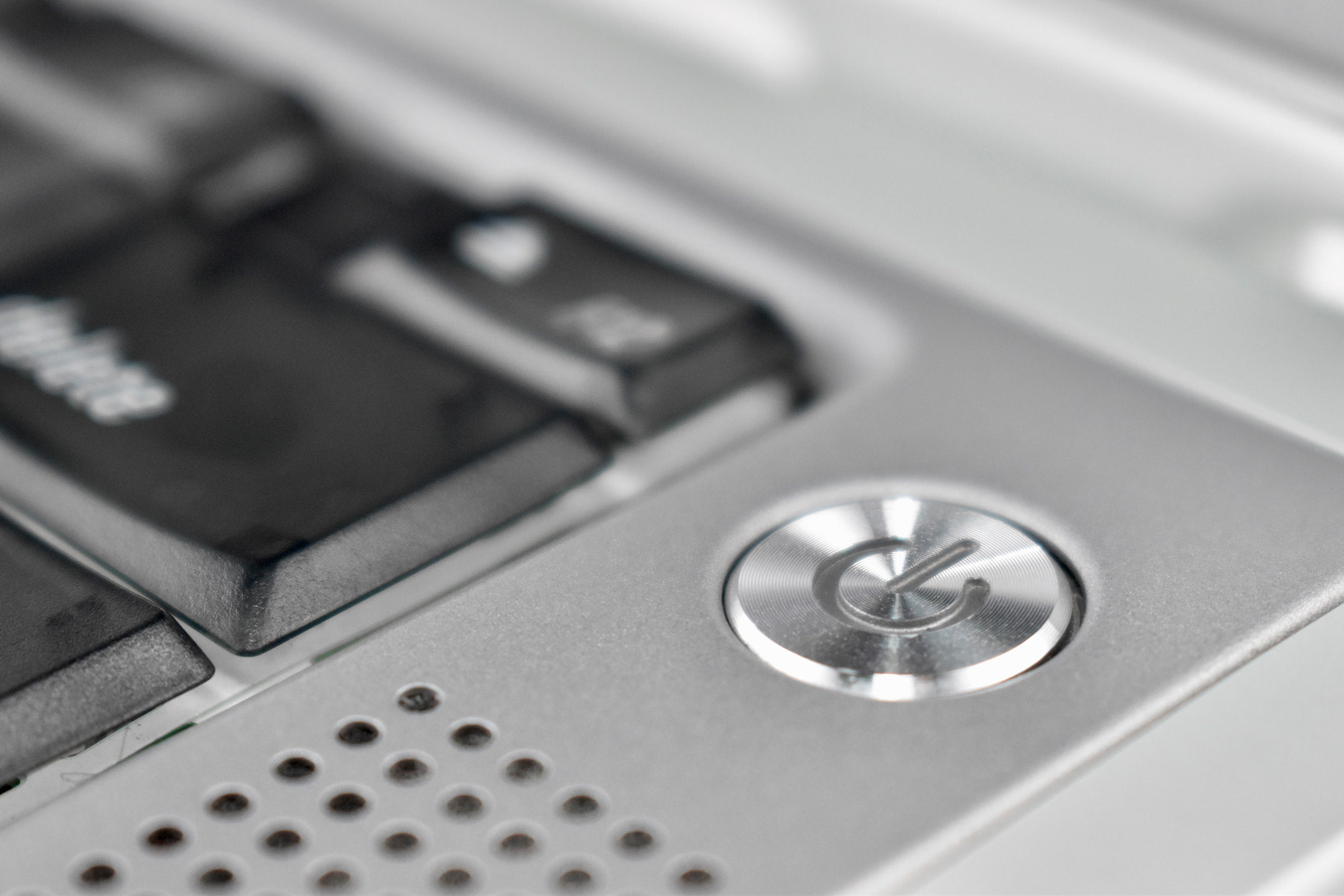
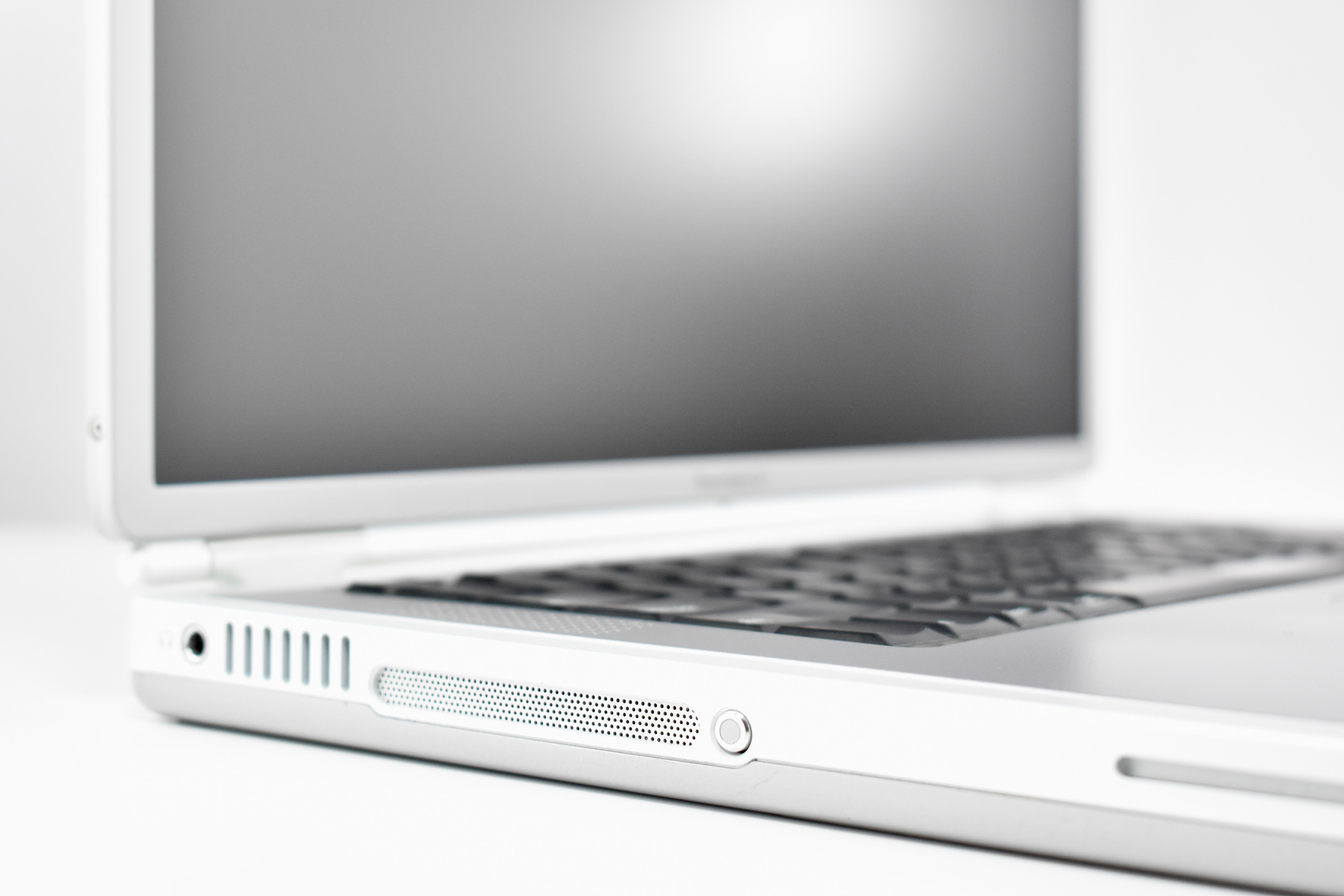
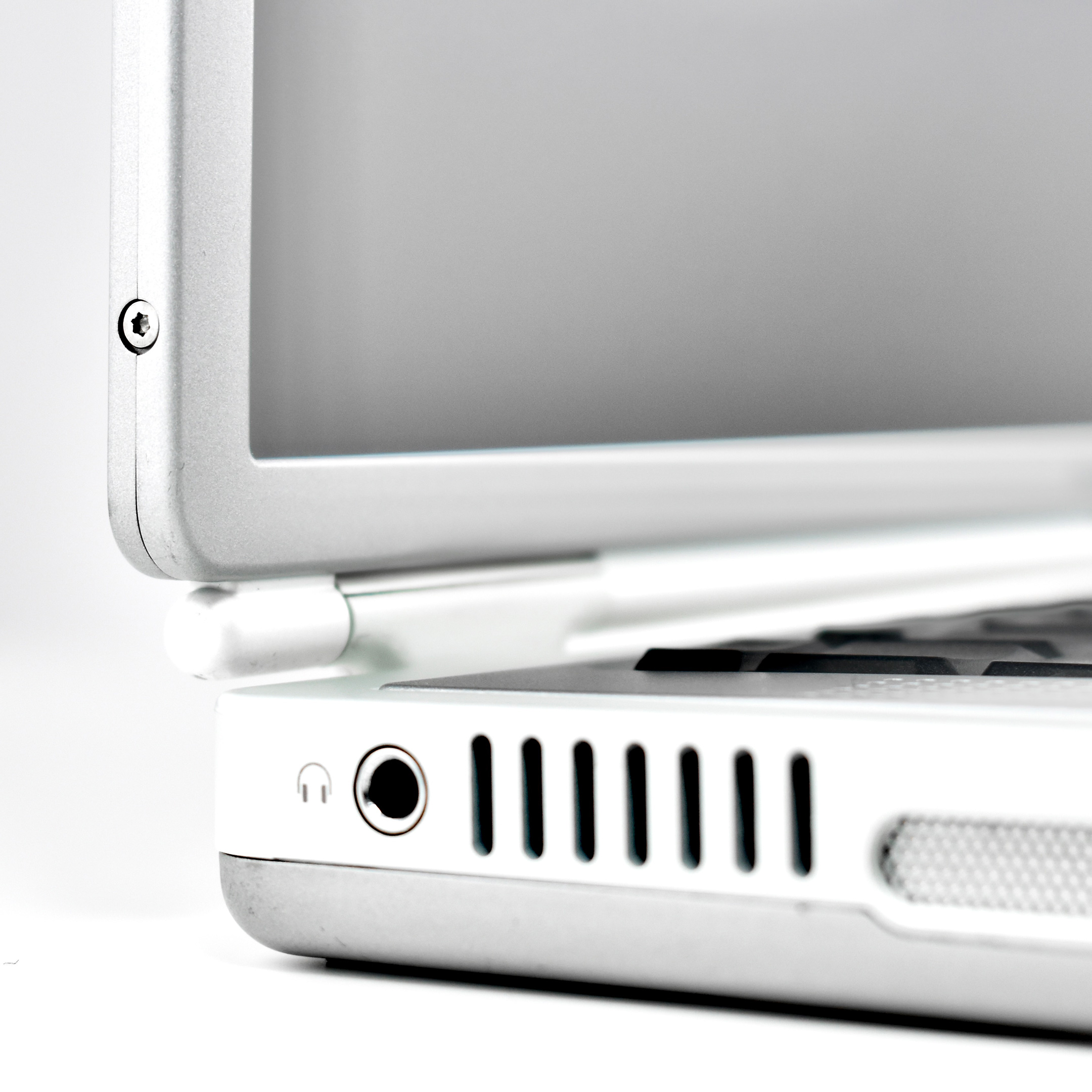
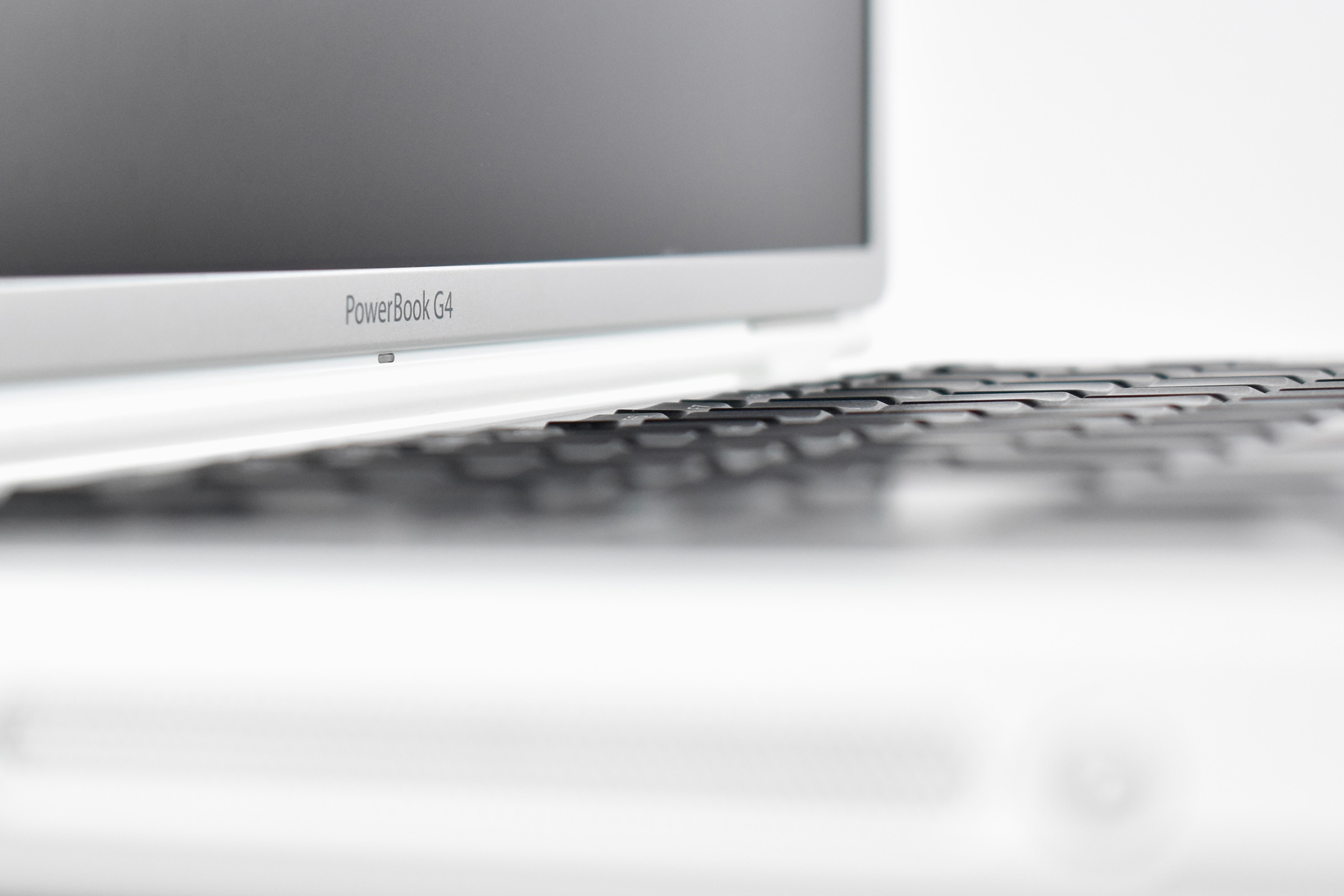
PowerBook G4 (Titanium, 867MHz, 2002)

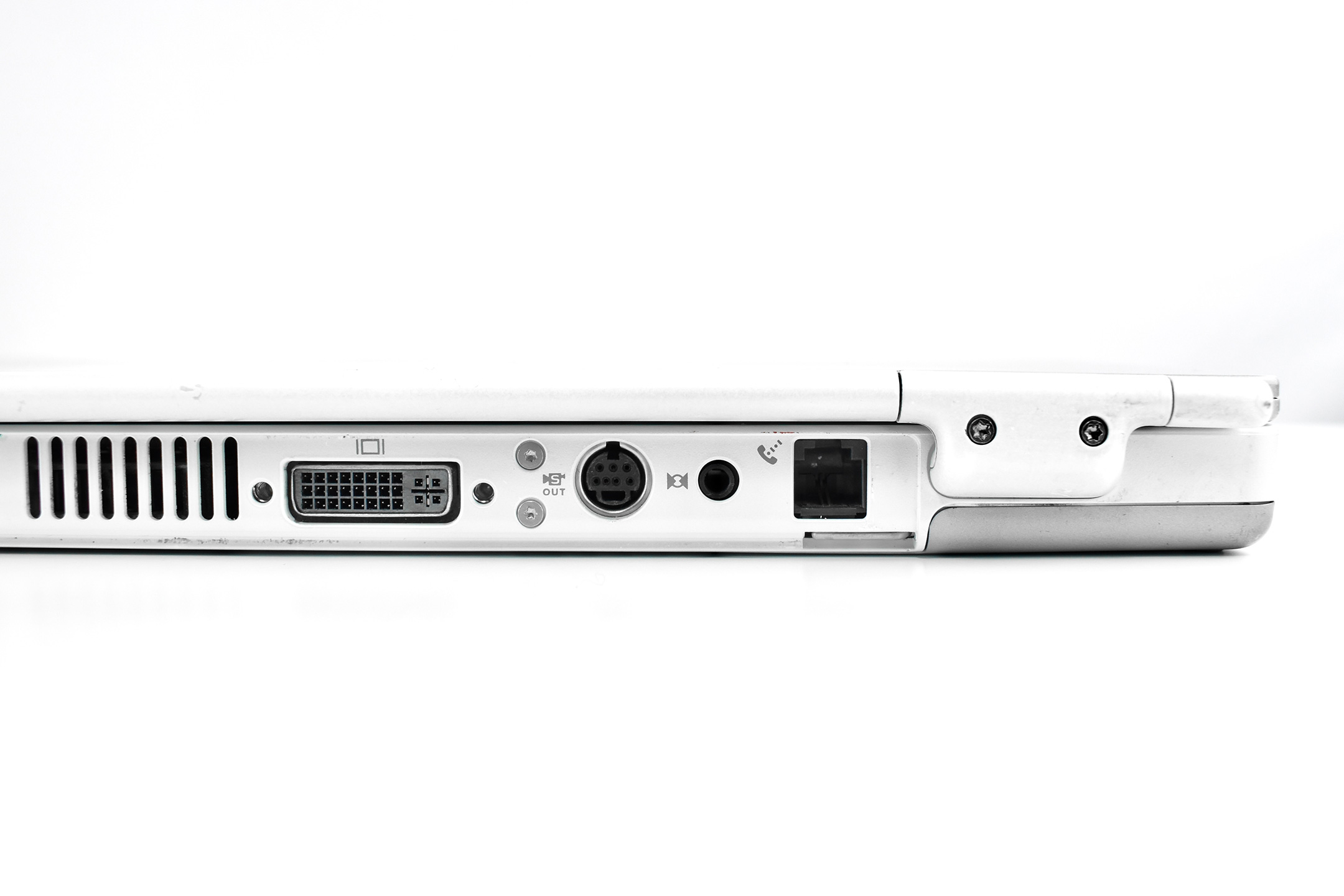
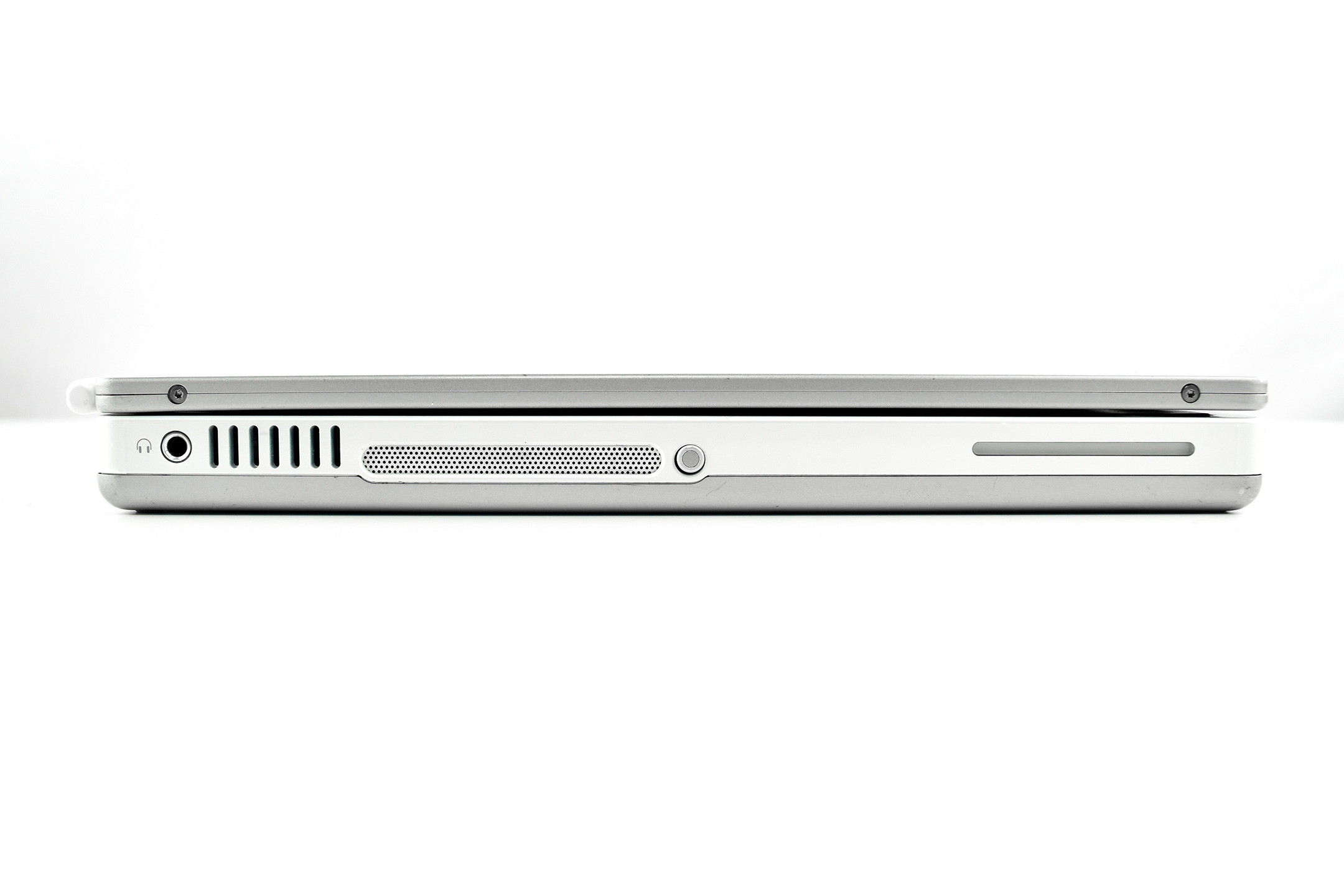
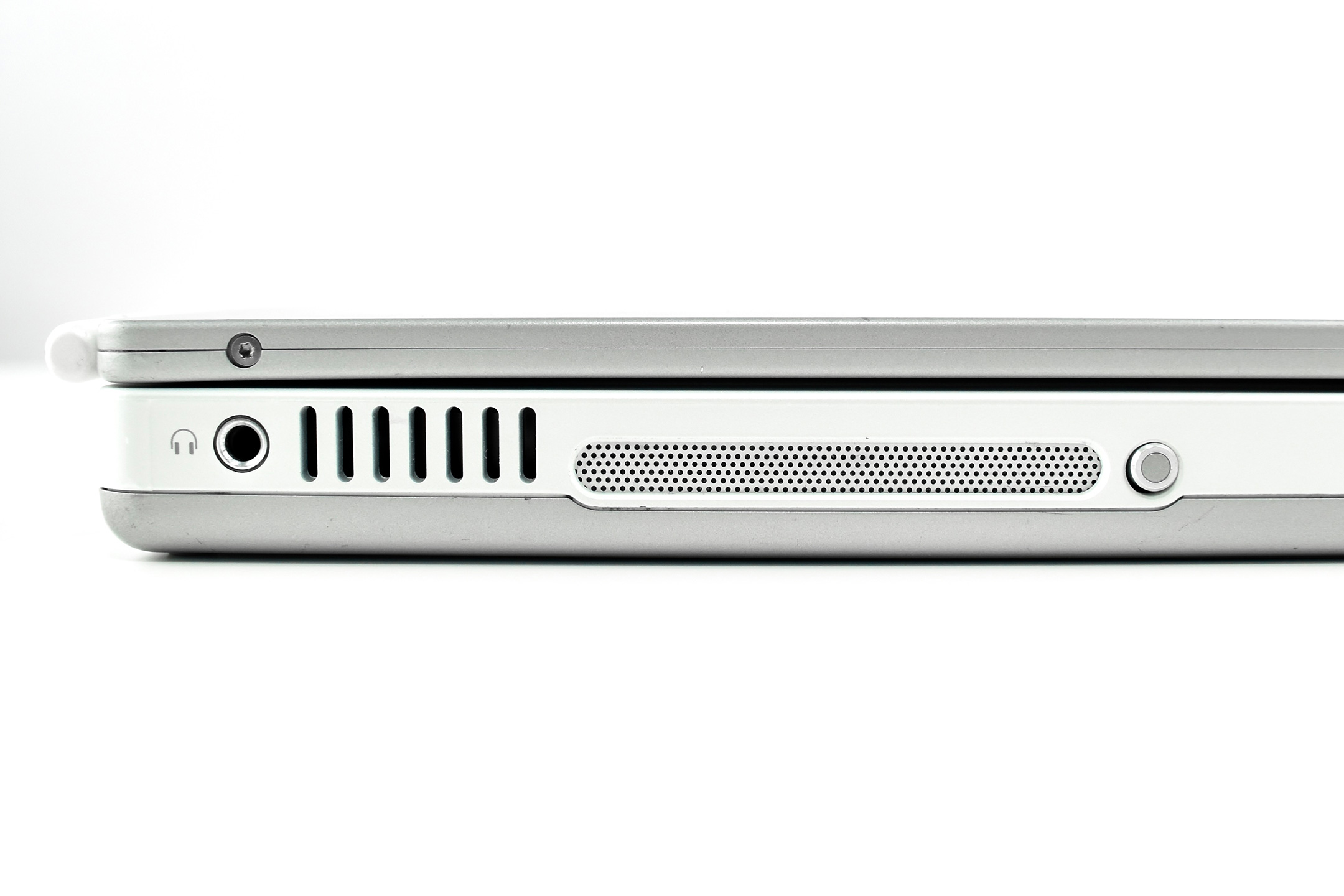
The Titanium PowerBook G4 with DVD burning SuperDrive was introduced on November 6, 2002. The laptop had the industry’s first slot-loading SuperDrive optical drive that allowed reading and burning both CDs and DVDs. It included integrated 802.11 wireless networking and the fastest mobile graphics processor until that time (ATI Mobility Radeon 9000). It weighed 5.4 pounds in a 1-inch-thick Titanium enclosure with a widescreen 15.2-inch display.

Apple touted the Titanium PowerBook G4’s speed as equal to or faster than desktop computers of the time:
“Combined with the power of Apple’s UNIX-based Mac OS X version 10.2 ‘Jaguar,’ the new PowerBook G4 runs professional applications including Adobe Photoshop up to 44 percent faster than a 2.2 GHz Pentium 4-based notebook. The fastest PowerBook ever now offers even more incredible 3D graphics performance with the ATI Mobility Radeon 9000 graphics processor featuring up to 64MB of dedicated Double Data Rate (DDR) video SDRAM and advanced capabilities such as programmable pixel and vertex shading for lighting and shadow effects, photorealistic 3D performance and cinematic-quality video.”
This laptop version included a 867MHz G4 processor, 512MB RAM, a 40GB hard drive, 56K modem, and AirPort wireless networking. The Apple model number is A1025. When released, it was “aggressively priced at only $2,299.”

A LoweEndMac review noted that this PowerBook now offered “Closed Lid Mode,” and described the feature:

“TiBooks support ‘lid closed’ (or clamshell) mode, which leaves the built-in display off and dedicates all video RAM to an external display.” The same website indicates that this laptop was also nicknamed the “TiBook,” short for “Titanium PowerBook.”

Sources: Apple (Newsroom), EveryMac, LowEndMac

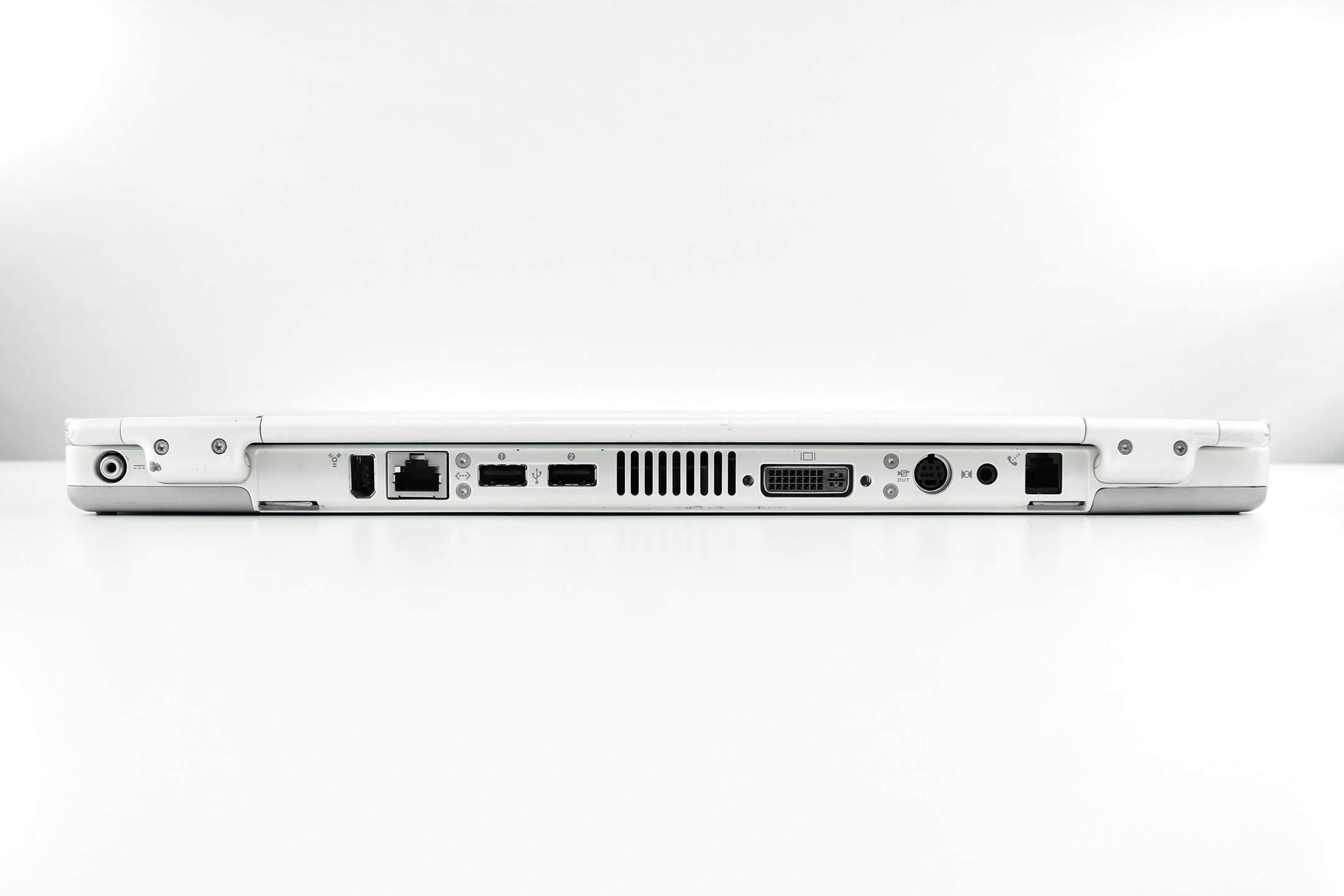
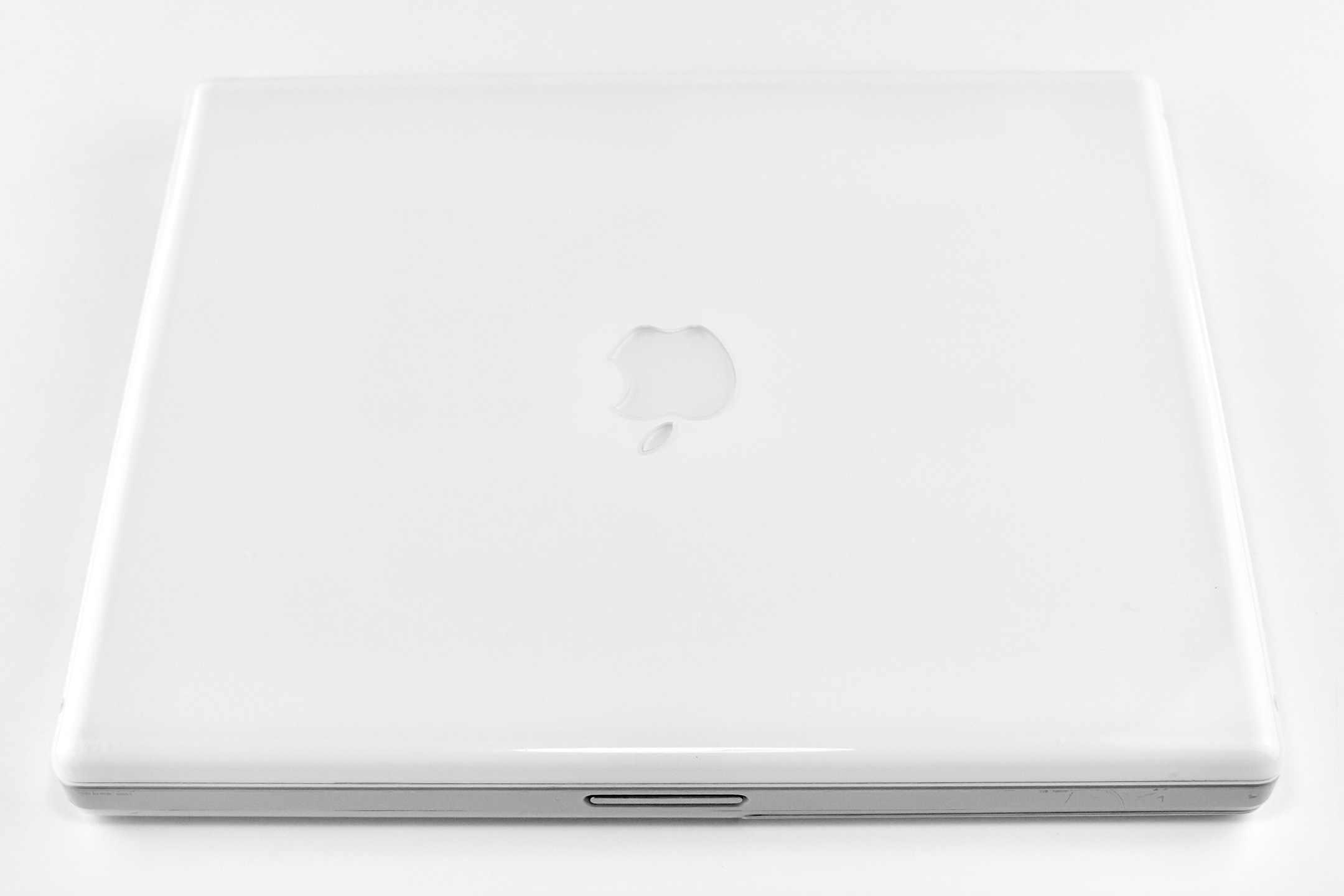
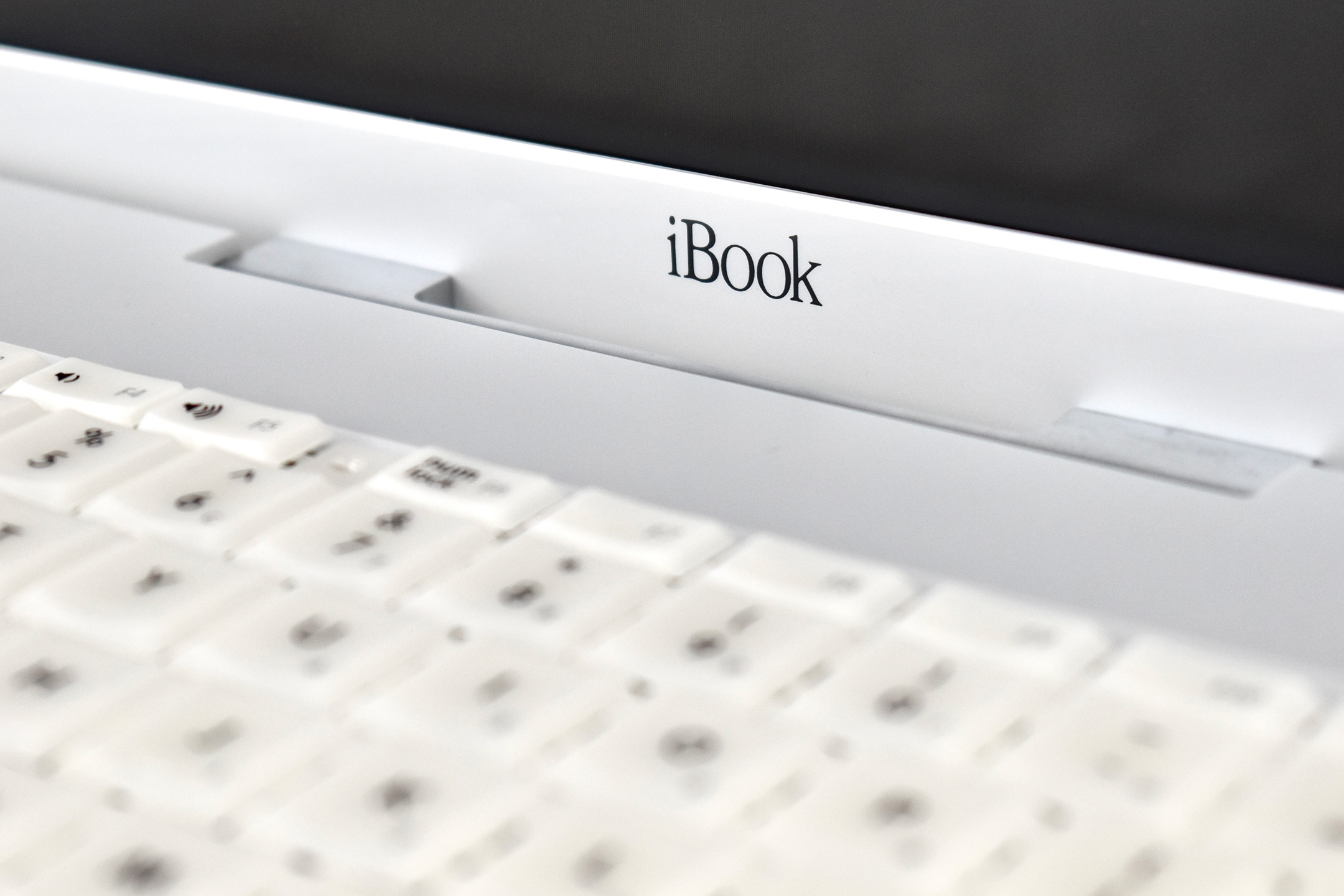
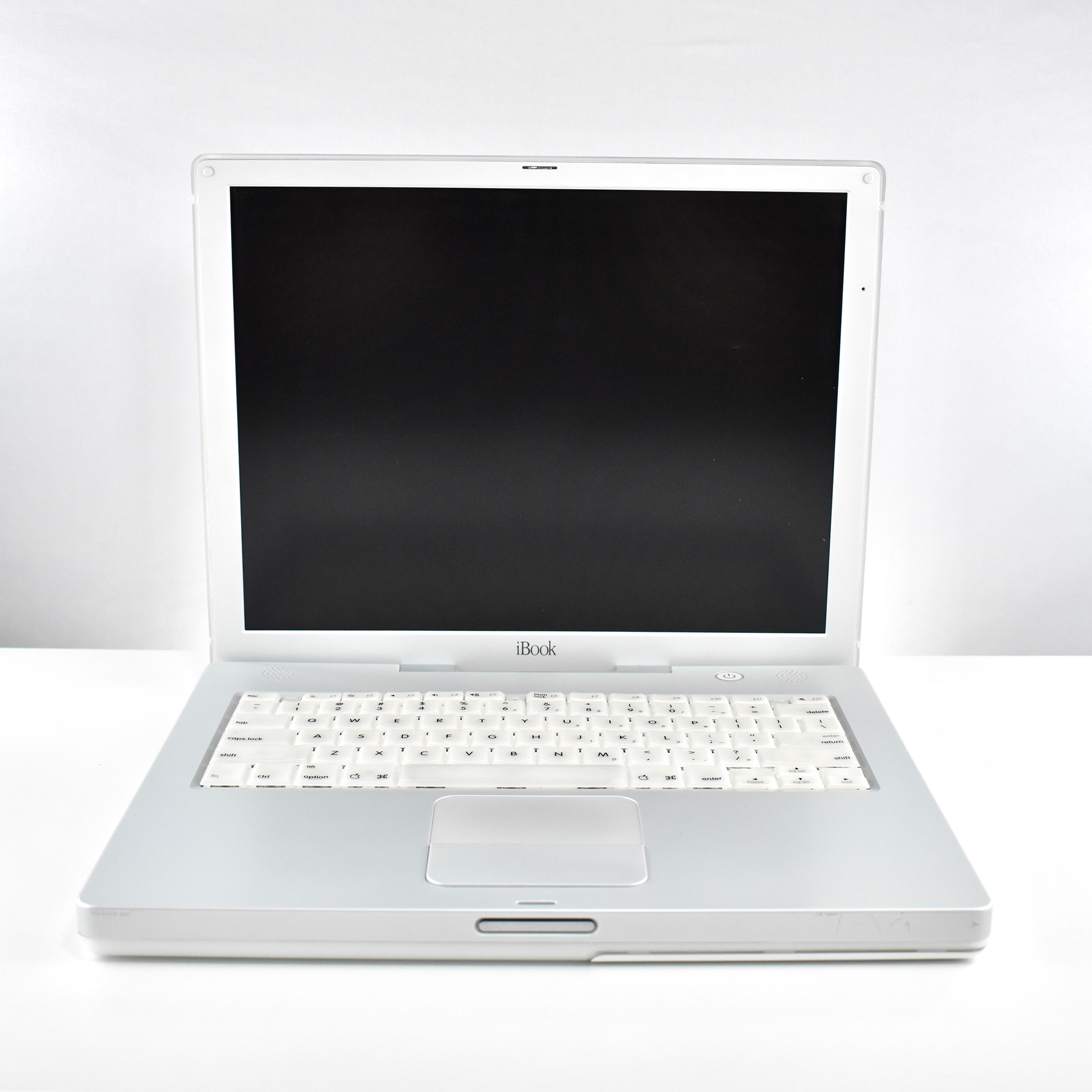
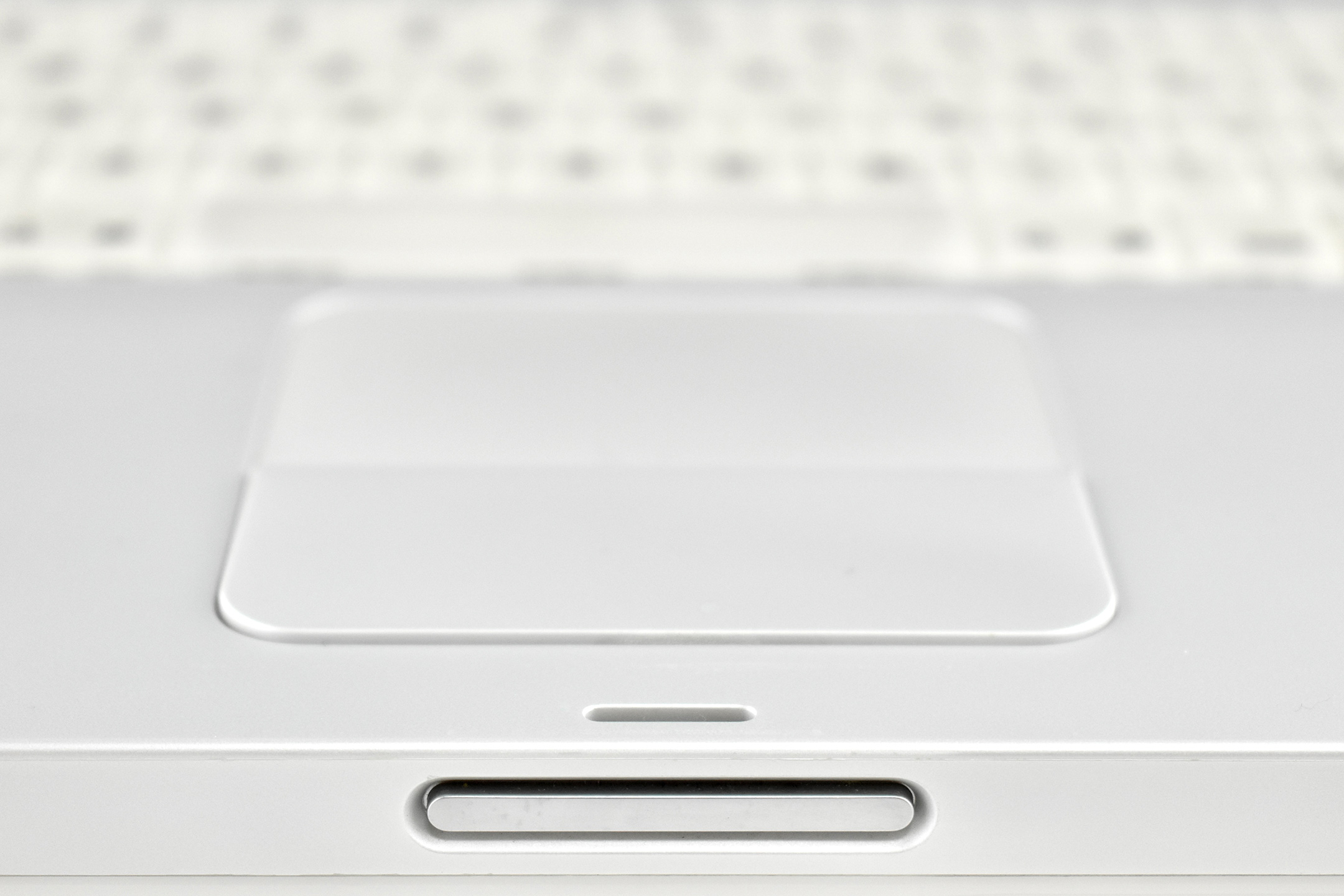
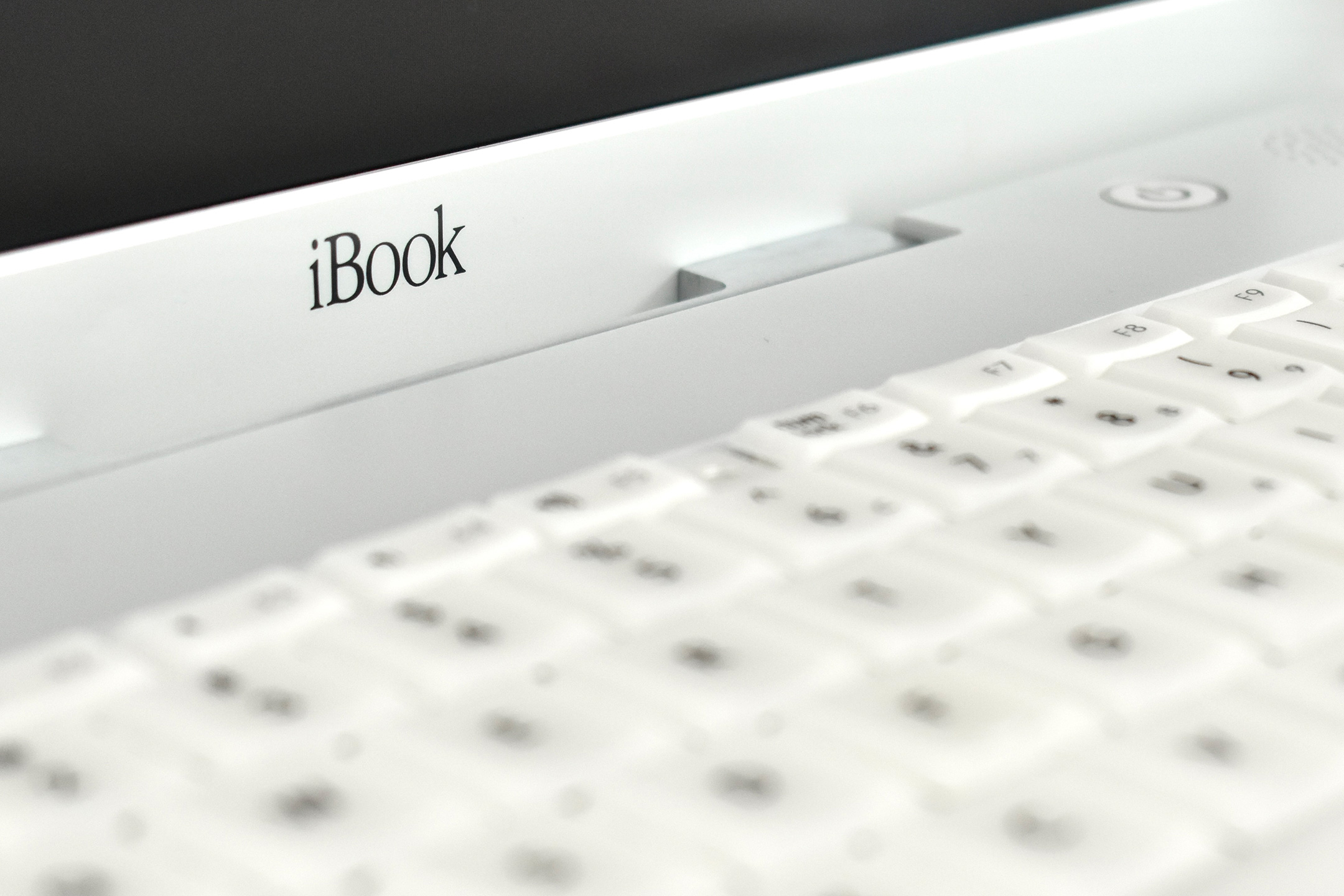
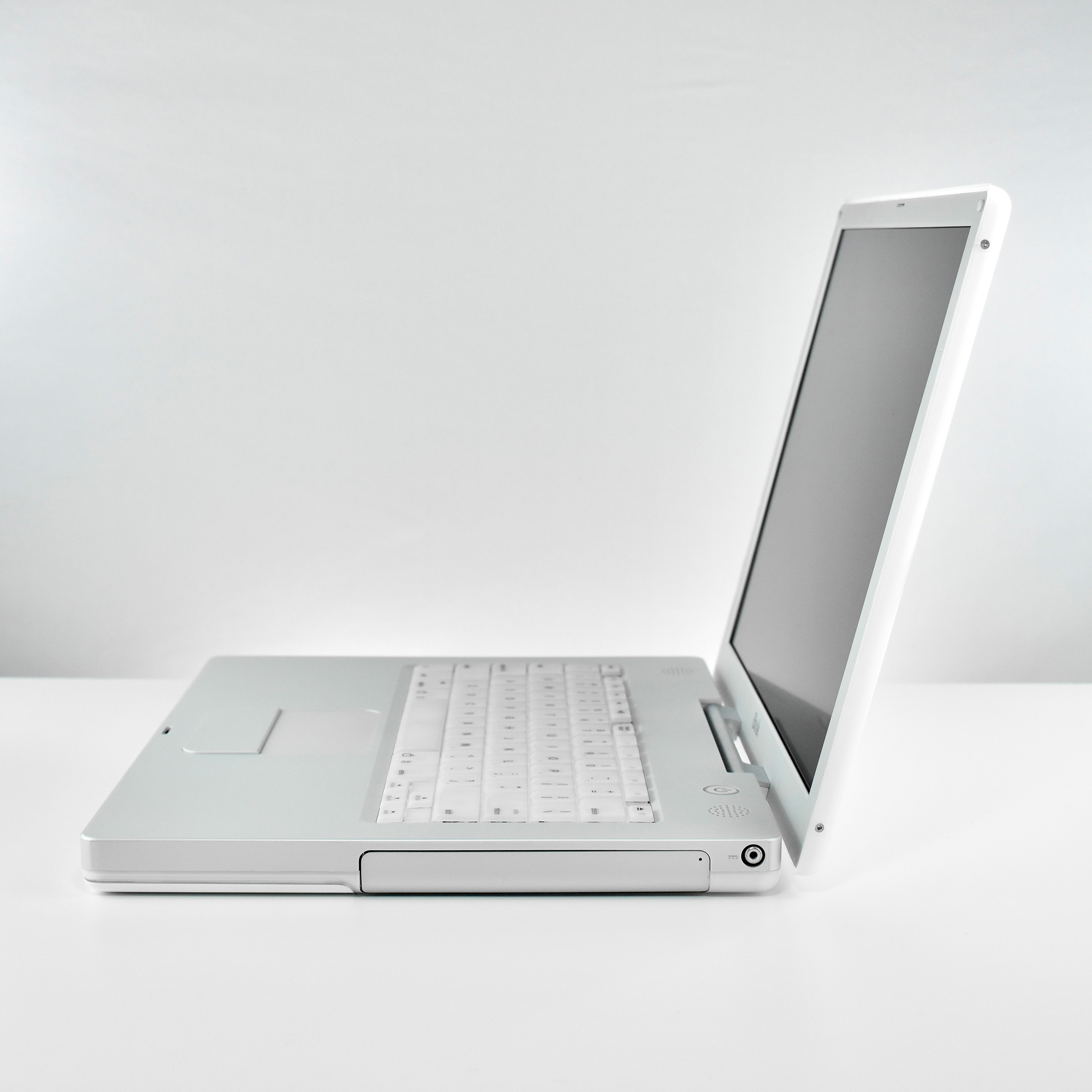
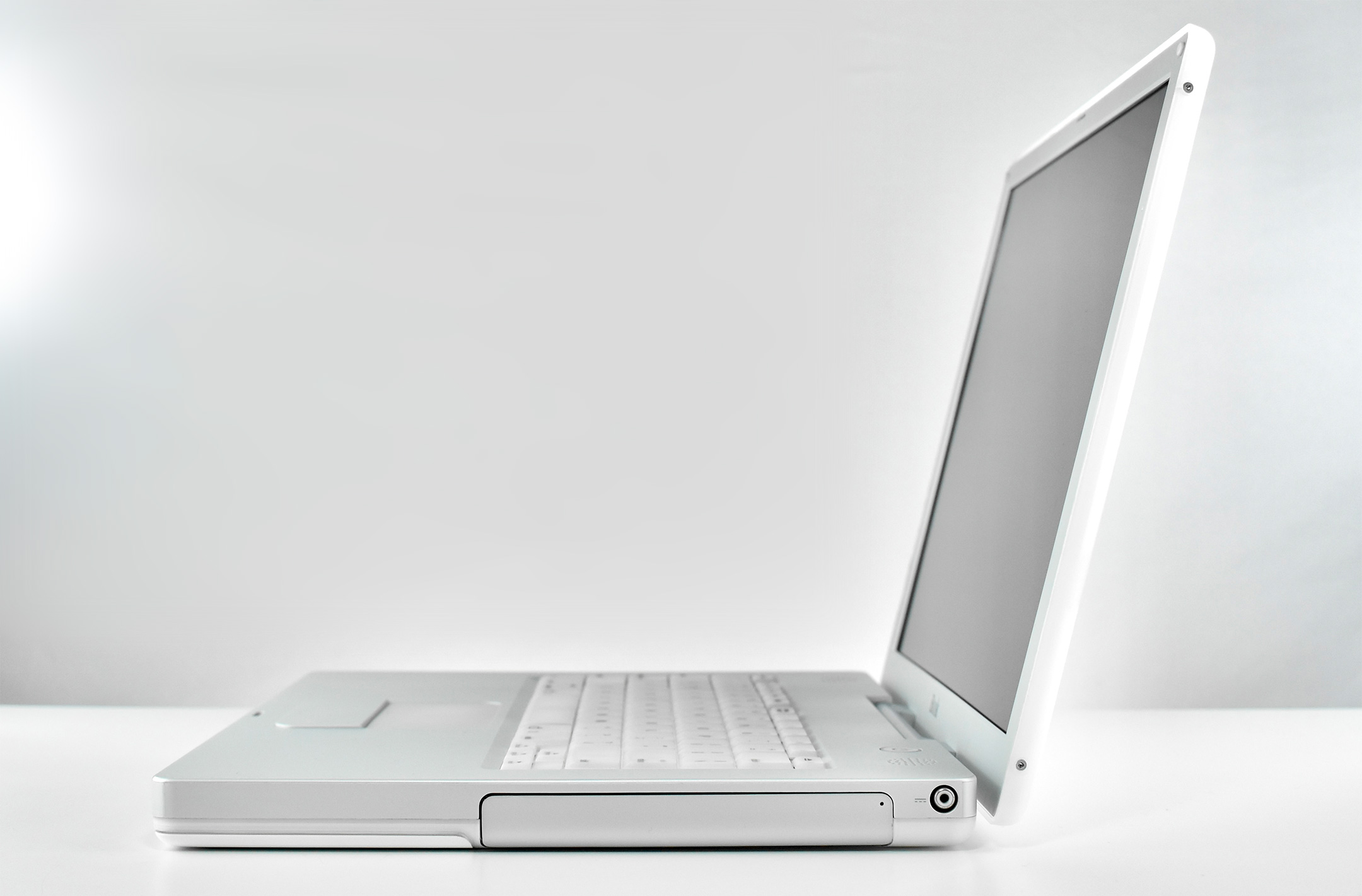
iBook G3 (600MHz, PowerPC 750cx, 14-inch, Early 2002)

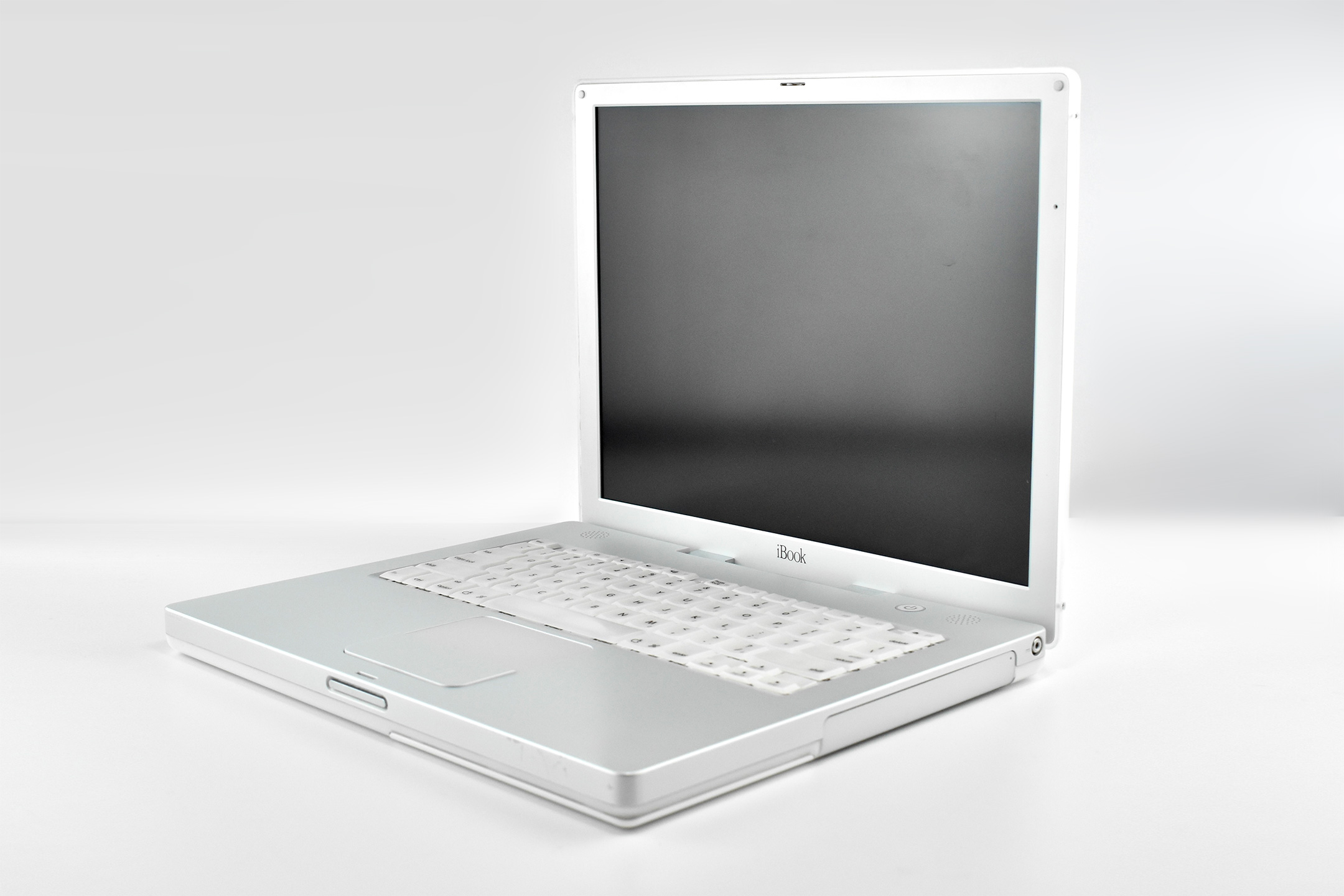
This 14-inch iBook was announced at the January 7, 2002, Macworld Expo in San Francisco, CA, as Apple’s “top end of its hugely popular iBook line of consumer notebooks.” Phil Schiller, Apple’s vice president of Worldwide Product Marketing at the time, noted that “The iBook is the best consumer and education notebook on the market and our most popular portable ever.” Schiller added, “The new iBook line now offers customers the additional choice of a 14-inch display and is more affordable than ever.”

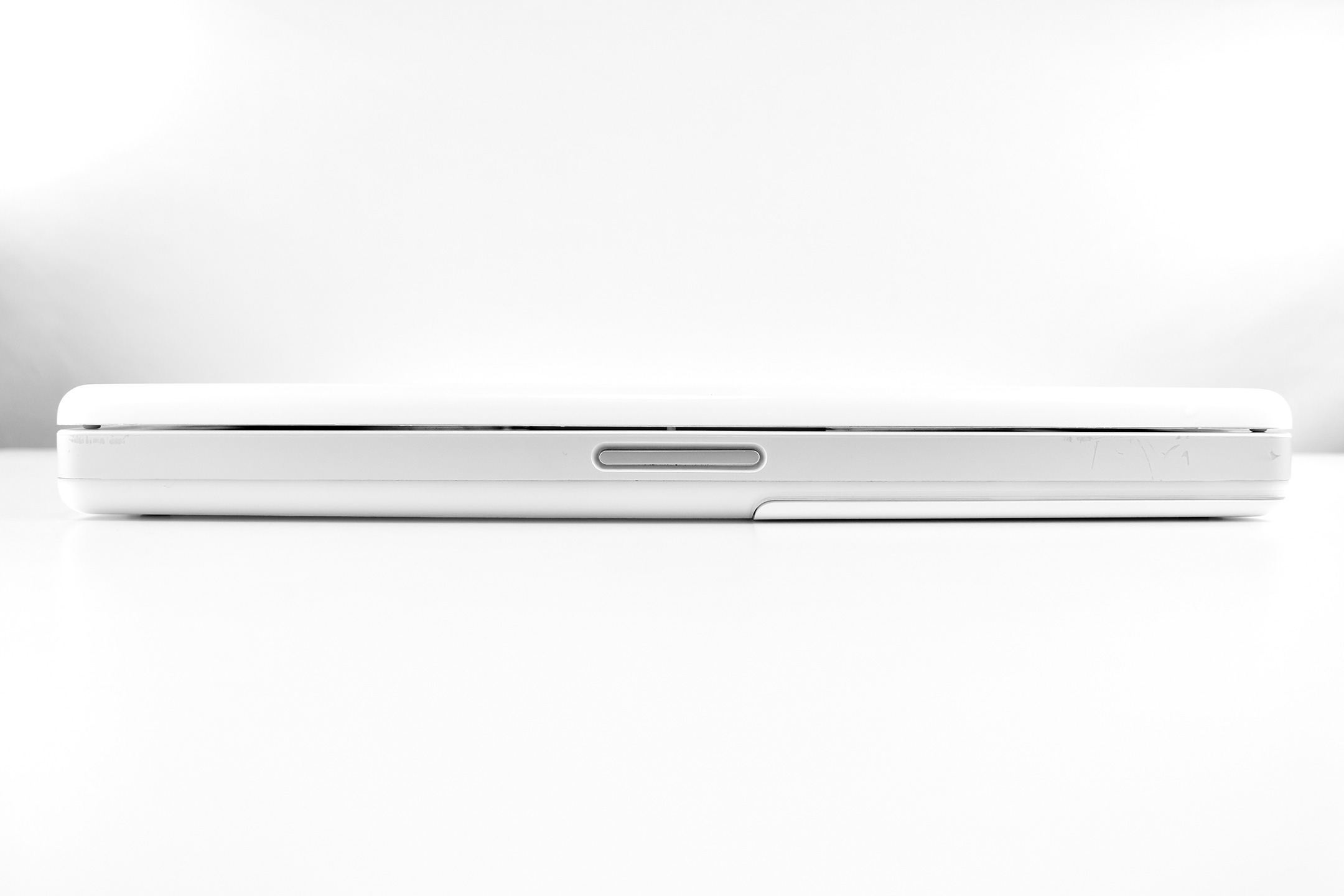
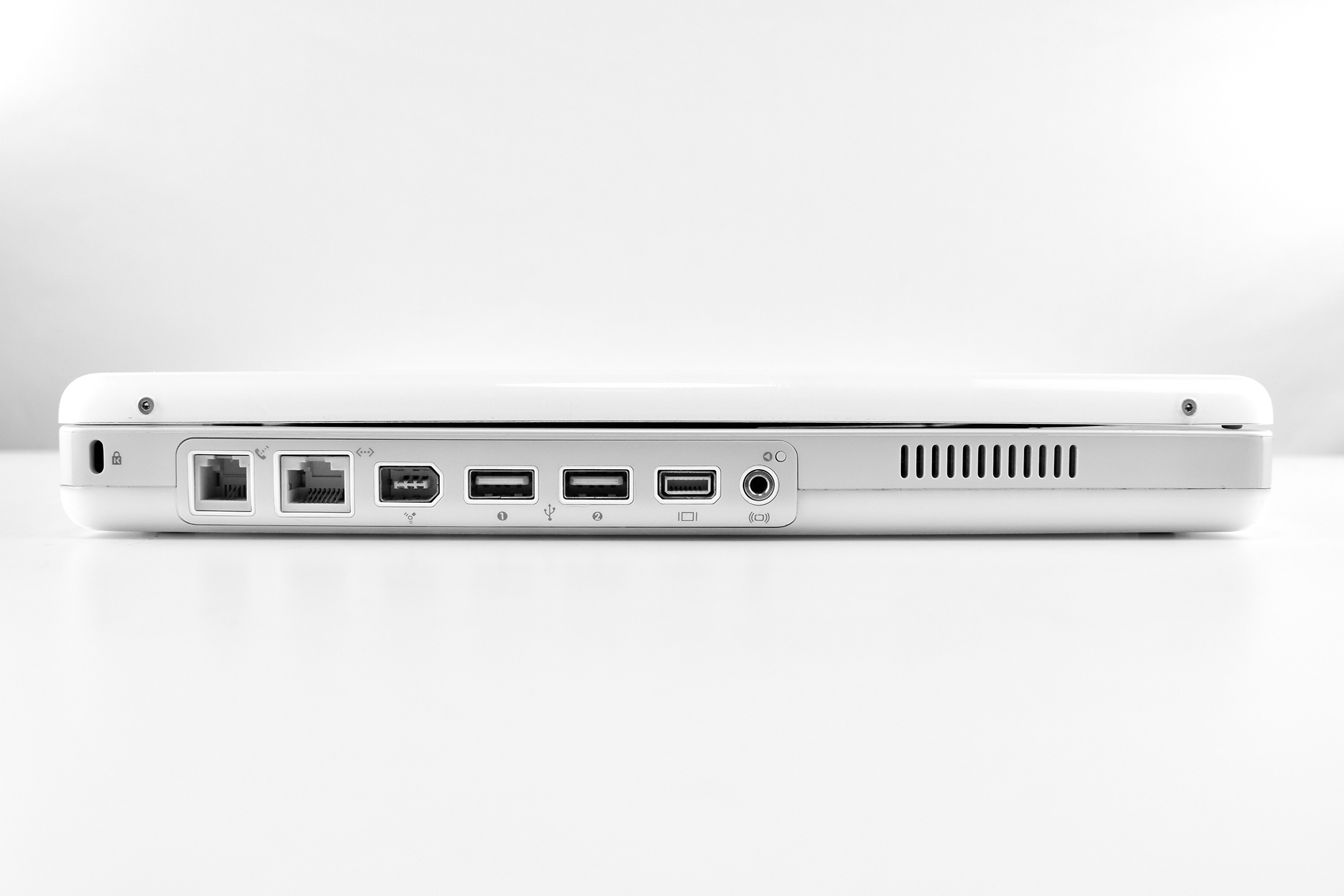
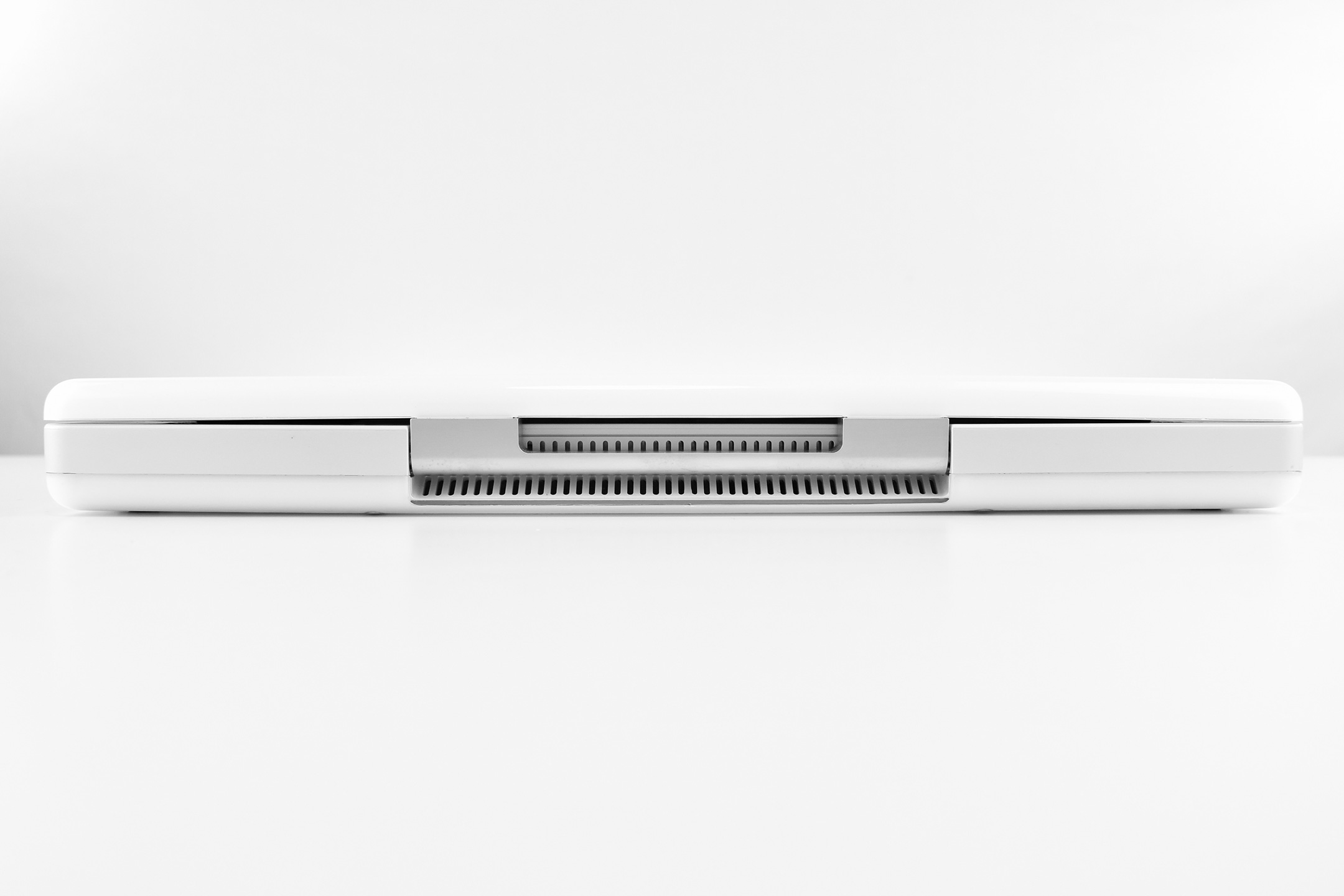
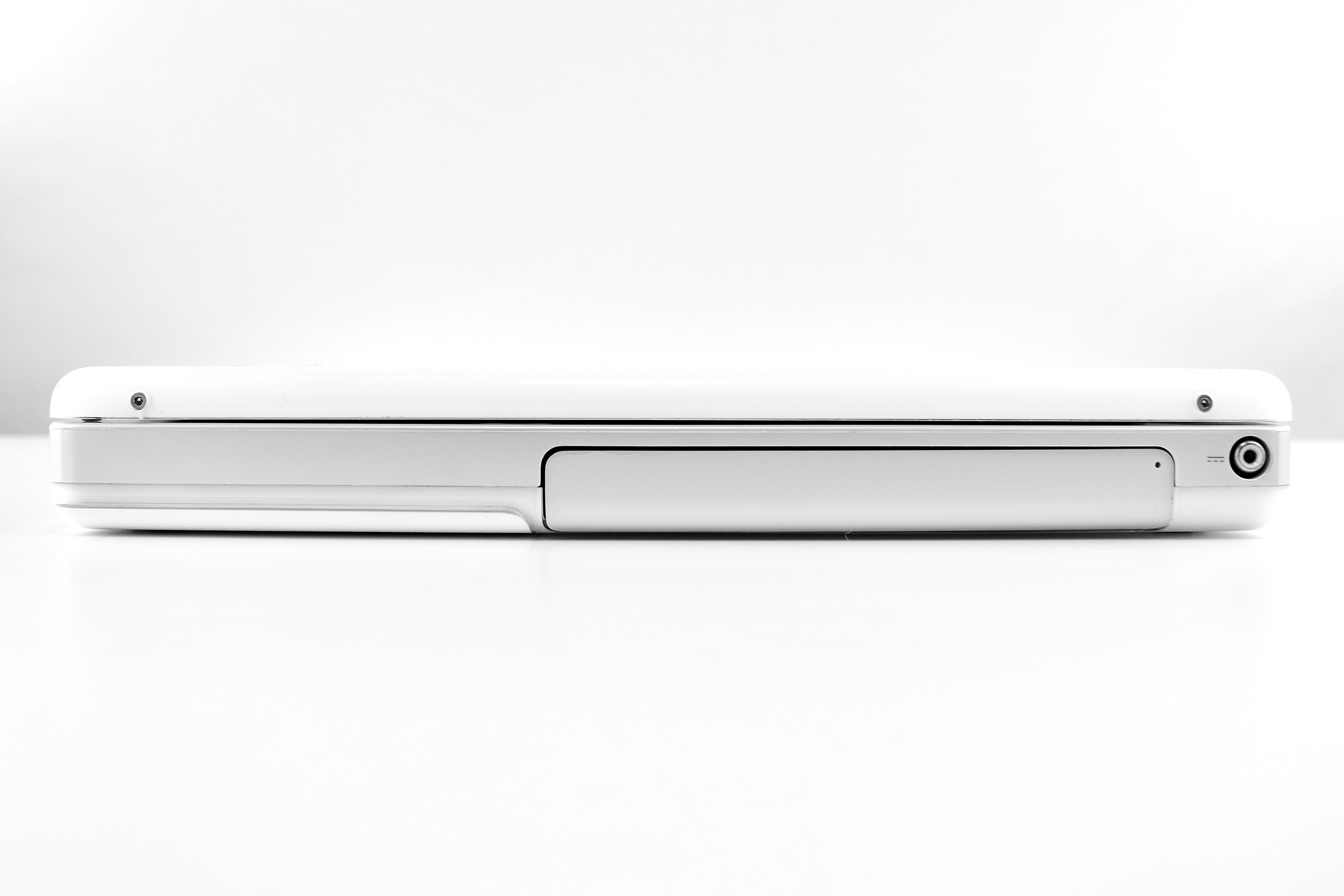
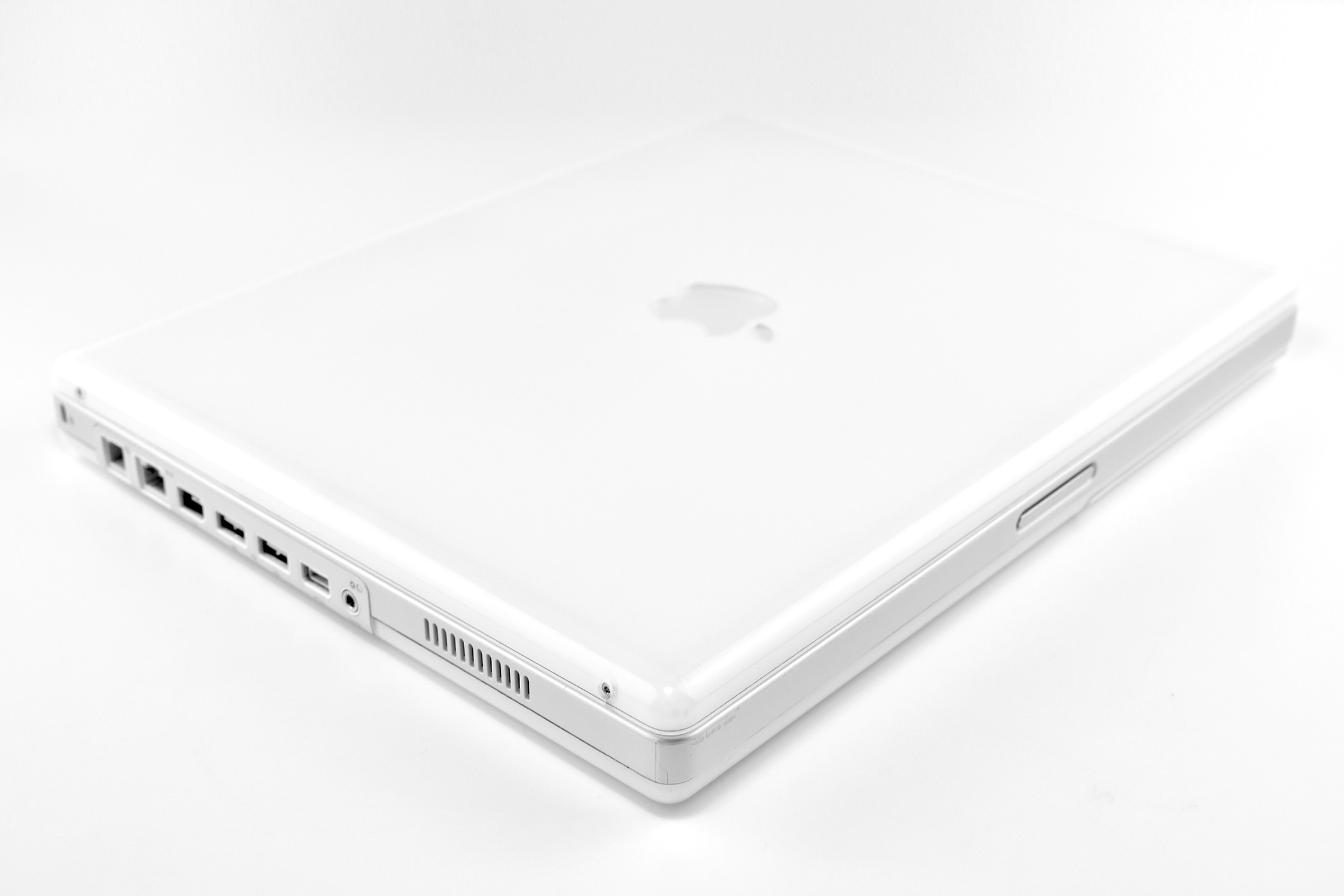
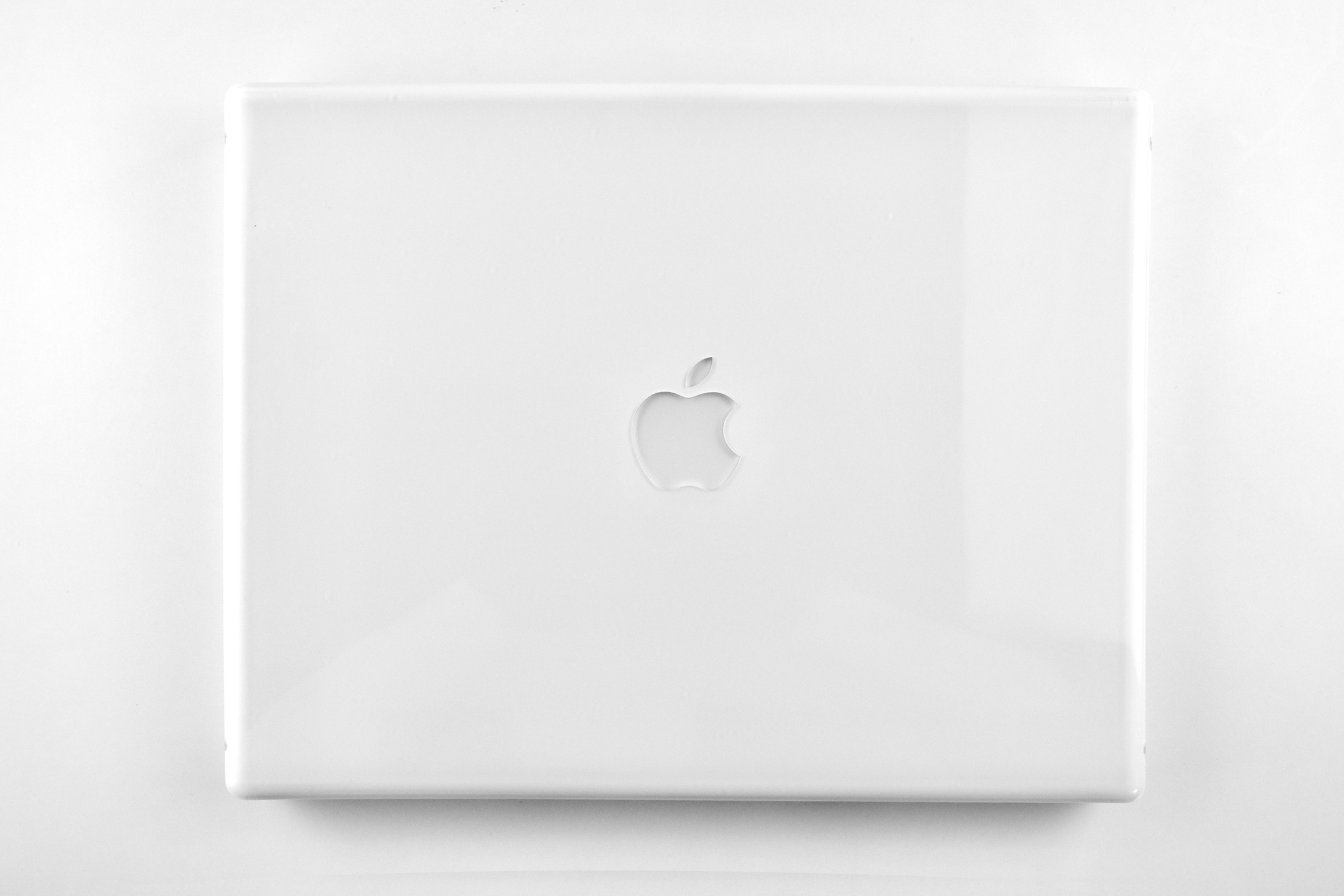
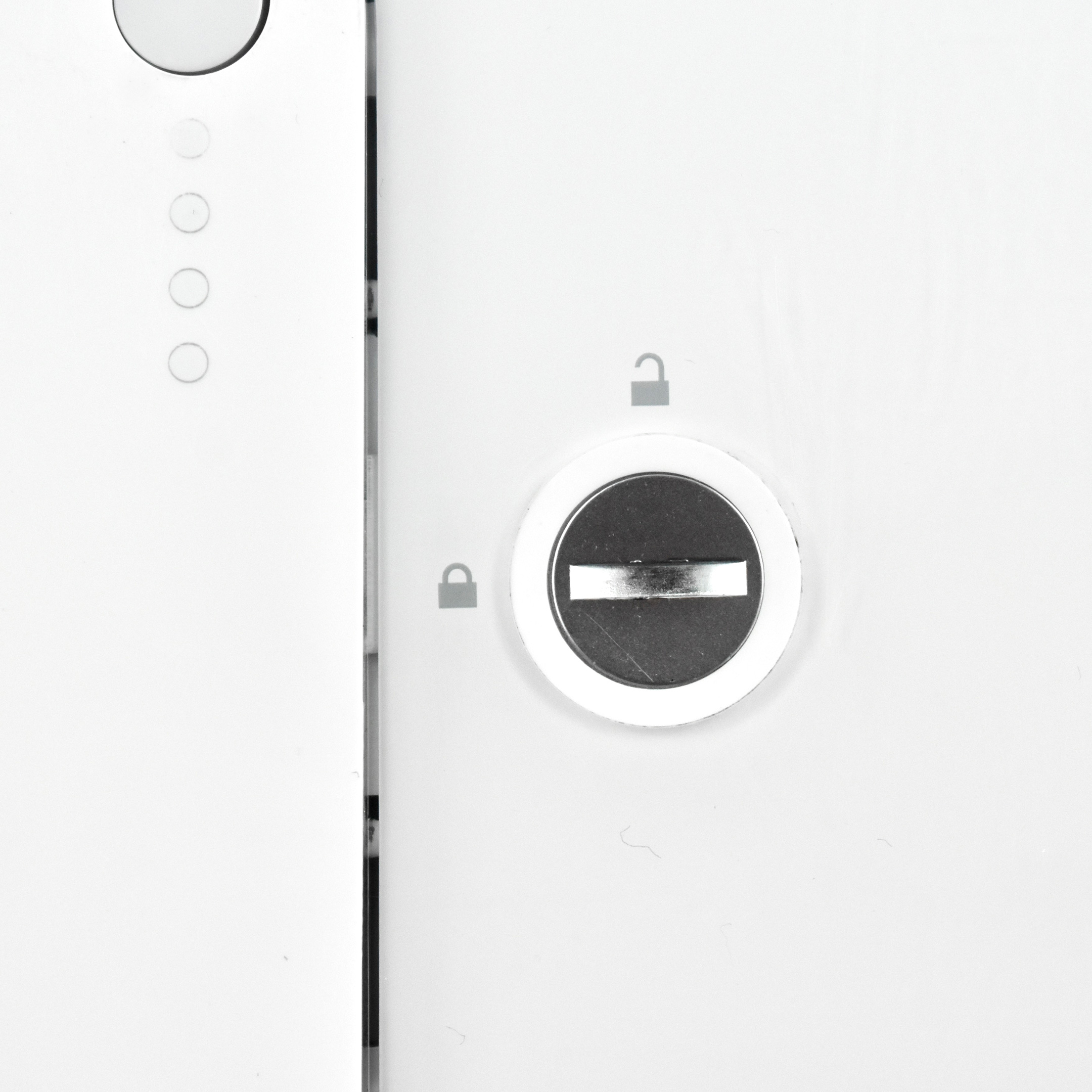
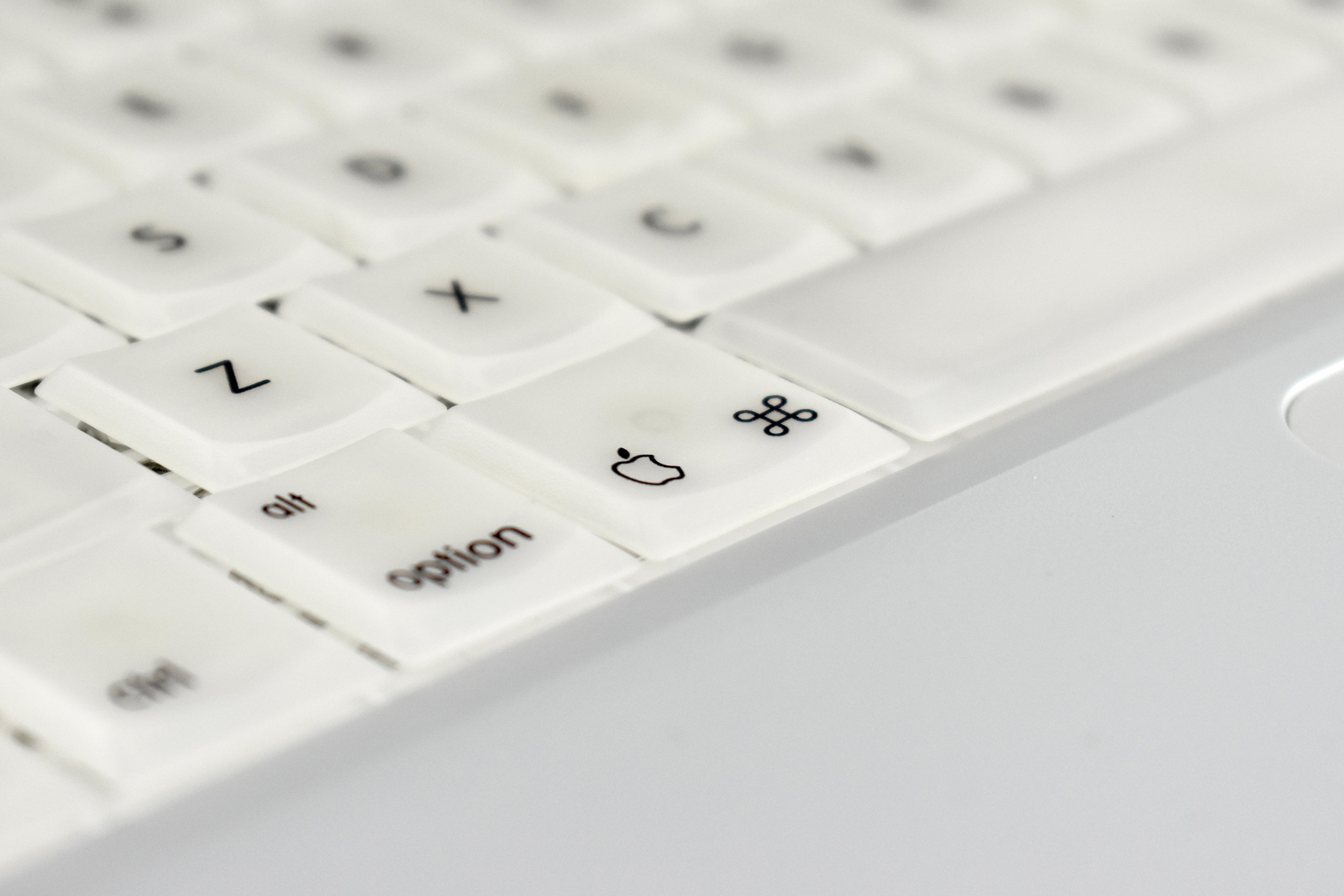
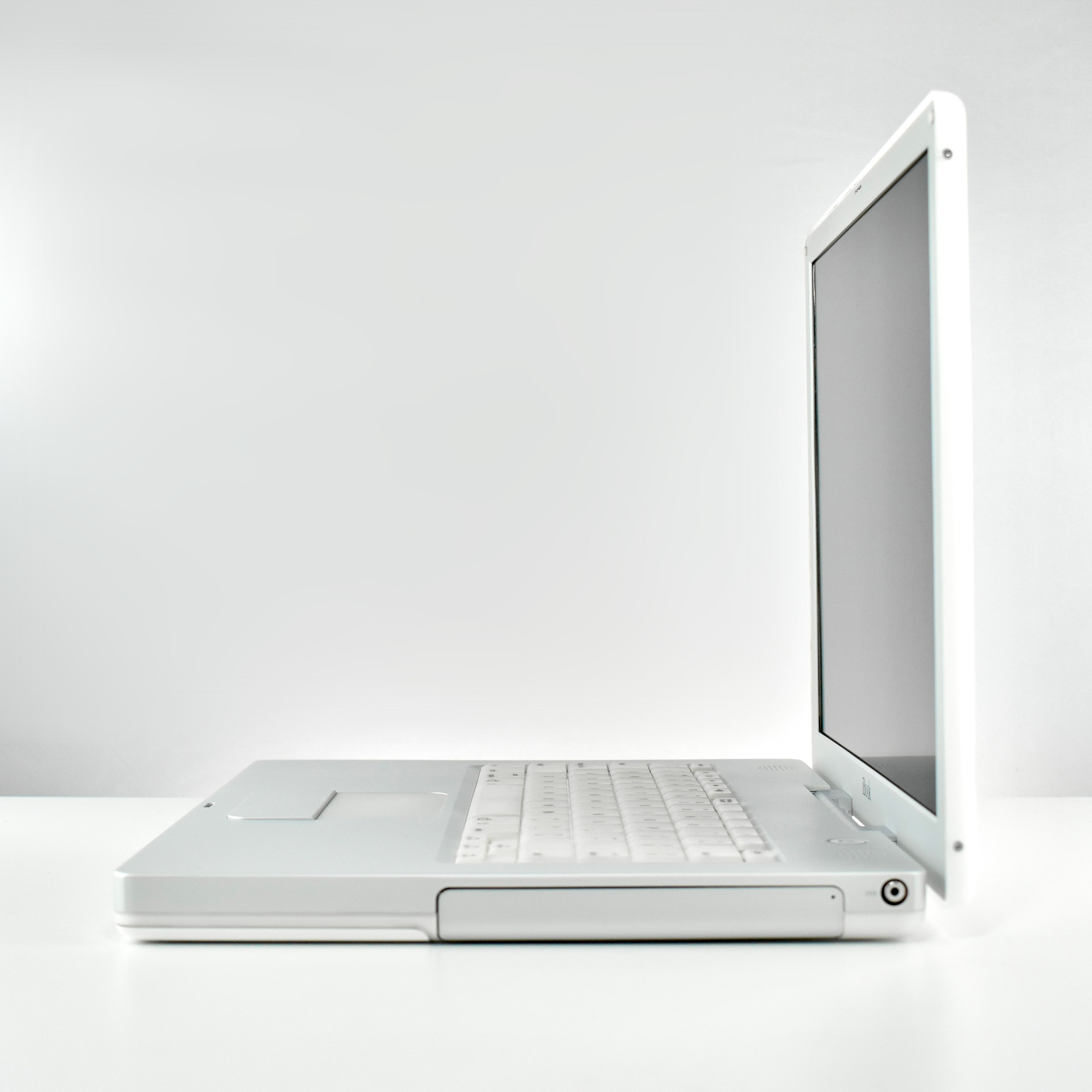
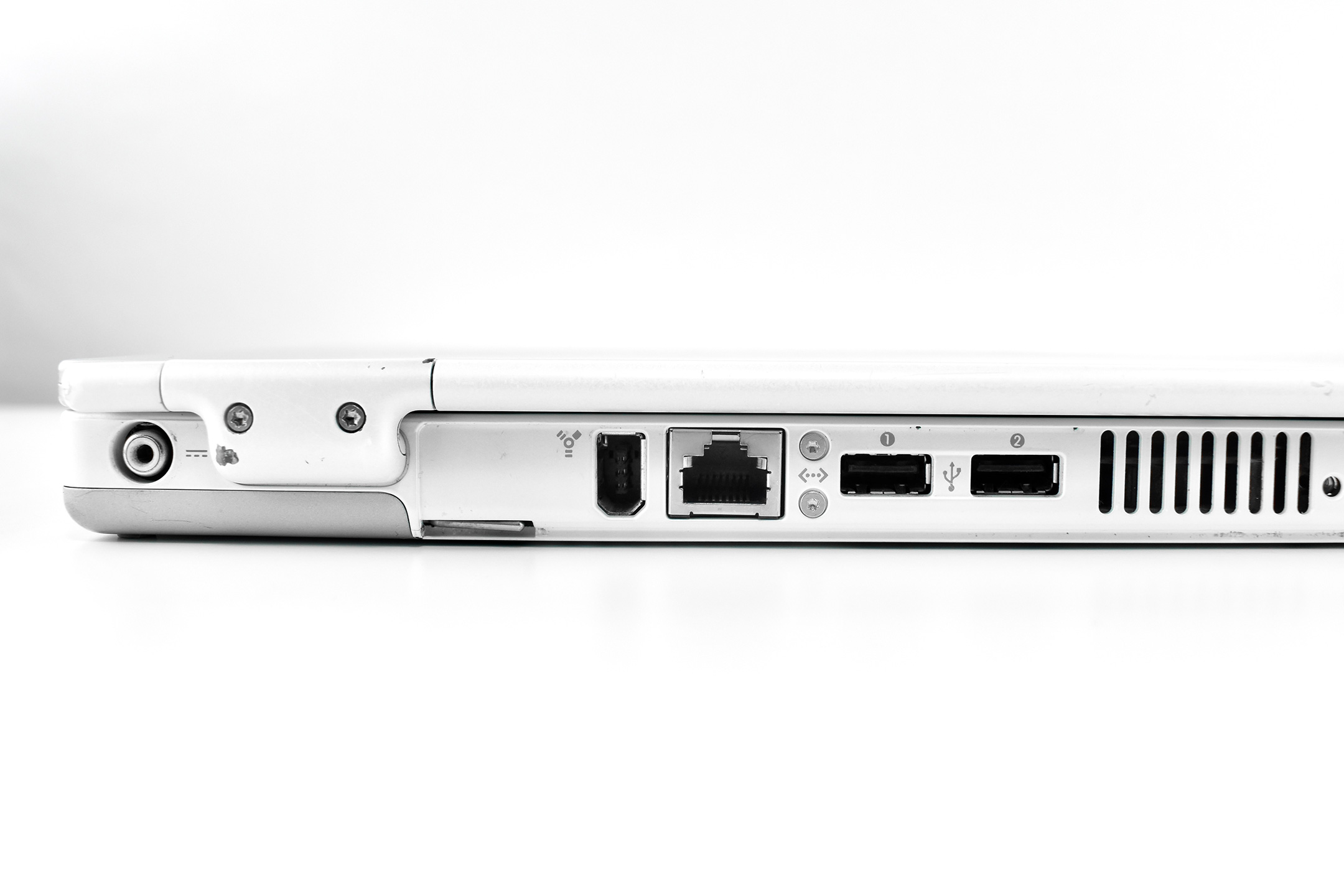
The iBook G3 14-inch (Early 2002) featured a 600MHz PowerPC 750cx G3 processor. It shipped with 256MB RAM, a 20GB hard drive, and a tray-loading Combo drive (DVD-ROM/CD-RW). The laptop had a white translucent case made from impact-resistant polycarbonate. The 14.1-inch TFT active matrix display had 1024×768 native resolution.

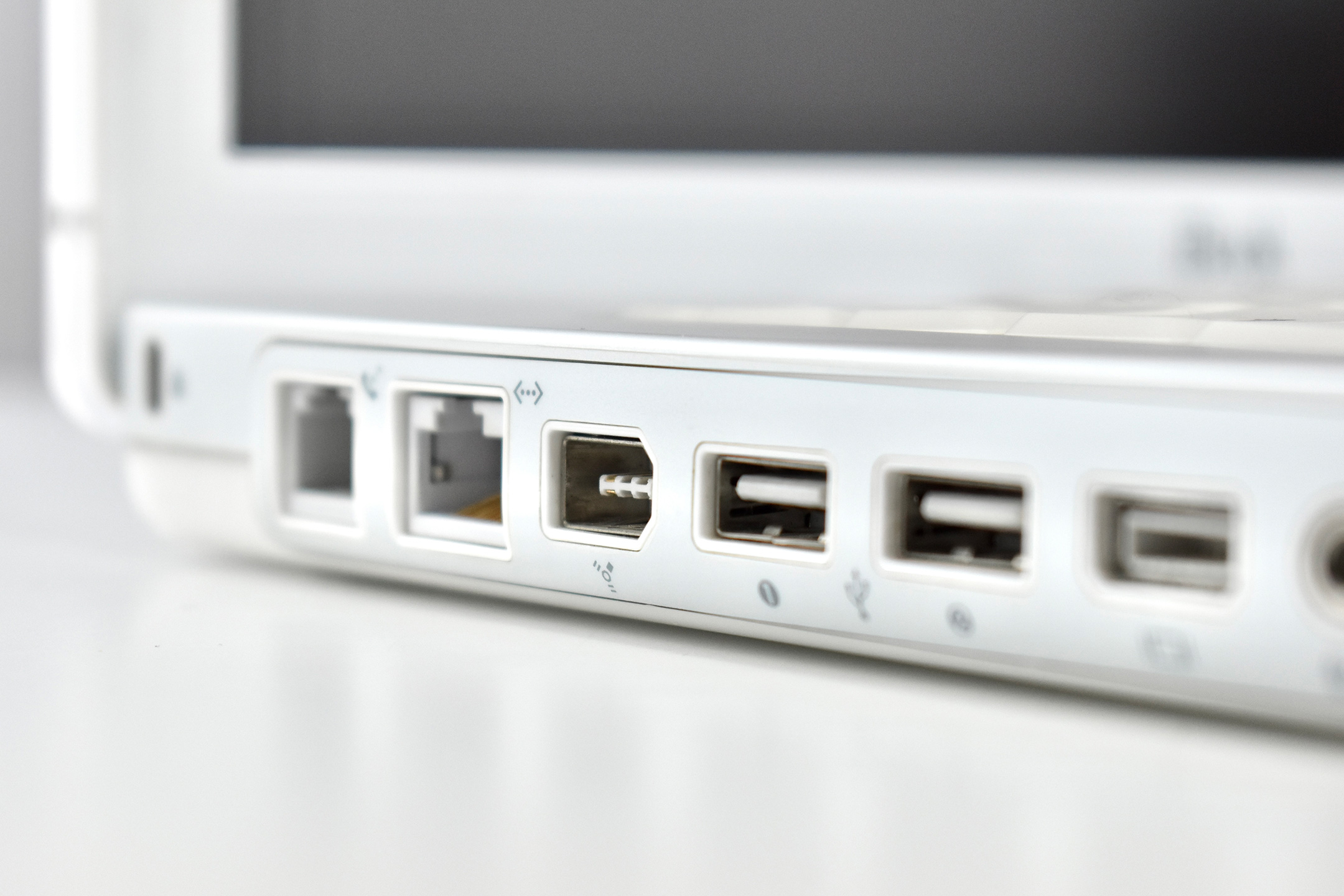
Wired connections included USB, FireWire, 56K modem, 10/100BASE-T Ethernet, and a VGA video-out port. It also allowed an AirPort wireless card to be added. This laptop shipped with Mac OS X version 10.1.2 and Classic Mac OS 9.2.2.

This 600MHz iBook (model M8413) weighed 4.9 pounds and originally sold for $1,499.

Sources: Apple (Newsroom), EveryMac

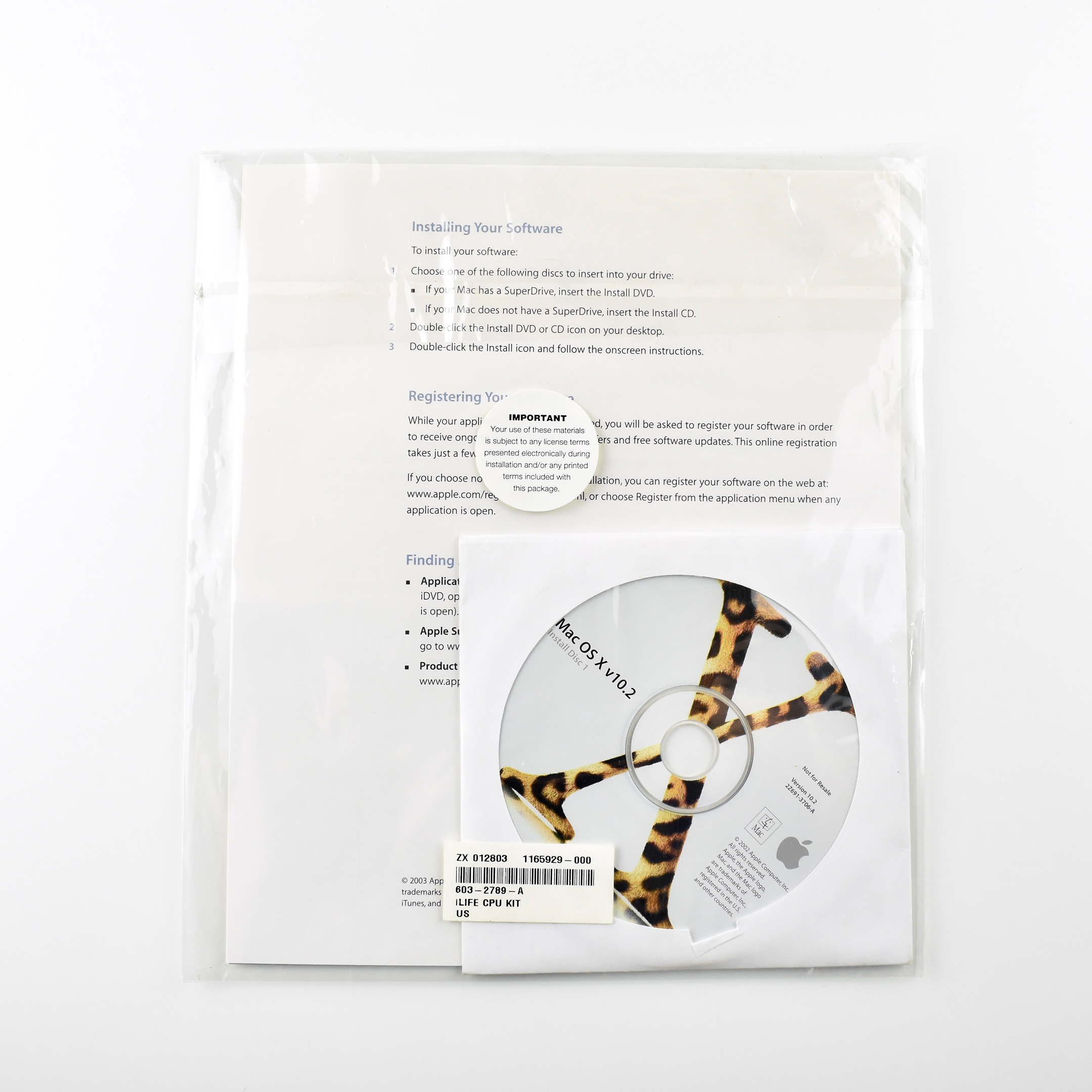
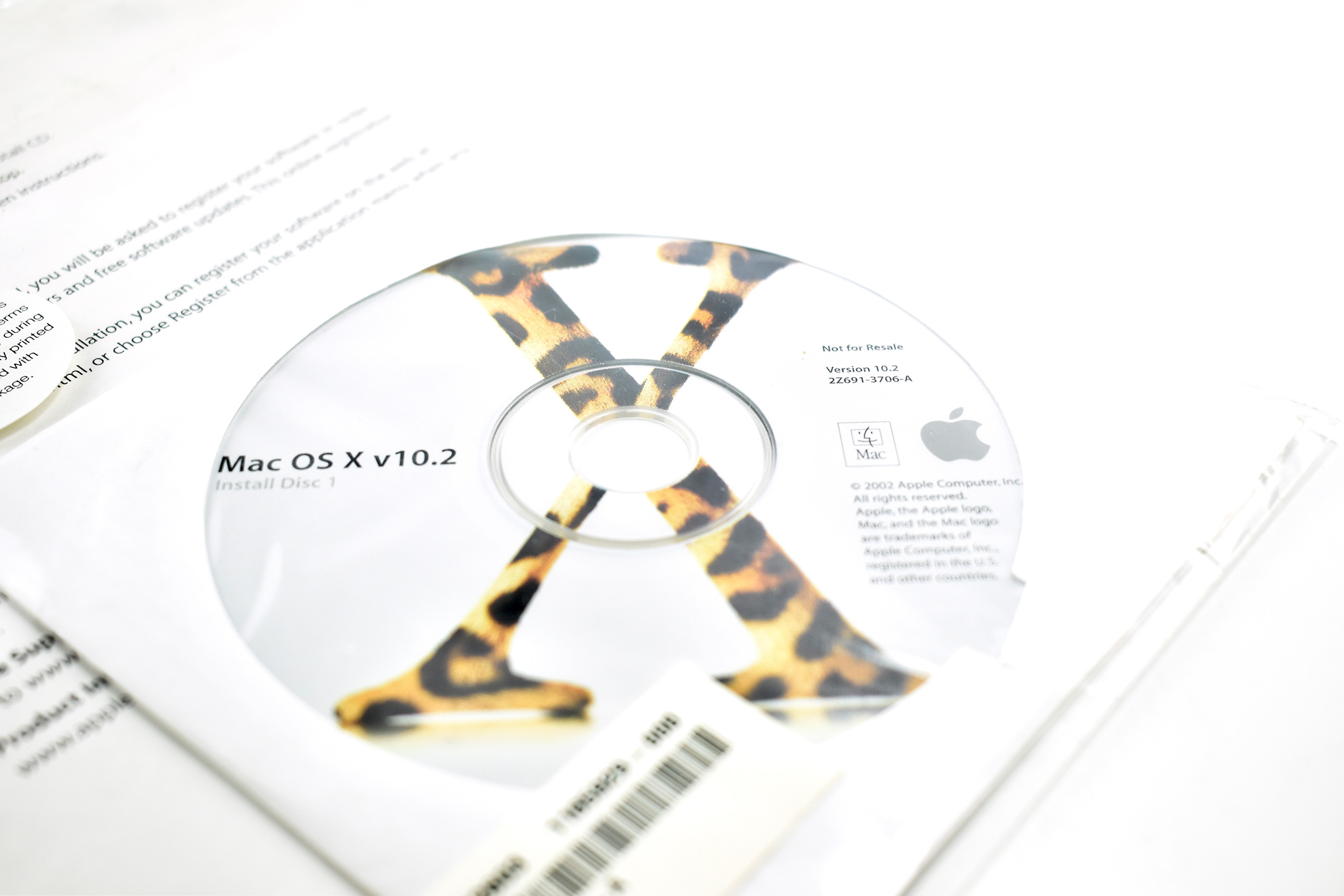
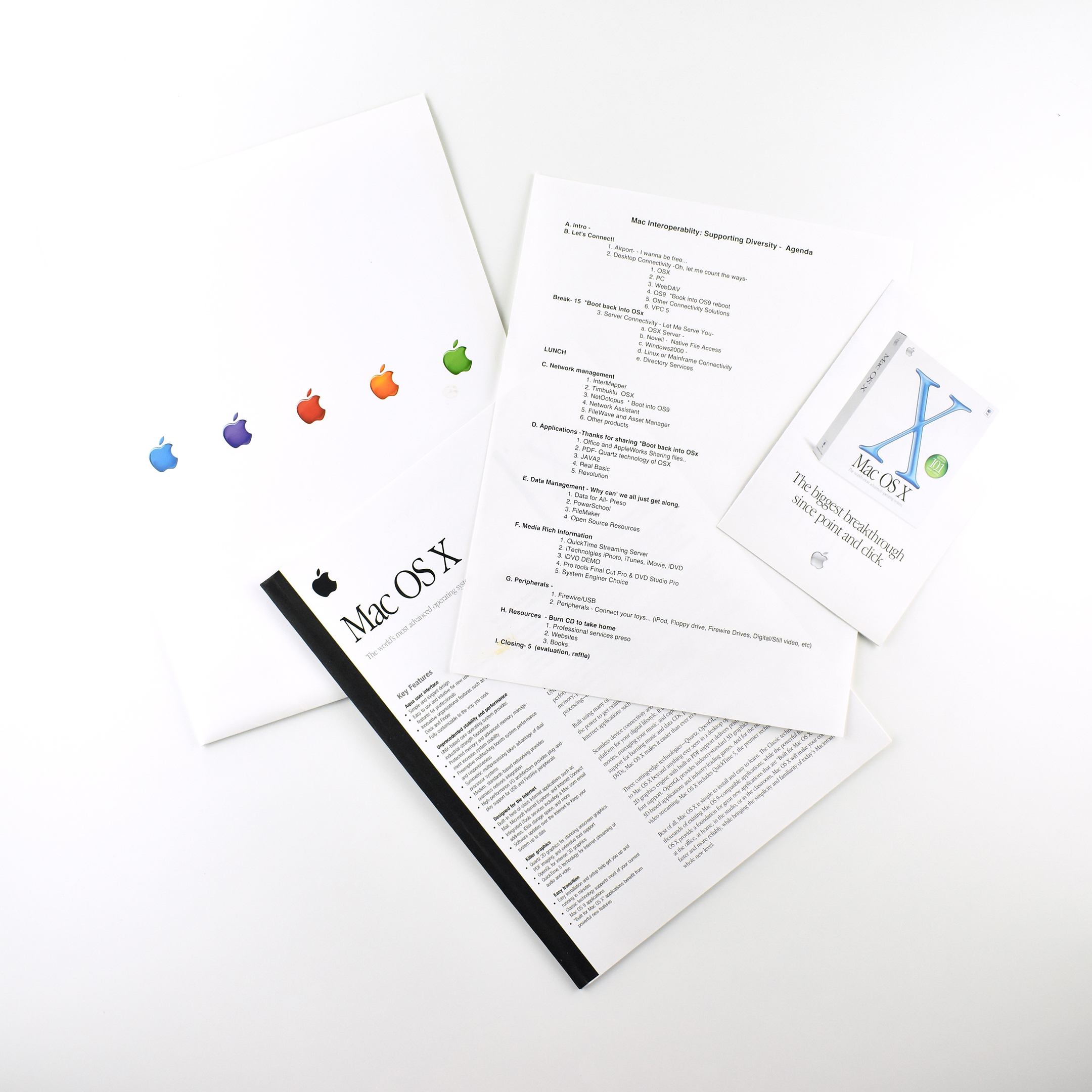
Mac OS X Jaguar, Version 10.2, installer CDs and guides (Not for Resale, 2002)

Mac OS X Jaguar, Version 10.2, was the third major release of the Mac OS X [ten] operating system, and the first to be referred to by its codename, “Jaguar,” in its product marketing. The previous two versions were codenamed “Cheetah” (Version 10.0) and “Puma” (Version 10.1), but they were referred to only by their version numbers.

Among over 150 new features, Jaguar included Quartz Extreme, “which accelerates graphics performance by using the power of the Mac’s built-in graphics engine to make the desktop more responsive and deliver seamlessly blended 2D, 3D and QuickTime content directly onto the desktop.” This new graphics technology was used to render the Jaguar fur in high resolution on the “X” [Roman numeral 10] that was used in the image on the install CD and on other product marketing.

Other Jaguar features included:

“a new Mail application designed to eliminate junk mail, iChat AIM-compatible instant messenger, a system-wide Address Book, Inkwell handwriting recognition, QuickTime 6 with MPEG-4, improved Universal Access, an enhanced Finder, Sherlock 3 with Internet Services and Rendezvous, Apple’s revolutionary home networking technology.”

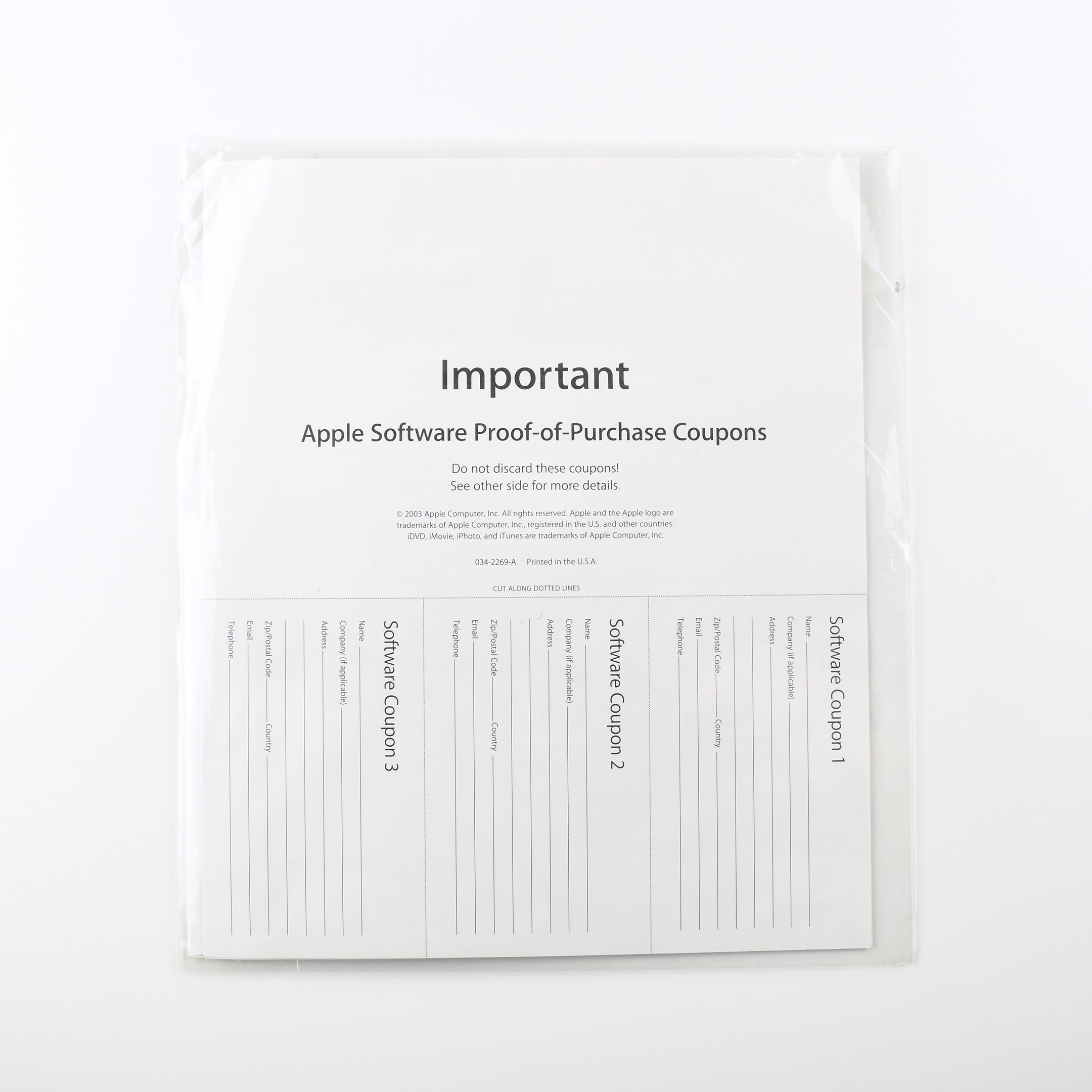
This is a “Not for Resale” set of all installer CDs and a 7.5 x 9-inch brochure with installation directions. The set is packaged in a 8.25 x 9.25-inch clear plastic envelope.

Sources: Apple, Wikipedia

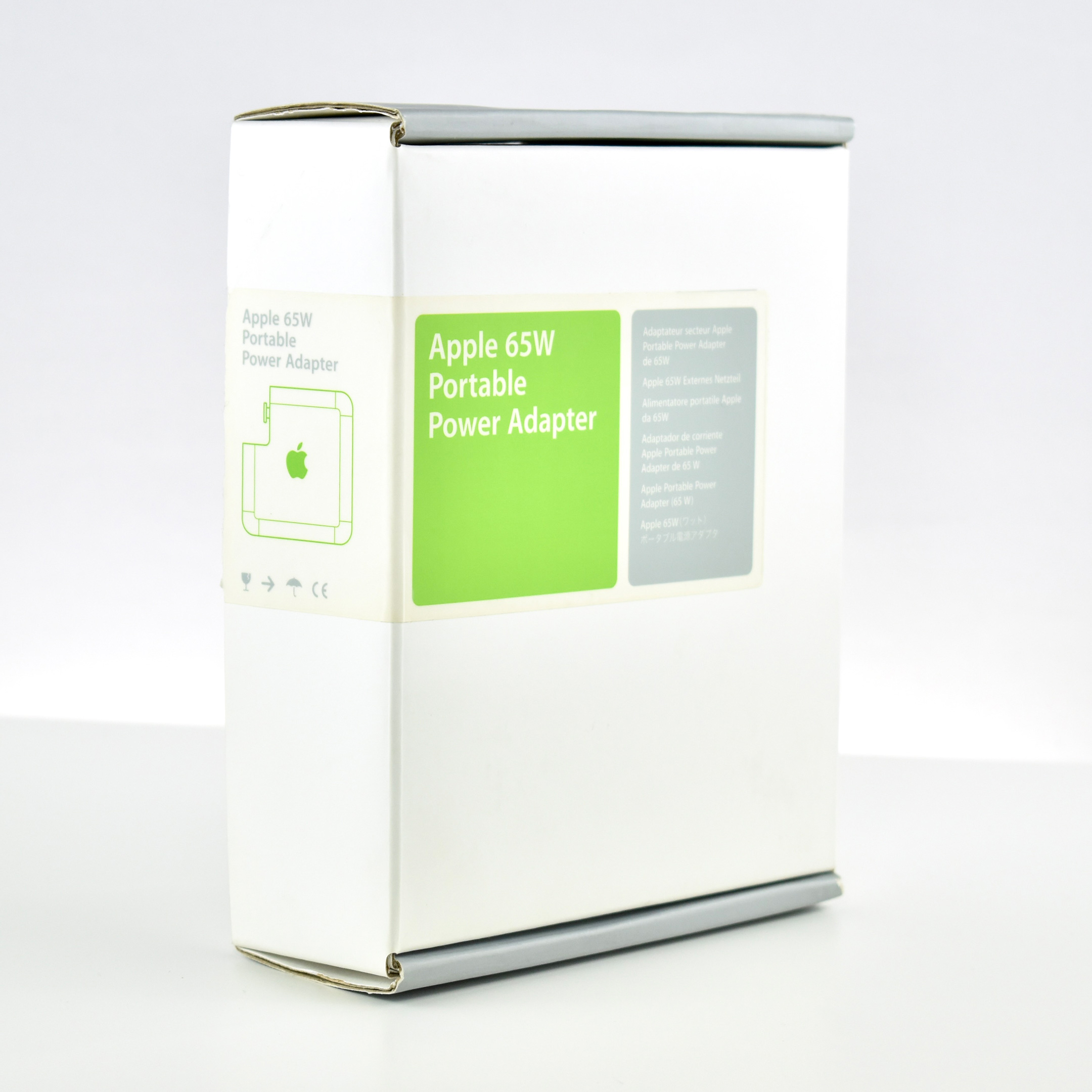
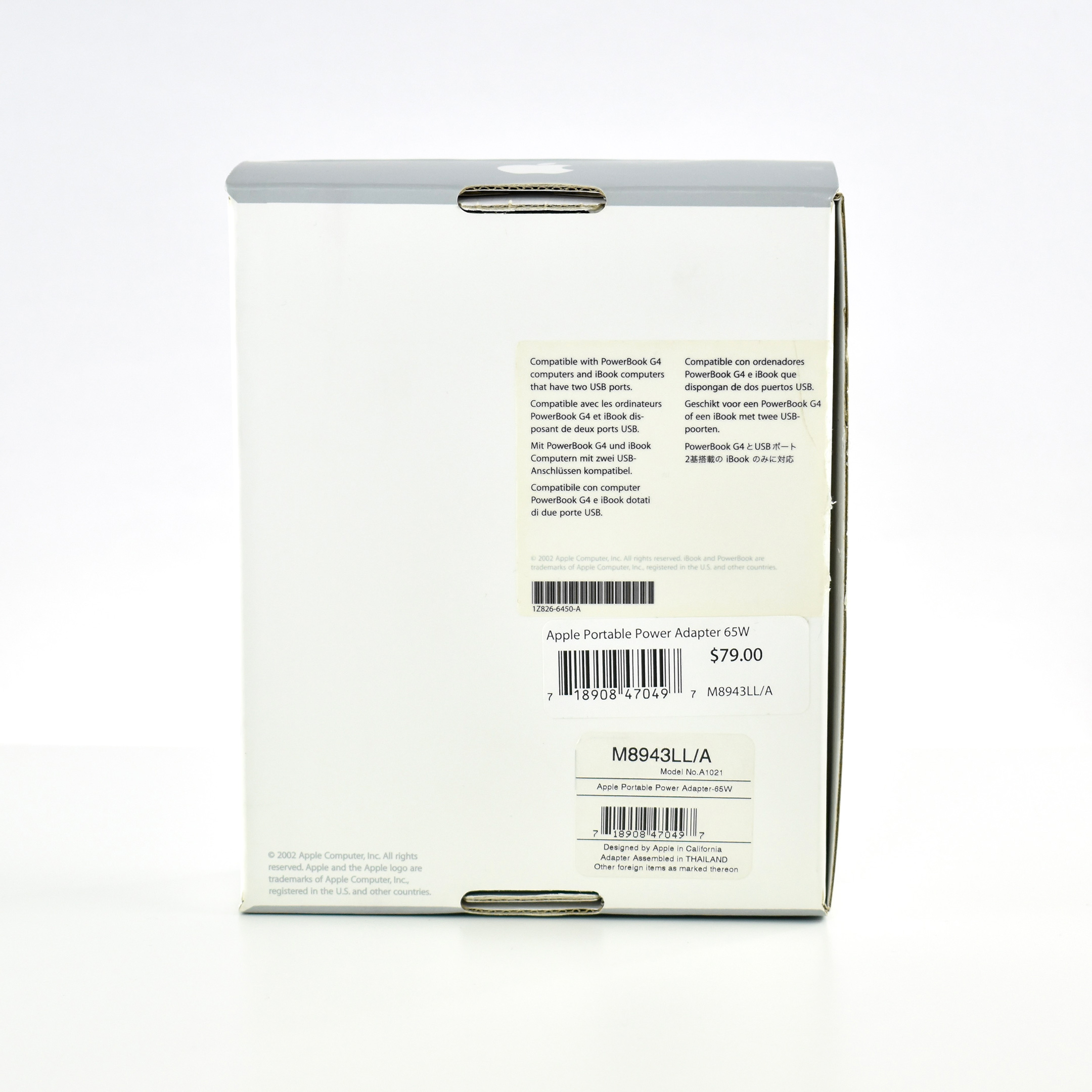
Apple 65W Portable Power Adapter (2002)

This box is an example of 2002-era packaging design for Apple accessories. This particular item is the Apple 65W Portable Power Adapter. The box indicates that it was:

“Compatible with PowerBook G4 computers and iBook computers that have two USB ports.”

The box uses the Apple Myriad font during the year Apple was transitioning away from using Apple Garamond in their corporate identity. The box measures 150cm x 190cm x 55cm.

The box contains the original adapter, but none of the internal cardboard packaging.

Source: Apple

We only get one chance Apple Education brochure (2002)

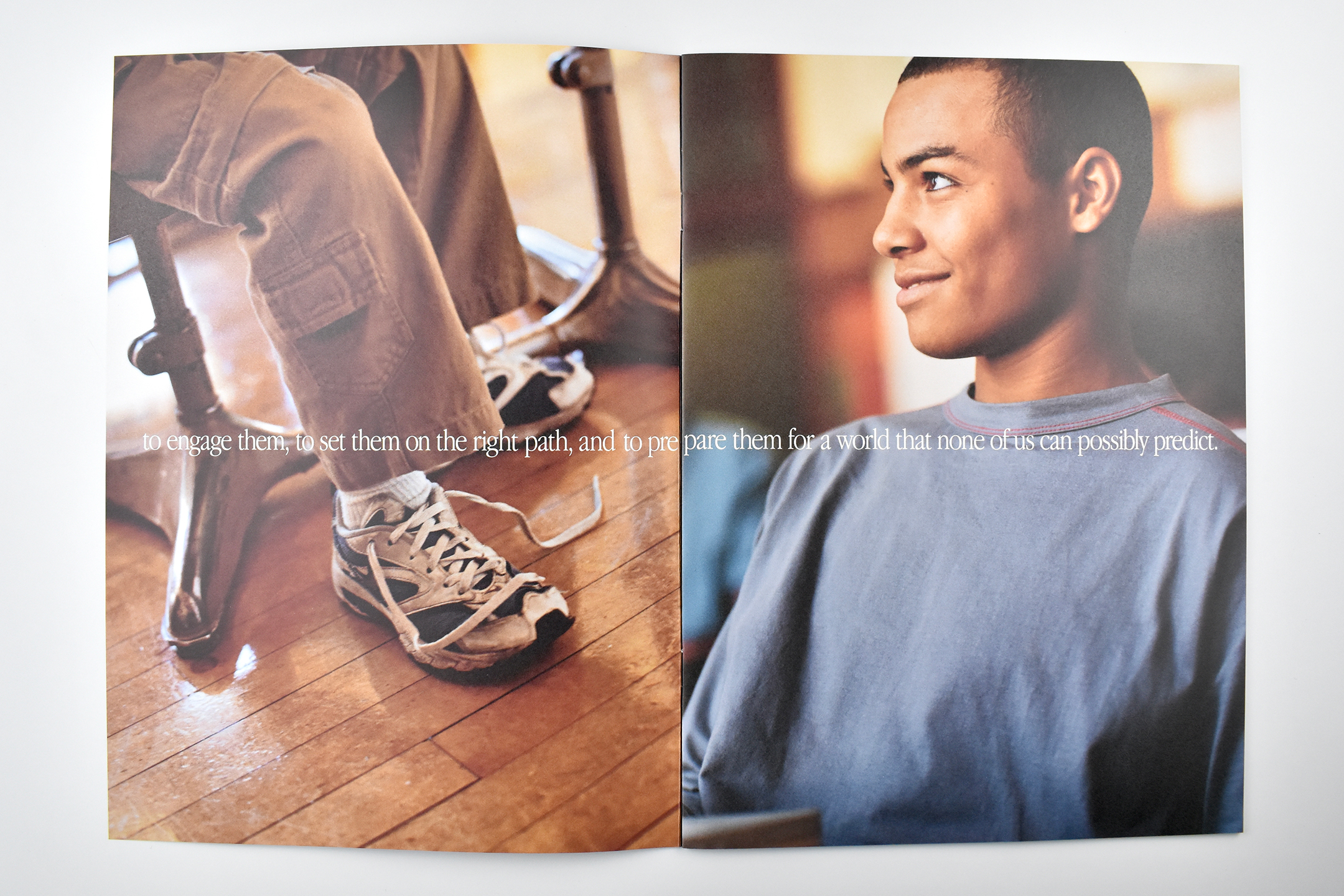
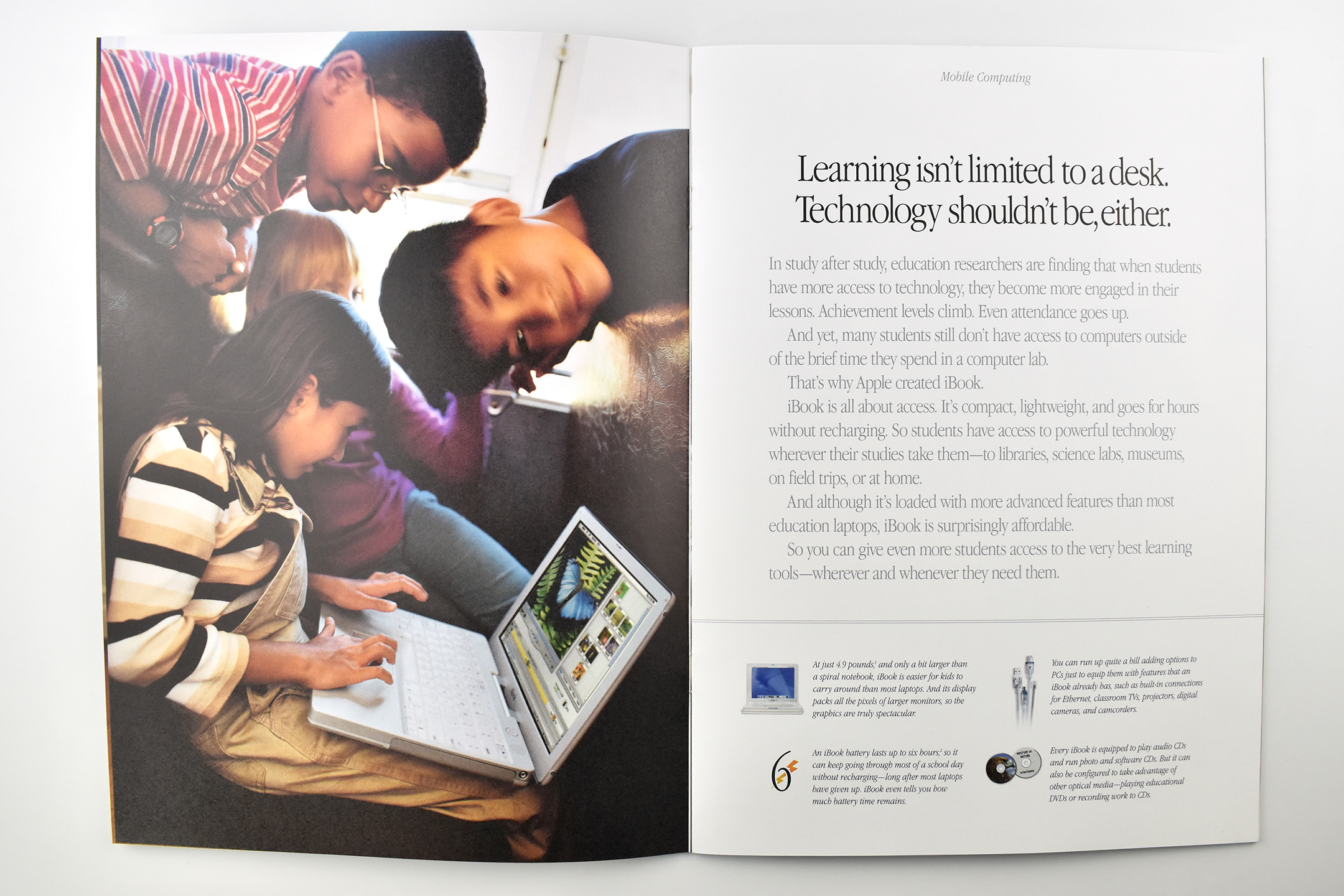
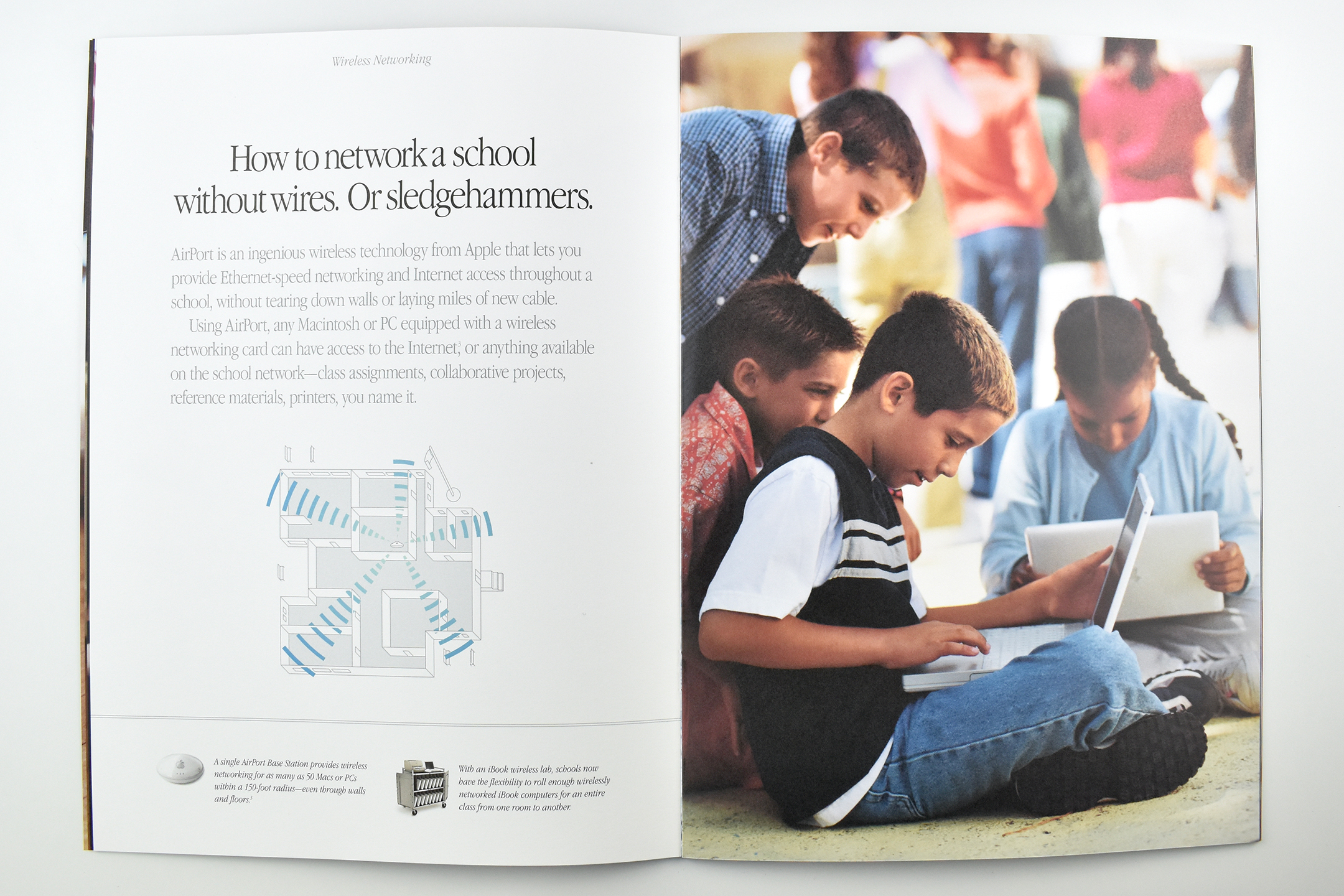
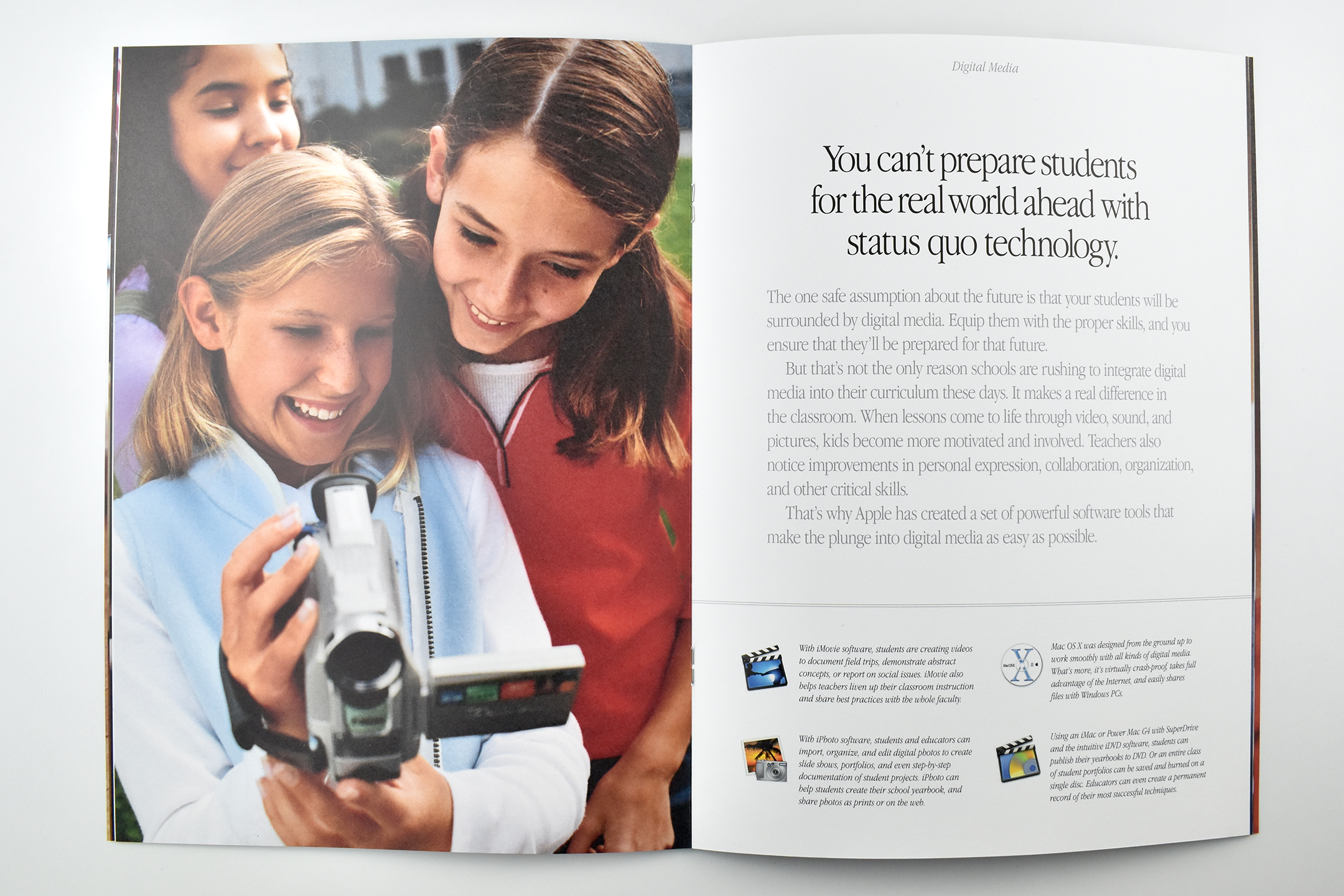
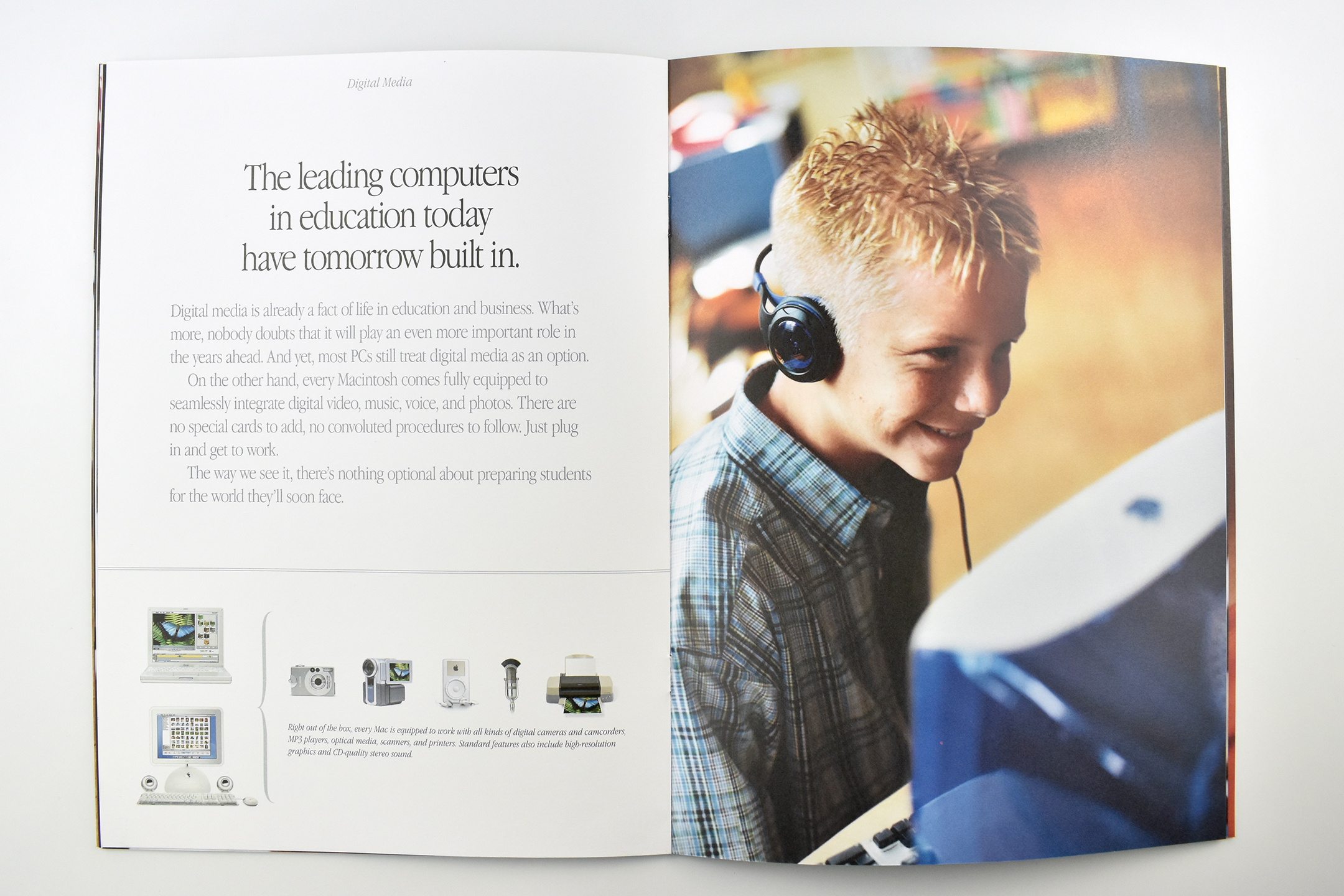
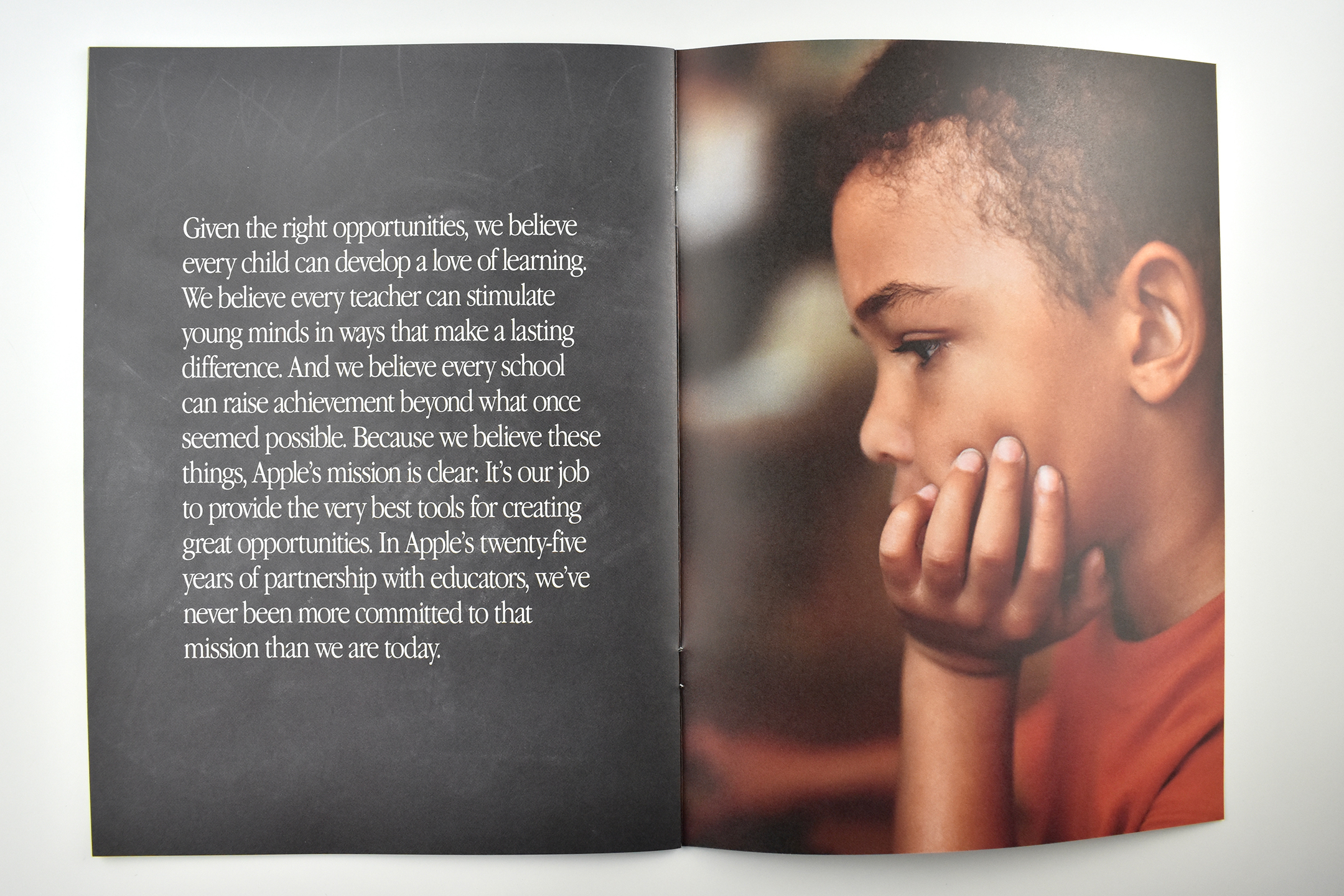
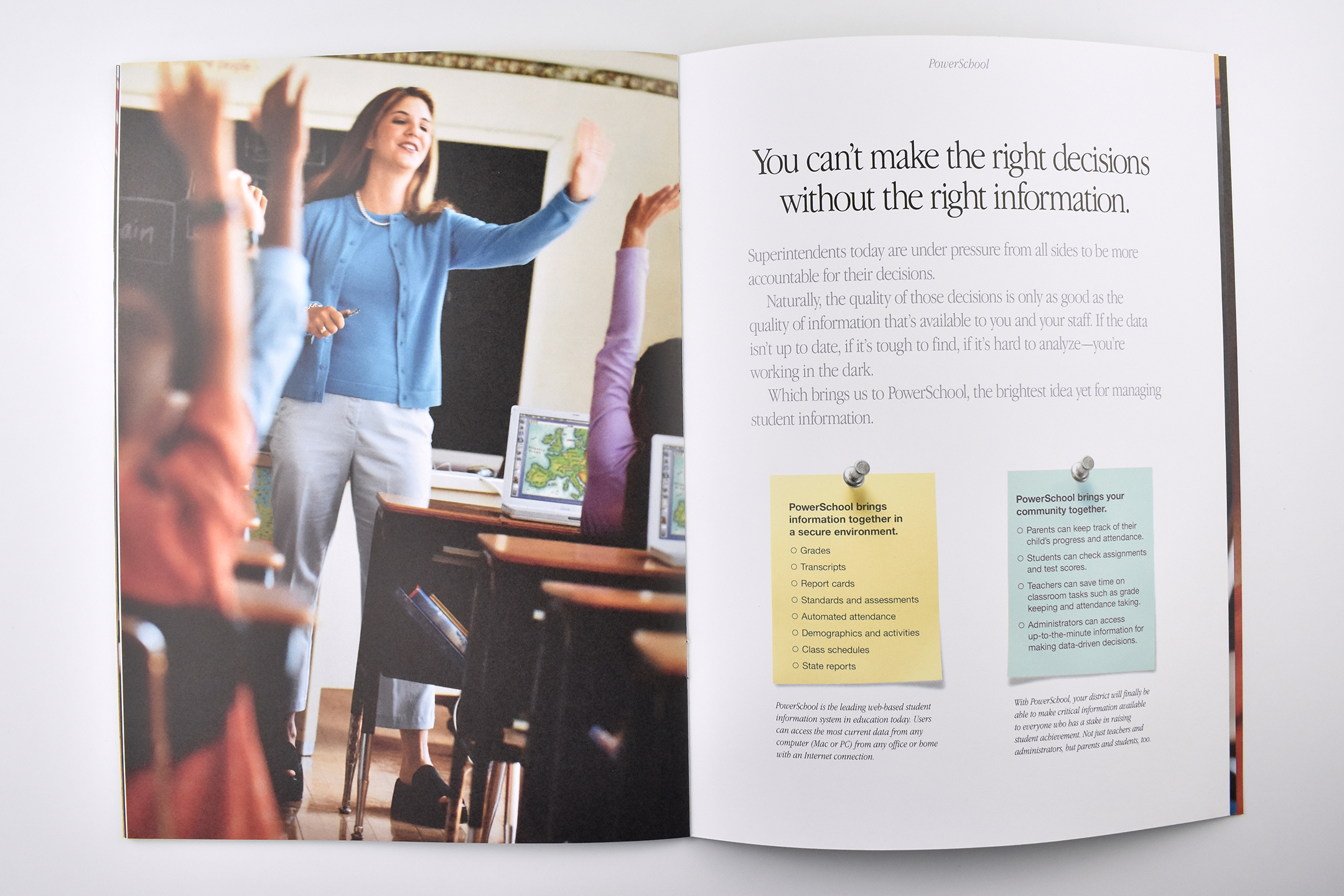
This Apple Education brochure was printed on heavy matte paper and featured an idealized message aimed at educators to introduce a vision of a digital-age classroom. All photography in the book features real students in classroom environments and is printed using full-page bleeds (all photos go all the way to the edge of the pages with no borders).

The cover begins with the text “We only get one chance,” and the first two-page spread continued, “to engage them, to set them on the right path, and to prepare them for a world none of us can possibly predict.” The next spread begins with the question “So, what will we do with this chance?”

The next pages are two-page spreads with a full-bleed photo on one side and information on the facing page discussing several categories including Mobile Computing, Wireless Networking, Digital Media, PowerSchool (a student information system no longer owned by Apple), and Apple’s Comprehensive Services.

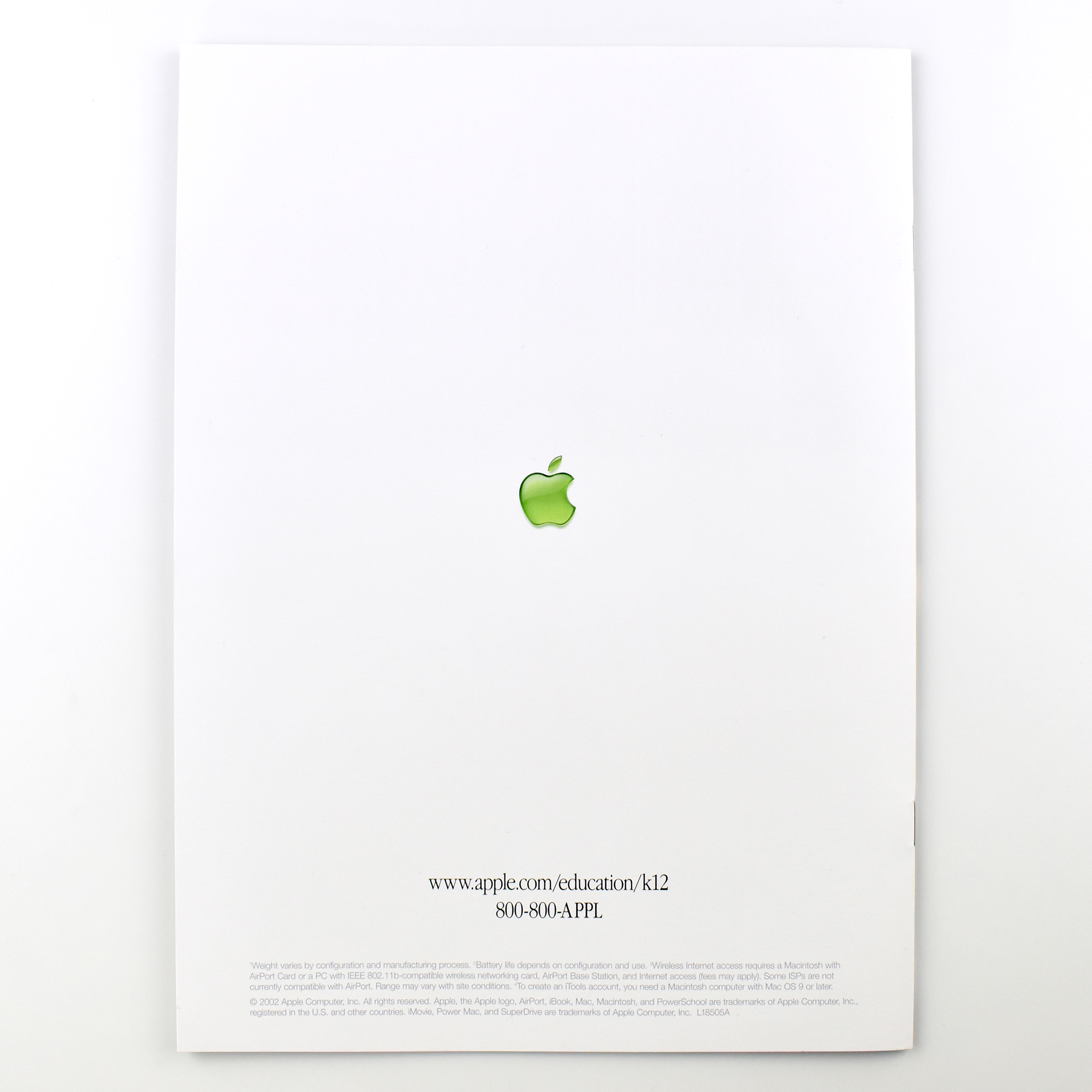
The final page features a green Apple logo with contact information.

This brochure measures 8 x 11 inches and has 16 pages.

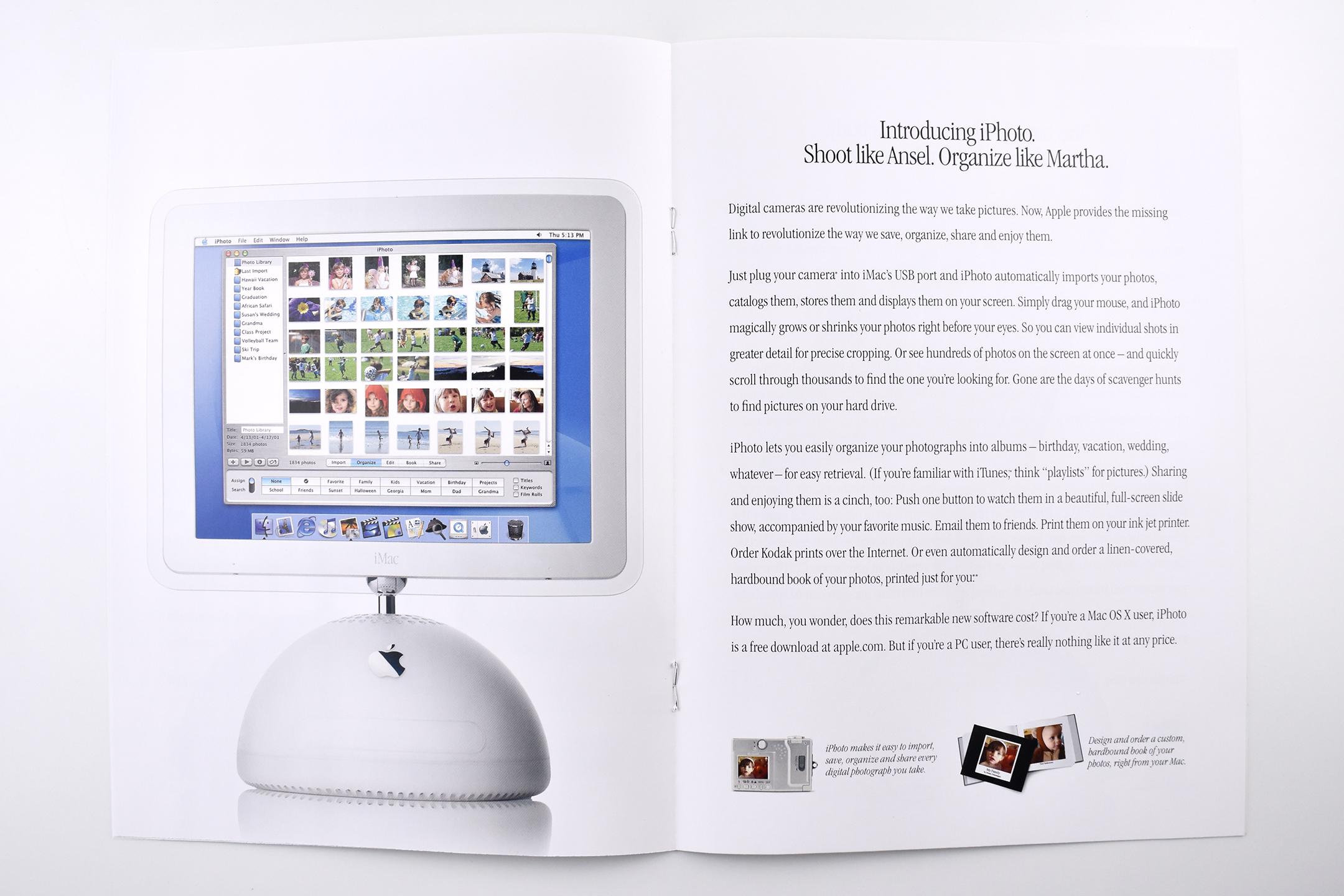
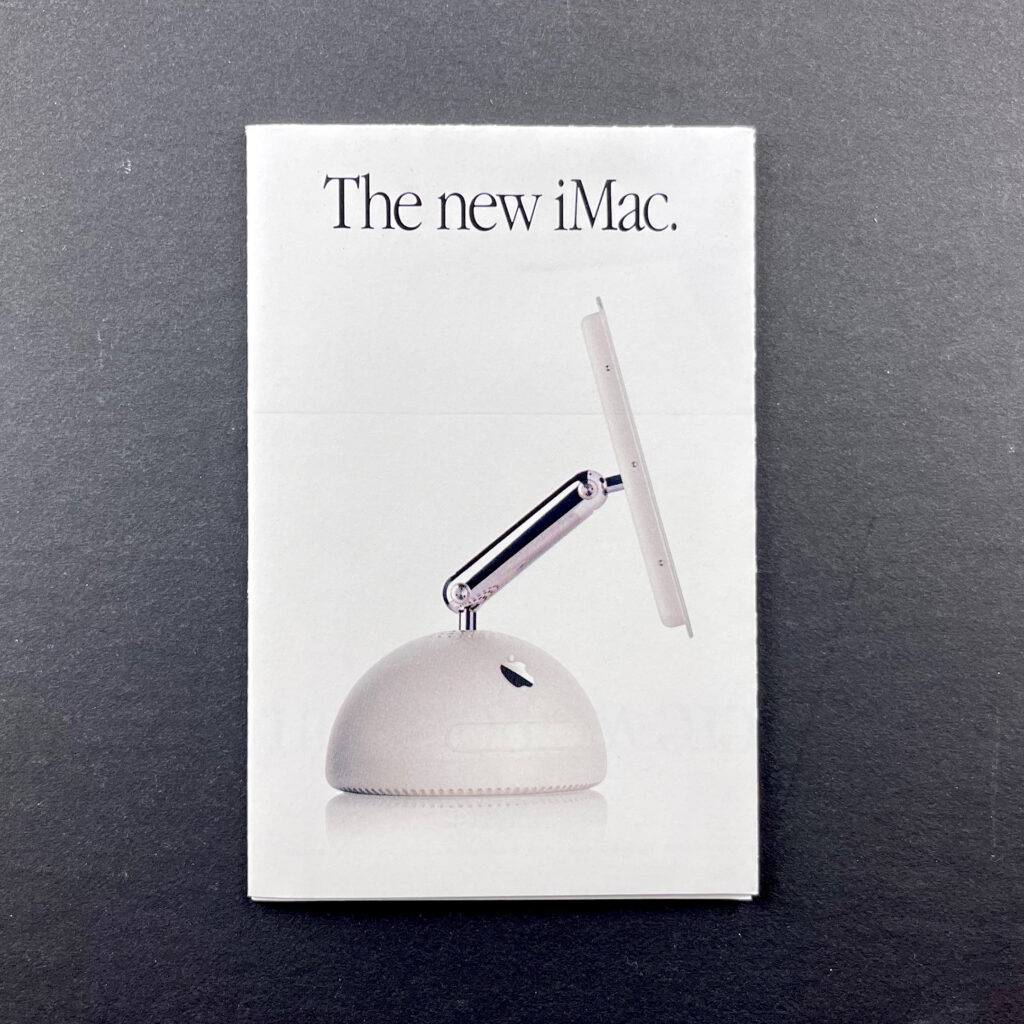
The new iMac. magazine insert (2002)

In the late 1990s and early 2000s, part of Apple’s print advertising included magazine inserts. These inserts functioned like “mini-magazines” within magazines. These inserts were glued with a pliable rubber cement that could be easily removed.

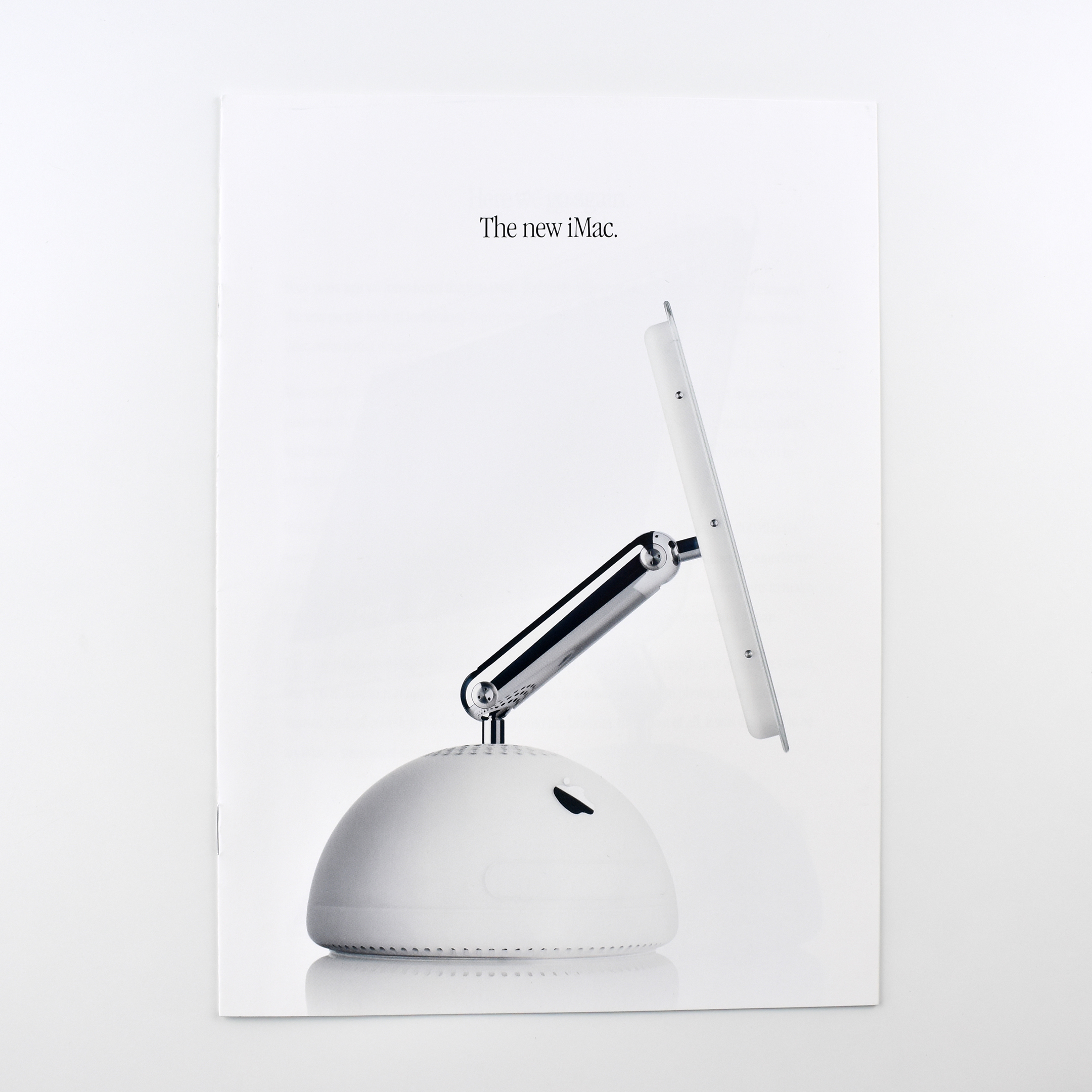
This 6-page magazine insert was used to introduce the first major iMac redesign. With this transformation, the iMac went from a colorful CRT-based computer to a flat-panel floating over a white half-sphere. The flat-panel display “floated” on an adjustable chrome arm that both tiled and swiveled.

The cover of this insert features a photo of the new iMac and the words, “The new iMac.”

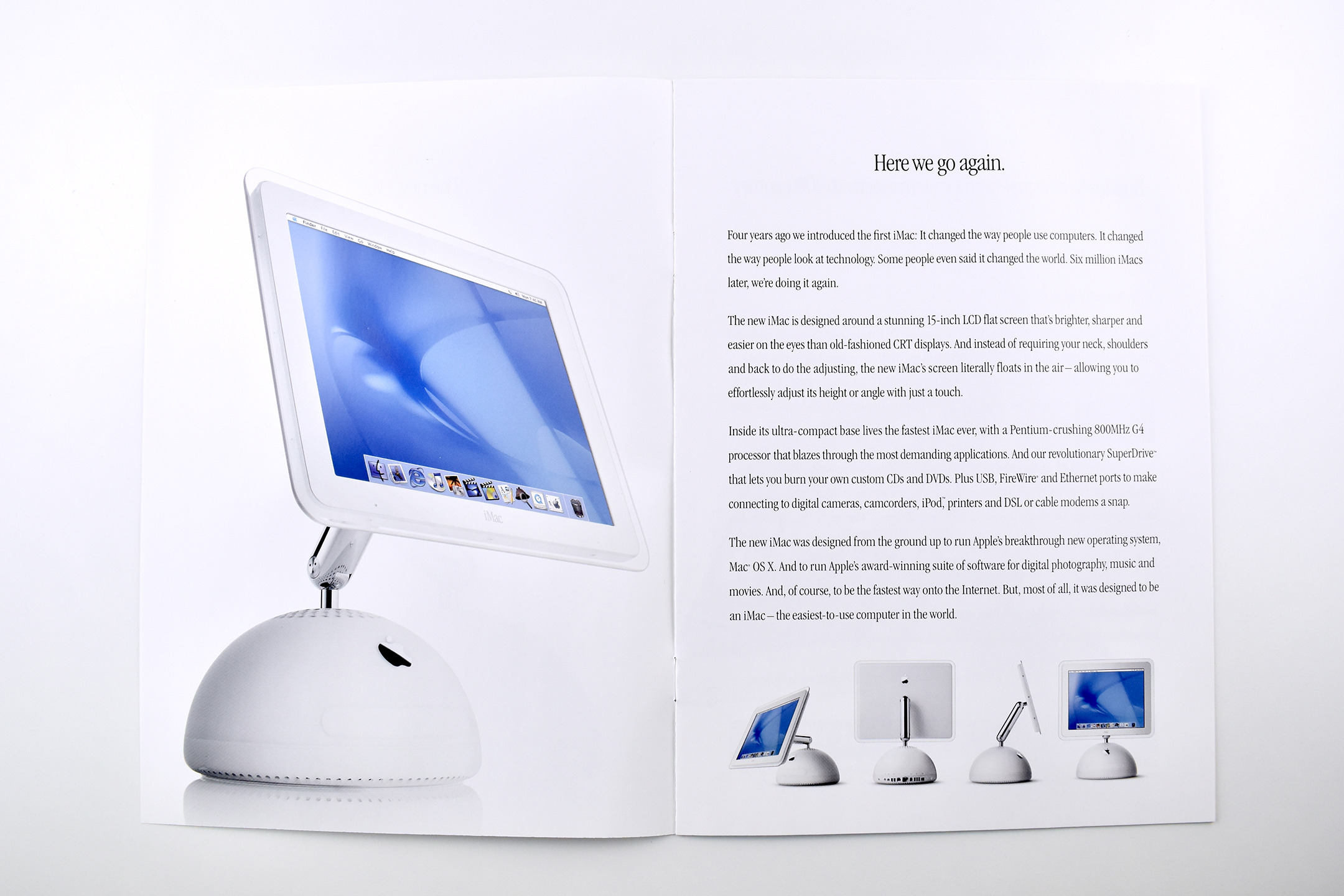
The first 2-page spread had the title “Here we go again.”, described the iMac’s new design and capabilities, and showed its screen-adjusting abilities in a series of side-by-side photos. The second spread focused on the Mac OS X operating system, followed by a spread devoted to iPhoto, a spread about creativity on the Mac, and two pages of “Myths,” followed by “Facts” directed at Windows users who wish to switch to Mac.

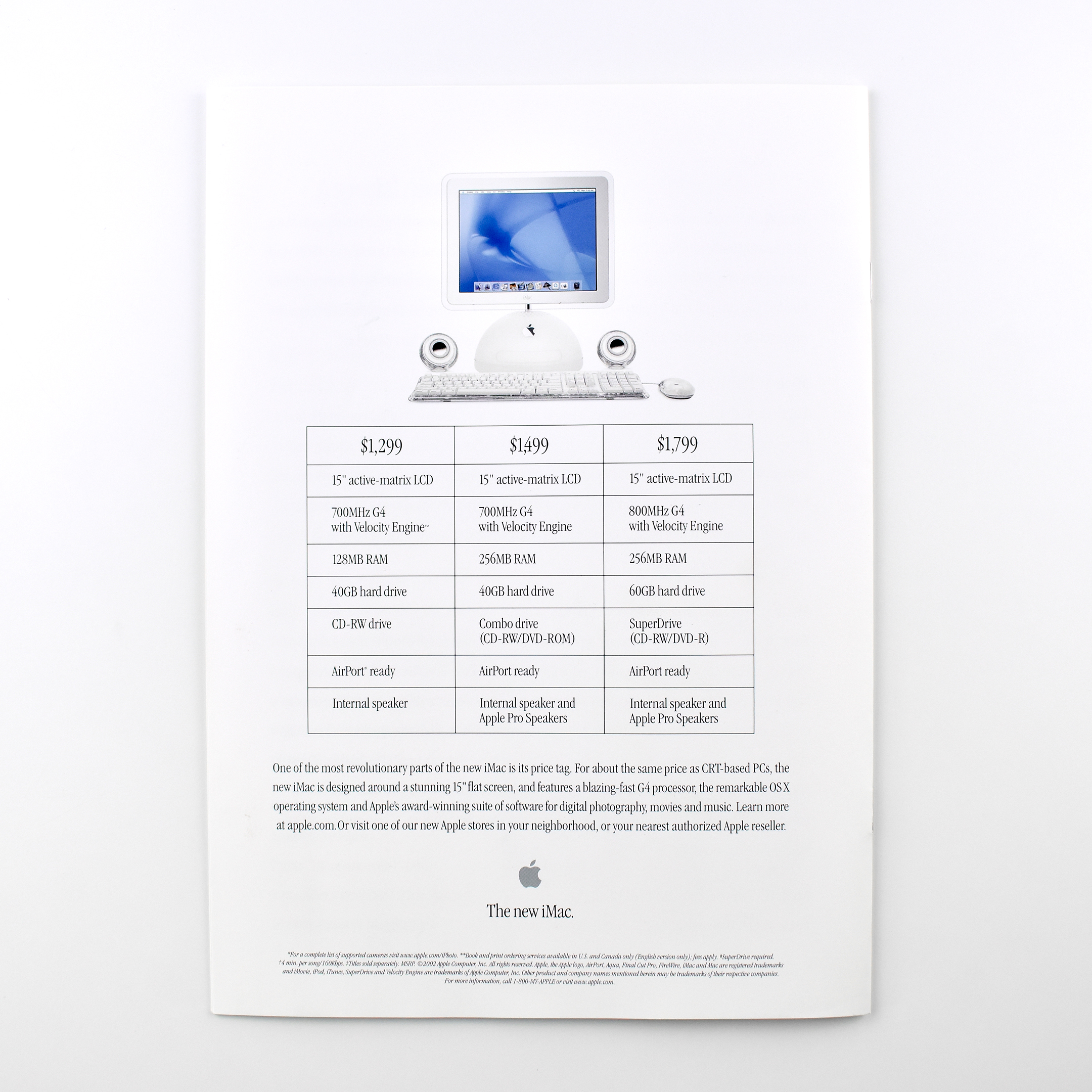
The back cover shows a photo of the full iMac system with keyboard, mouse, and external speakers, along with a grid showing the three available configurations of the new iMac.

Folded, the insert measures 7.5 x 10.5 inches.

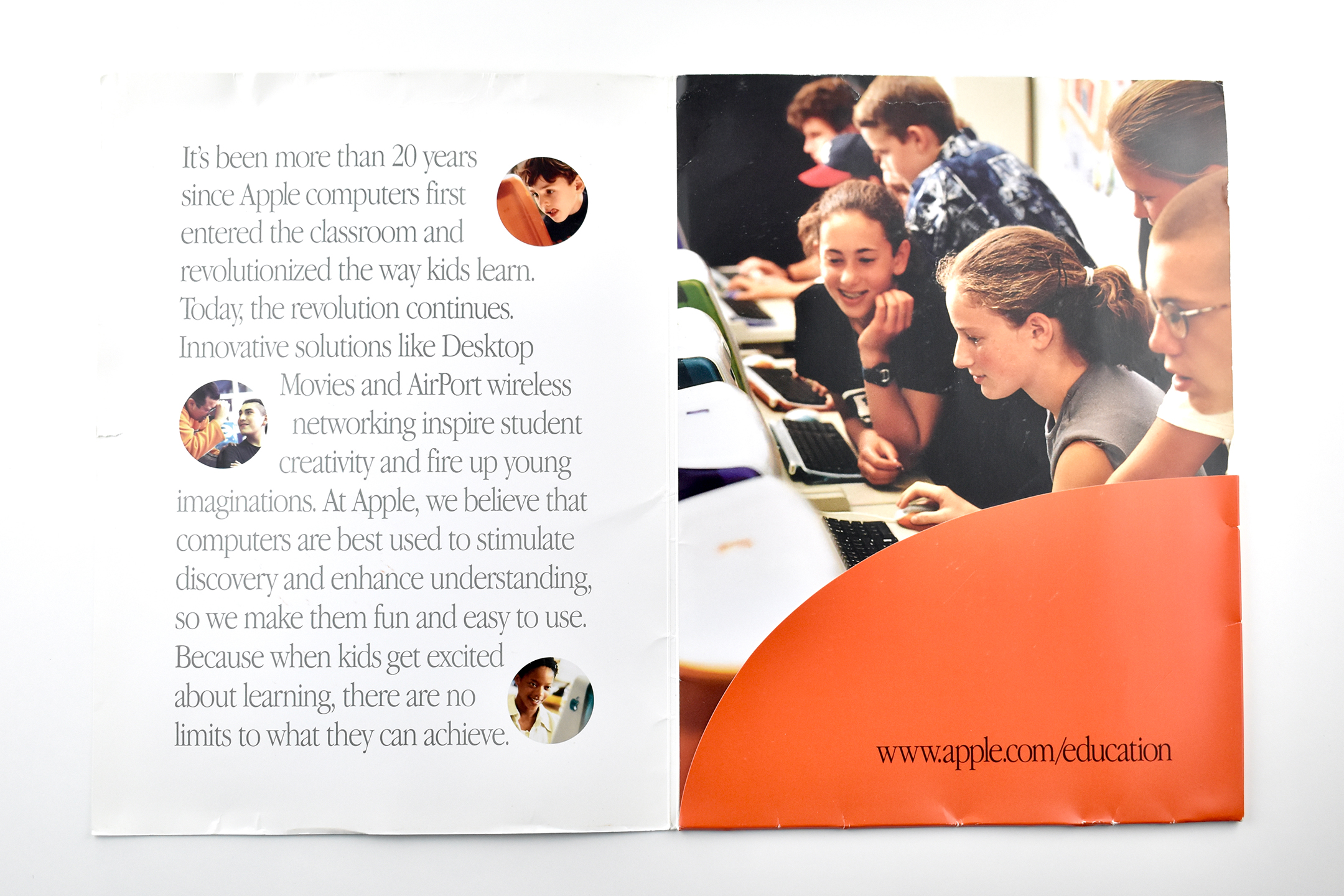
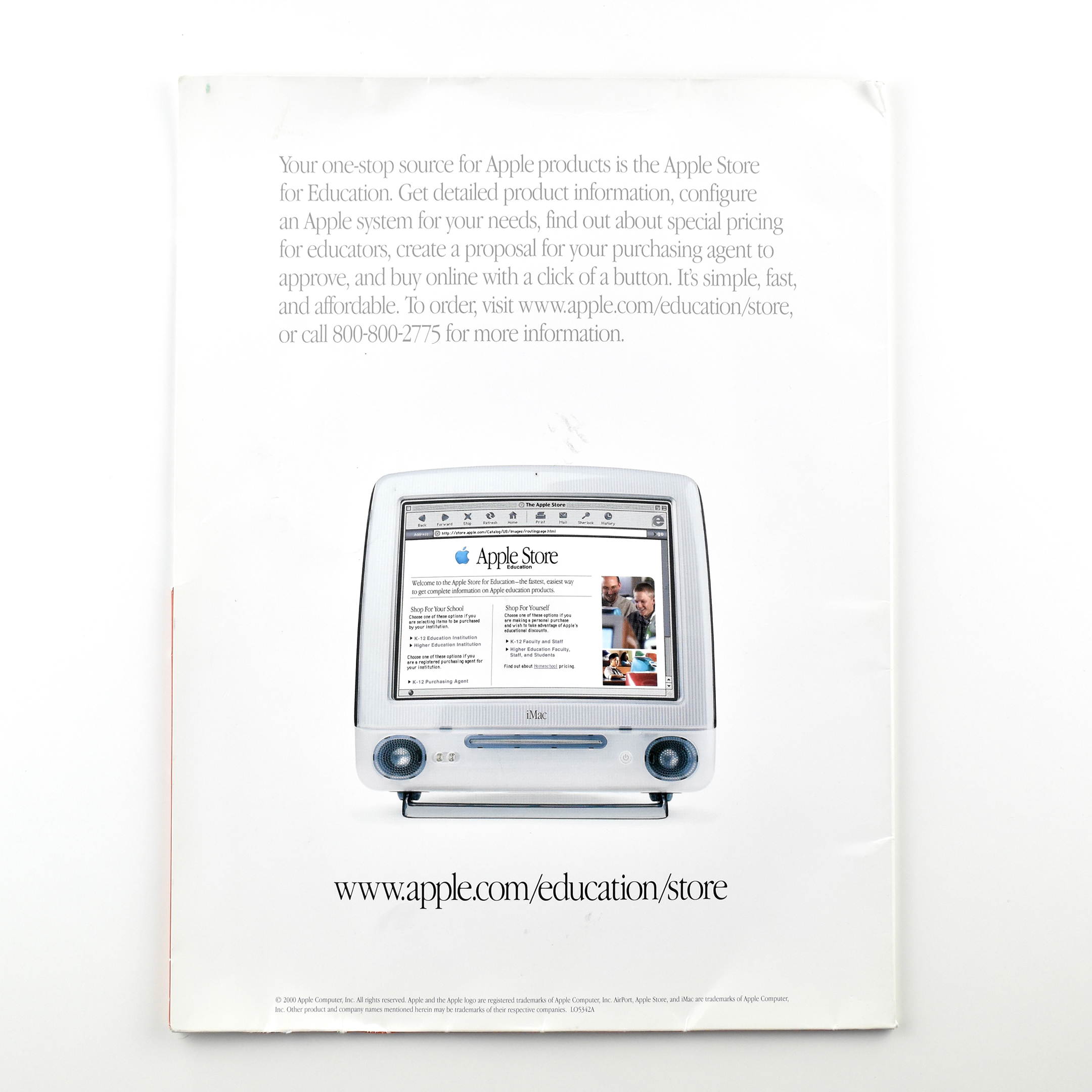
Apple Education folders and materials collection (2000, 2001, 2002)

In the early 2000s, Apple Education hosted education events at conferences, schools, and at their Executive Briefing Centers. These events often included providing printed materials to attendees on various topics, product brochures, and/or event agendas.

This small collection of Apple Education folders from 2000–2002 included three different folders from Apple Education. Each folder measures 9 x 12 inches and includes two internal pockets.

Mini-brochures collection (2002)

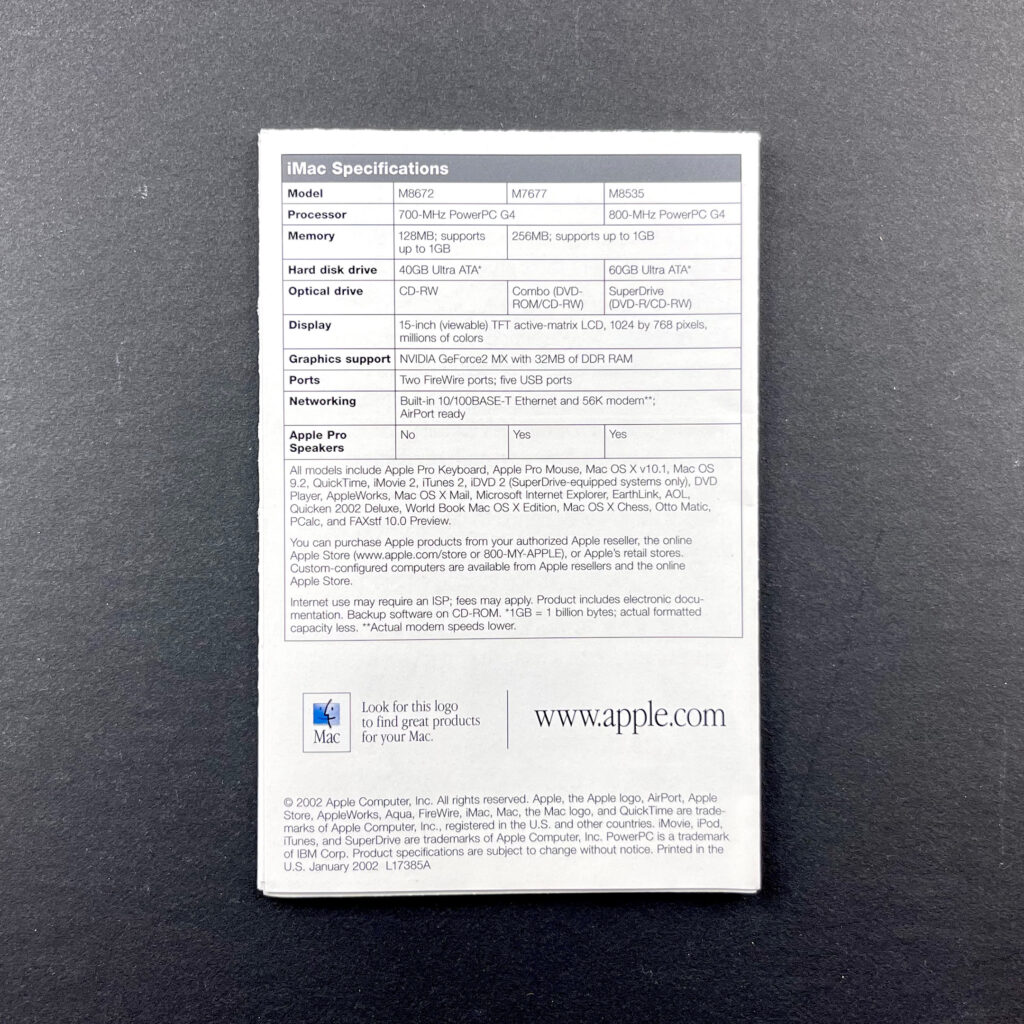
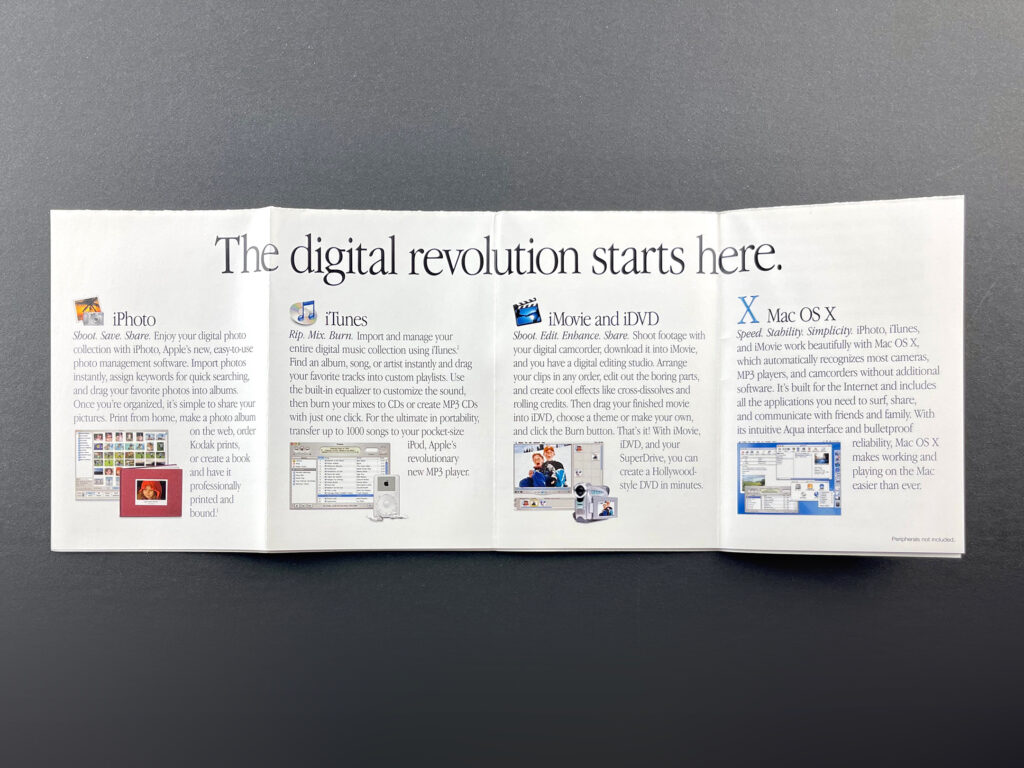
These product mini-brochures were available in Apple Stores and elsewhere in the early 2000s. They measured 3 x 4.5 inches folded, and designs folded out into different configurations. All of these mini-brochures feature a photo of the product on the front panel, information inside, and specifications on the back panel.

iMac (January 2002)
This brochure features an indigo iMac on the cover. The horizontal 4-up layout features several tasks that can be completed on an iMac with four photos and the headlines “Surf the Internet,” “Make movies,” “Mix music,” and “Make a photo album.” The fully unfolded 8-up poster features a birds-eye view of an indigo iMac with the headline, “Your digital life starts here.”

The new iMac. (January 2002)
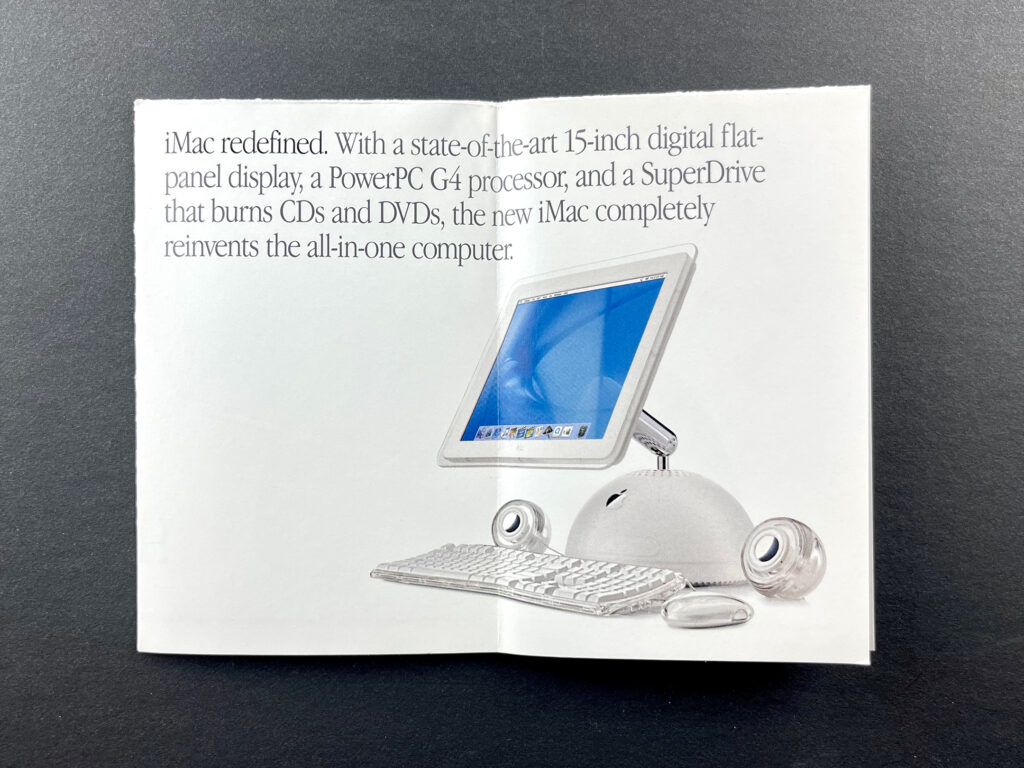
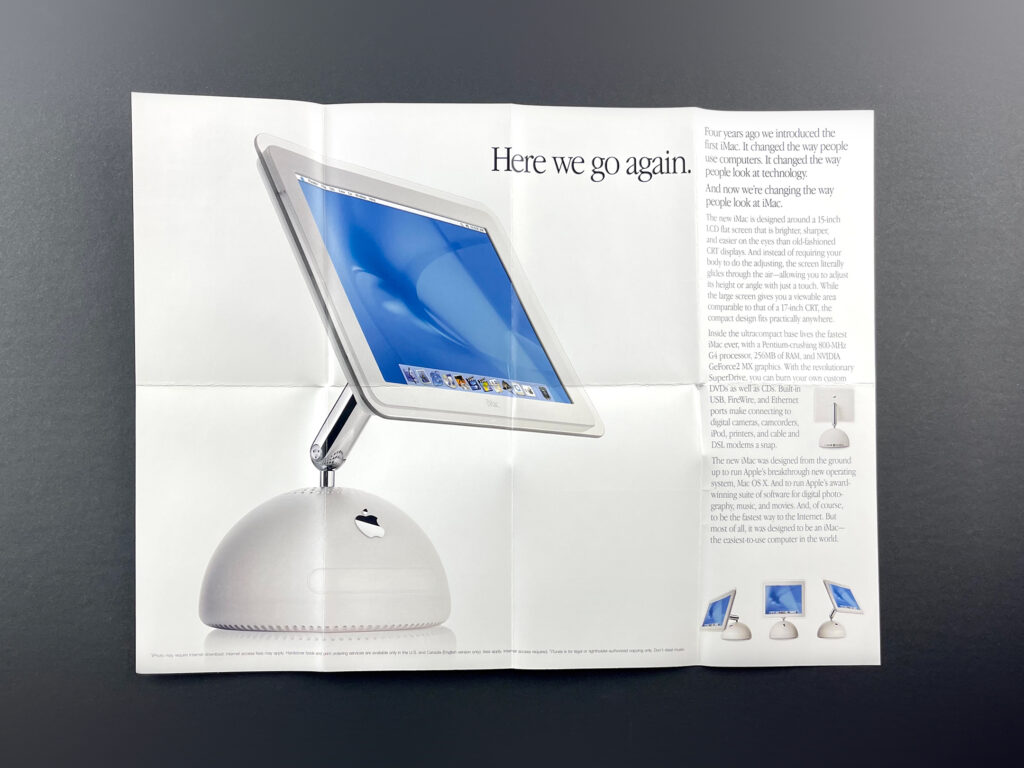
This brochure features the first flat-panel iMac (with a white half-sphere base) on the cover. The opening 2-up layout features the copy, “iMac redefined. With a state-of-the-art 15-inch digital flat panel display, a PowerPC G4 processor, and a SuperDrive that burn CDs and DVDs, the new iMac completely reinvents the all-in-one computer.” The fully unfolded 8-up mini-poster features the headline “Here we go again.”